Poetic Rendering

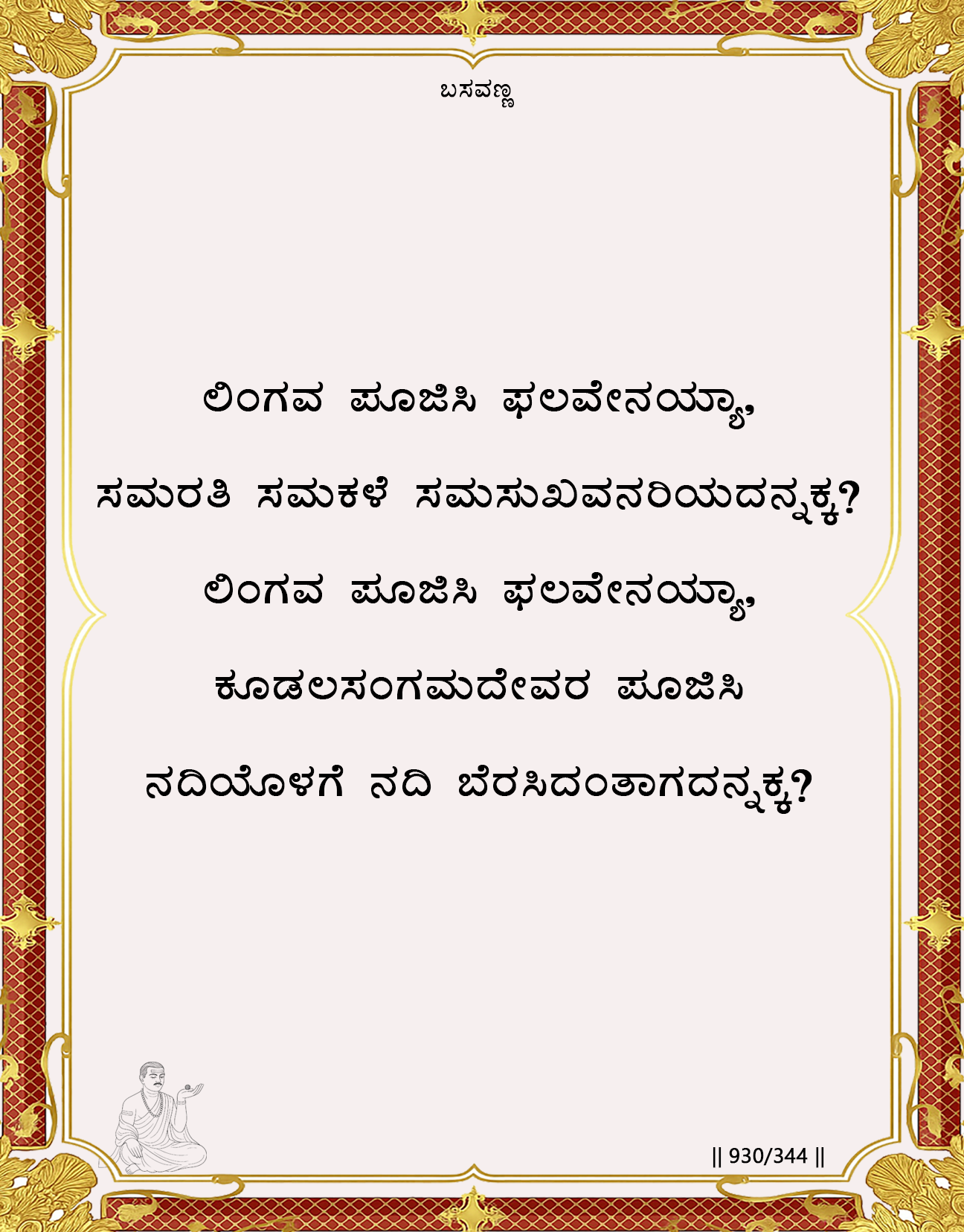
What gain is there in worshipping the Linga
if the heart does not flow
with equal love, equal joy, equal worth
toward every being?
What gain is there in calling upon Kudalasangama
if my devotion does not stream outward
like river meeting river
mingling without boundary,
without name,
without the slightest rise of pride?
Basavanna here gives one of his most direct and uncompromising teachings: devotion without equality is no devotion at all. The worship of the Linga becomes meaningful only when it transforms the devotee’s heart into a river of equal regard for all beings. If worship remains confined to the shrine, and does not dissolve social distinctions, prejudices, and ego-driven separations, then it has not touched the essence of Shiva. The metaphor of “river meeting river” symbolizes the highest state of spiritual maturity. When two rivers meet, they do not ask which is greater, holier, or purer they simply merge. In this natural merging, Basavanna reveals the ideal of egalitarian spirituality: a consciousness without edges, where devotion flows horizontally into universal compassion. This vachana articulates the completion of spiritual realization: when the vertical worship of the Divine flowers into the horizontal embrace of all beings, then the devotee becomes the very embodiment of Kudalasangama’s oneness.
Spiritual Context
Core Spiritual Principle: Equality as the Litmus Test of Realization (Samatā Parīkṣā). Spiritual attainment is not measured by mystical experience but by the eradication of partiality (vaiṣamya) in one’s emotional, evaluative, and relational being. If worship does not produce equal love (sama-prem), it is cosmetic.
Cosmic Reality Perspective: This is a non-dual manifesto applied to sociology. From the perspective of Shiva-Shakti, all manifestation is the dance of the One. To prefer one wave over another, one expression of Shakti over another, is to deny the fundamental unity of the dancer. The “river meeting river” is Shakti recognizing herself in her own myriad flows, the play of consciousness rejoining itself.
Historical Reality (Anubhava Mantapa Context): This was the ethical crescendo of the Lingayoga revolution. In a society rigidly structured by caste-based impurity and privilege, Basavanna issued the ultimate criterion: any religious practice that left these hierarchies intact in the heart was adharma, a failure. It compelled the community to internalize the social revolution as a personal, spiritual necessity true devotion must dismantle internalized caste.
Interpretation
1. “What gain is there in worshipping the Linga if the heart does not flow with equal love, equal joy, equal worth toward every being?” This redefines spiritual profit. The “gain” (lābha) of worship is not celestial reward but a fundamental rewiring of human affect. “Equal love” (sneha) is empathetic connection. “Equal joy” (ānanda) is taking delight in others’ wellbeing. “Equal worth” (mulya) is the foundational recognition of inherent divinity. Without this triad, worship is spiritual consumerism.
2. “What gain is there in calling upon Kudalasangama if my devotion does not stream outward like river meeting river?” This challenges the directionality of devotion. “Calling upon” implies a vertical, upward movement. Basavanna insists devotion must also stream outward, horizontally. The river metaphor shifts the paradigm from ascent to confluence, from reaching to merging.
3. “Mingling without boundary, without name, without the slightest rise of pride.” This defines the quality of confluence. “Boundary” is ego. “Name” is label (caste, creed, gender). “Pride” is the residual current of separateness. The merging is so complete that the contributing waters cannot be distinguisheda perfect metaphor for a consciousness that has dissolved the “I-other” divide.
Practical Implications: Every act of worship, prayer, or meditation must be followed by conscious reflection: Has this made me more inclusive? Does it soften my judgments? Does it increase my sense of shared being with those I normally overlook or disdain?
The Cosmic Reality
Anga (Human Dimension): The Anga is the riverbed being eroded. Its banksthe conditioned identities of family, tribe, nation, religionmust be worn away by the constant flow of conscious equality until only the flow remains.
Linga (Divine Principle): Kudalasangama is the ocean and the law of gravity. It is the destination that draws all rivers, and it is also the principle that all water seeks its own levelthe spiritual law that equality is the natural state towards which consciousness evolves.
Jangama (Dynamic Interaction): The Jangama is the living confluence. They are the place where rivers meet in a personwhere the devotional love for God and the compassionate love for beings become indistinguishable. Their presence does not teach equality; it is equality in motion.
Shata Sthala
Primary Sthala: Aikya. The experience of “mingling without boundary” is the definitive mark of Aikya. This vachana expands that union from the divine-human binary to the totality of relationships, showing that genuine non-duality is all-inclusive.
Supporting Sthala: Pranalingi. To perceive “equal worth” in all beings is to see the one Life-Principle (Pranalingi) equally present in all forms. This perceptual equality is the foundation for the relational merger of Aikya.
Practical Integration
Arivu (Awareness Practices): Practice “The River Meditation.” In stillness, visualize your consciousness as a river. See the banks (your identities, preferences, judgments). Consciously imagine them softening, dissolving, allowing your waters to expand and merge with the wider landscape of being.
Achara (Personal Discipline): Engage in “Conscious Confluence.” Daily, initiate a genuine connection with someone outside your typical social, ethnic, or ideological circle. Let it be a simple, human exchange where you consciously look for the shared “water” beneath the surface “banks.”
Kayaka (Sacred Action): Dedicate your work to the principle of equal worth. Ask: “Does this action honor the inherent worth of all affected by it? Does it create or erase boundaries?” Let your labor be an act of building confluence, not fortification.
Dasoha (Communal Offering): Build community rituals that explicitly celebrate merging. Shared meals where all serve each other, circles where everyone’s voice is heard without hierarchy, and collective service projects that erase roles all become practices of becoming one river.
Modern Application
Algorithmic Tribalism and Hyper-Individualism. Our digital and social worlds reinforce echo chambers, solidify ideological boundaries, and monetize our attention by amplifying differences. We are conditioned to strengthen our “banks” (political, cultural, identity-based) rather than dissolve them. This leads to profound alienation and conflict.
Becoming a Confluence in a Fractured World. The practice of Shivayoga today is a radical act of de-programming tribal consciousness. It means curating information and relationships that deliberately challenge your boundaries. It involves listening to understand, not to rebut. It values experiences that foster a sense of shared humanity over those that reinforce in-group superiority. It is the active, daily practice of letting your “river” merge, becoming a force of healing confluence in a landscape carved by separation.
Essence
You built a dam of prayer
to hold a sacred reservoir for yourself.
You measured its depth,
boasted of its clarity,
and called it devotion.
But the water grew still,
then stagnant,
separate from the great watershed of life.
True worship is not a reservoir
but a relinquishing of banks.
Let your love be the mountain snowmelt
that knows no property,
your joy the current that carries all boats equally,
your sense of worth the sea
to which every river is heir.
Only when “yours” and “mine” dissolve
does the Linga’s name
become the sound of the ocean
in every shell.
This vachana describes the transition from a closed system to an open system in spiritual thermodynamics. A heart worshipping without equality is a closed system: energy (devotion) is invested, but it circulates only within the self-other boundary, leading to spiritual entropy (pride, stagnation). The call for equal love opens the system. Devotion becomes an energy exchange with the entire field of consciousness. The “river meeting river” is a visualization of open-system equilibrium, where energy and identity freely flow to achieve a state of maximum connection and minimum gradient (hierarchy). This is the system’s most stable, evolved state.
Imagine two gardens separated by a tall fence (the mind with boundaries). The owner of one garden prays for beautiful flowers (worships the Linga) but refuses to let water or bees cross the fence. His garden may bloom, but it’s fragile, isolated, and his enjoyment is private and comparative. Basavanna says: tear down the fence. Let the water, pollen, and shade flow freely. Now, your prayer for beauty blesses both gardens. Your joy is in the blooming of the whole landscape, not just your plot. The “gain” is the resilience, biodiversity, and shared beauty of an ecosystem infinitely richer than a private bouquet.
Our sense of safety and identity is often tied to boundaries knowing who we are by knowing who we are not. This vachana identifies this very mechanism as the source of spiritual poverty. The fear is that without our banks, we will cease to exist. The revolutionary promise is that in merging, we don’t disappear; we become part of the vast, powerful, boundless flow of the sacred itself. The “equal love” he demands is not a strenuous moral effort, but the natural affection that arises when we realize the other is our own water in another channel. The worship that culminates in this realization is the only worship that truly reaches Kudalasangama, for it has become indistinguishable from the Deva’s own boundless, confluent nature.

Views: 15