Poetic Rendering

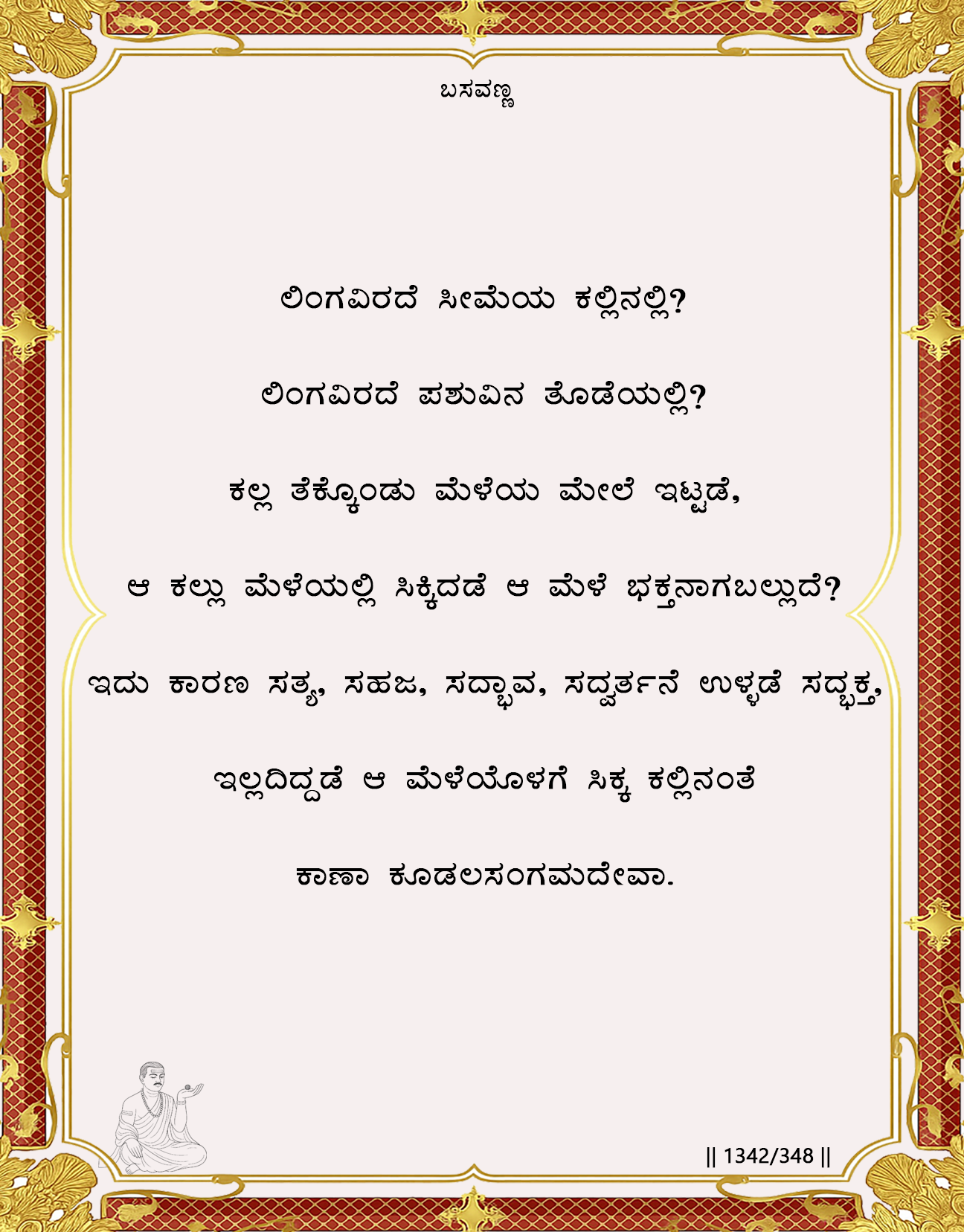
Does not a Linga lie upon a boundary stone?
Does it not hang even from the thigh of a beast?
If that very stone is set among shrubs,
and if those shrubs grow thick around it,
do the shrubs become devotees
merely by touching what is called sacred?
Know this, O Kudalasangama:
Only the one whose heart holds reverence,
whose life holds truth,
whose nature holds tenderness,
whose companionship uplifts
only such a one becomes
a true bearer of the Linga.
The rest remain like shrubs
clinging to a stone,
never touched by its essence.
This vachana is Basavanna’s clear-eyed warning against mistaking possession of symbols for possession of spirit. He dismantles the assumption that proximity to the sacred automatically transforms a person. Just as a stone Linga tied to a bull or left among shrubs does not elevate the beast or the plants, merely wearing or touching sacred objects cannot elevate an unawakened mind. Basavanna points out that true spiritual worth is not inherited from external forms but revealed through inner qualities sincerity, truthfulness, humility, reverence, and the company one keeps. Without this inner transformation, devotion becomes nothing more than decoration, and the person remains unchanged, like a shrub surrounding a sacred stone yet knowing nothing of its meaning. In this teaching, Basavanna strips spirituality of all superficiality and restores it to its essence: devotion lived, not displayed; transformation embodied, not performed.
Spiritual Context
Core Spiritual Principle: Internality as the Locus of the Sacred (Antaḥkaraṇa Śuddhi). The sacred is not a property of objects but a quality of consciousness. An object becomes sacred only when consecrated by a sacred consciousness. Therefore, spiritual work is the purification of the inner instrument (antaḥkaraṇa), not the acquisition of sacred objects.
Cosmic Reality Perspective: This is a non-dual critique of objectification. Shiva (the real Linga) is formless consciousness. The stone Linga is Shakti as form. To worship the stone while ignoring the consciousness that perceives it is to worship Shakti in ignorance of Shiva. The “true bearer” is one in whom Shiva (consciousness) and Shakti (life and action) are united; their very being is the Linga, making any external stone redundant.
Historical Reality (Anubhava Mantapa Context): This was a direct challenge to ritualistic reductionism and empty orthodoxy. In a society where the sacred was often conflated with physical idols and ritual purity, Basavanna redirected the focus to ethical and psychological purity. It democratized sanctity: a humble laborer with a reverent heart was more “sacred” than a Brahmin priest meticulously tending an idol without inner transformation.
Interpretation
1. “Does not a Linga lie upon a boundary stone? Does it not hang even from the thigh of a beast?” This desacralizes the object through context. By placing the sacred symbol in mundane or even impure contexts (boundary marker, animal’s thigh), Basavanna demonstrates its inertness. Its sacredness is not intrinsic but conferred by the meaning and reverence invested in it by a conscious mind.
2. “If that very stone is set among shrubs, and if those shrubs grow thick around it, do the shrubs become devotees merely by touching what is called sacred?” This exposes the fallacy of proximity. Physical contact or proximity to a sacred object has no transformative power. The shrubs remain shrubs, their nature unchanged. This is a direct analogy for humans who perform rituals or wear symbols without inner change.
3. “Know this… Only the one whose heart holds reverence, whose life holds truth, whose nature holds tenderness, whose companionship uplifts…” This redefines the sacred as a set of qualities. The list moves inward: from heart (reverence) to action (truth), to innate disposition (tenderness), to social impact (uplifting). This is a portrait of integrated spirituality.
4. “…only such a one becomes a true bearer of the Linga. The rest remain like shrubs clinging to a stone, never touched by its essence.” This delivers the final verdict. “Bearer” (dhāraka) implies active holding, integration, and responsibility. The “essence” (tattva) is the consciousness the symbol points to. The shrub is passive, clinging externally, and thus untouched by the essence within.
Practical Implications: Spiritual practice must prioritize the cultivation of inner virtues over the meticulous care of external symbols. The symbol is a tool for the mind; if the mind is not transformed, the tool is useless. One must regularly audit: “Am I cultivating the qualities of a ‘bearer,’ or am I just tending the shrubs around my stone?”
The Cosmic Reality
Anga (Human Dimension): The Anga is the potential “bearer.” Its task is to become fertile, receptive ground for the seed of the Linga’s essence. This requires tilling the soil with discipline, watering it with devotion, and weeding out qualities contrary to reverence, truth, and tenderness.
Linga (Divine Principle): Kudalasangama is the essence and the seed. It is the living consciousness that can grow within the human heart. The external stone is its husk. True worship is planting and nurturing the seed, not polishing the husk.
Jangama (Dynamic Interaction): The Jangama is the fully grown tree that has sprung from the seed within. They are the “true bearer” their entire being expresses the essence. They don’t need to point to a stone; their life is the testimony.
Shata Sthala
Primary Sthala: Prasadi. The cultivation of the listed virtues (reverence, truth, tenderness) is not a willful achievement but the blossoming of grace (Prasadi) within a prepared heart. The vachana distinguishes between those who receive this grace (bearers) and those who don’t (shrubs).
Supporting Sthala: Bhakta. This teaching is essential for the Bhakta to avoid the pitfall of devotional materialism. It redirects the Bhakta’s energy from external displays to the internal cultivation that marks true devotion.
Practical Integration
Arivu (Awareness Practices): Practice “Essence Detection.” When engaging with any spiritual symbol or ritual, ask: “What inner quality is this meant to cultivate? Am I focusing on the husk (the form) or the seed (the essence)?” Shift attention inward to the associated feeling or state of consciousness.
Achara (Personal Discipline): Choose one “bearer quality” (e.g., tenderness) as a monthly focus. Consciously apply it in daily interactions. Observe how this inner work does more to “bear the Linga” than any ritual ever could.
Kayaka (Sacred Action): Let your work embody “truth” and “uplifting companionship.” Prioritize integrity and the positive impact on colleagues/clients over mere external success. This makes your profession a field for bearing the Linga.
Dasoha (Communal Offering): In spiritual community, value and celebrate demonstrations of inner qualities (kindness, patience, honesty) more than displays of ritual knowledge or ownership of sacred items. Make the community a greenhouse for growing “bearers,” not a museum for displaying “stones.”
Modern Application
Spiritual Consumerism and Identity Branding. We collect sacred objects, yoga mats, malas, and spiritual jargon as identity markers. Social media encourages performative spiritual it photos in meditation poses, quotes without context. This is the modern equivalent of “shrubs growing around a stone”: clinging to external signifiers without inner transformation.
Cultivating Unseen Authenticity. The practice of Lingayoga today means rejecting spiritual branding in favor of anonymous integrity. It involves investing in silent character development practicing truth when no one is looking, showing tenderness to those who cannot benefit you, being reverent in private moments. It values the humble, unseen growth of the “bearer” over the impressive display of the “shrub.”
Essence
The stone can sit on a post,
hang from a beast,
lie in a field.
It does not make the post wise,
the beast holy,
the field enlightened.
You may build a temple around it,
dress it in silk and flowers.
But if your heart is a field of stone,
what grows?
True worship is not what surrounds the symbol,
but what grows from its meaning planted within.
Tend that inner soil.
Let reverence root,
let truth leaf,
let tenderness flower.
Then you will not need to point to a stone
and say, “This is sacred.”
You will simply walk,
and the ground you touch
will know it has been blessed.
This vachana illustrates the principle of intrinsic versus conferred properties in consciousness. A stone Linga has conferred properties (sacredness) based on human agreement and projection. A human being has the potential for intrinsic properties (reverence, truth) that arise from conscious evolution. The spiritual error is to treat the conferred property of the object as if it were an intrinsic property that could transfer via contacta kind of magical thinking. True spirituality is the cultivation of intrinsic sacred properties within the subjective field of consciousness itself. The “bearer” is one in whom the intrinsic property of divine awareness has become an operational, defining characteristic.
Imagine a championship trophy (the stone Linga). Putting it on your shelf (wearing the symbol) doesn’t make you a champion. The trophy is inert. Becoming a champion (the true bearer) requires the inner cultivation of skill, discipline, and heart (the virtues). The shrubs are like fans who gather around the trophy for a photo they are near the symbol of achievement but have done none of the work. Basavanna says: don’t be a fan of God, gathering around symbols. Do the inner work to become a “champion” of divine qualities. Then you embody the victory; you don’t just display the trophy.
We are drawn to symbols because they offer a shortcut to identity and belonging without the demanding work of transformation. It’s easier to buy a sacred object than to cultivate a sacred heart. This vachana confronts our laziness and our desire for spiritual status without spiritual sweat. The fear is that without the external symbol, we are nothing our spirituality has no visible proof. Basavanna assures us that the only proof that matters is the invisible fruit of character, which is its own witness. In the end, the stone remains a stone. But the human being can become a living temple not by housing a stone, but by being the conscious space where the divine essence finally feels at home.

Views: 20