Poetic Rendering

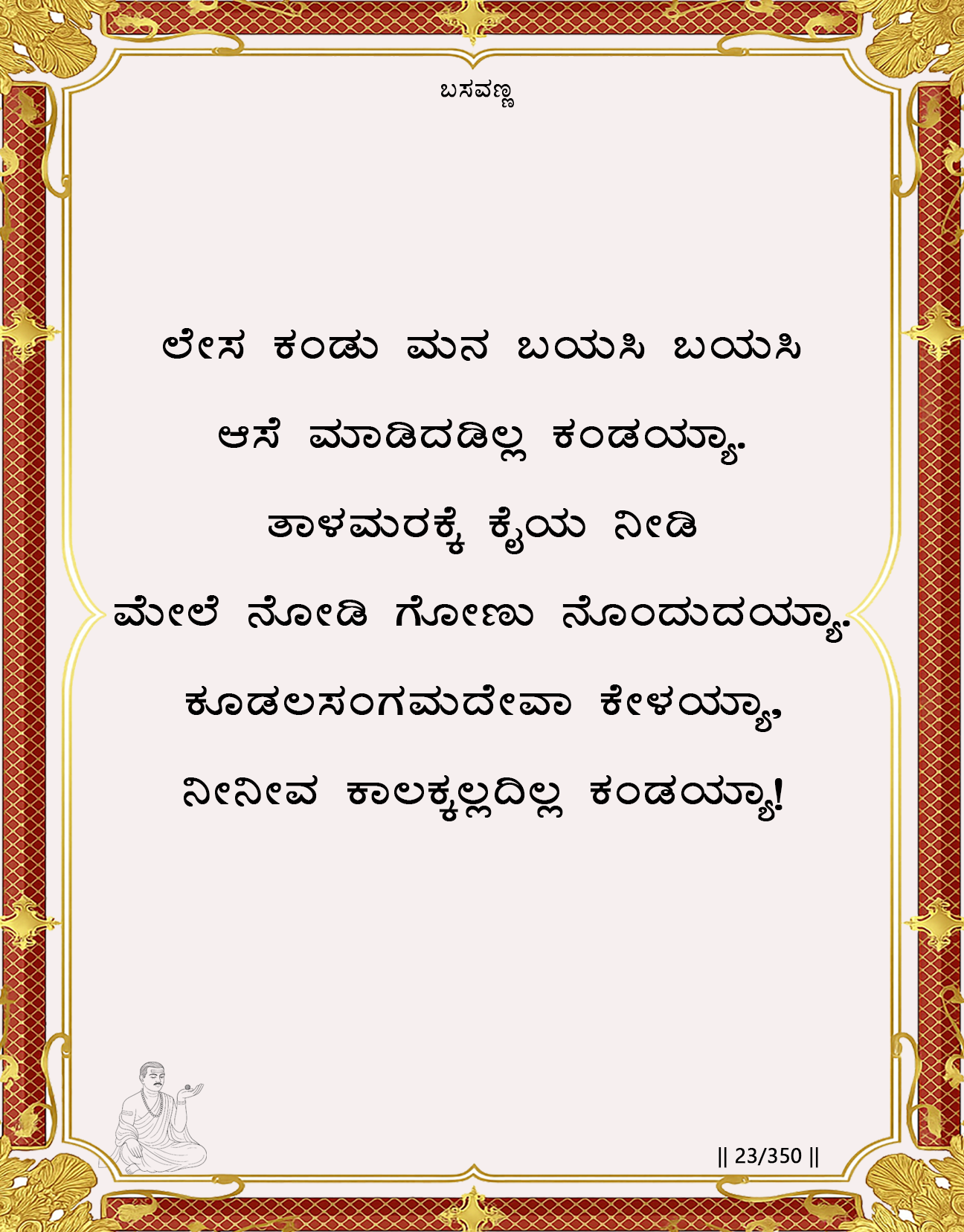
Once the heart has tasted true goodness,
the mind runs after it again and again
it cannot let go of the sweetness
it has once known.
Holding palm-leaf scriptures in my hands,
reading line after endless line,
I lifted my gaze again and again
until my neck grew sore
yet still the knowing did not arrive.
O Kudalasangama Deva, hear me:
even a lifetime is too small
to grasp all that is written.
Only by Your grace do I see
what cannot be learned by reading.
In this vachana, Basavanna reflects on the infinite expanse of scriptural knowledge. He describes how the seeker who tastes even a little of spiritual goodness becomes irresistibly drawn to it. Yet, when he turns to the vast sea of palm-leaf scriptures stretching across volumes and lifetimes he discovers the limits of intellectual study. However much one reads, however diligently one tries, the fullness of truth cannot be captured through words or acquired through study alone. Even a lifetime is insufficient for the scriptures to reveal what only direct experience can. Basavanna’s insight is radical and compassionate: the essence of realization is not in reading but in living. Thus, he points toward the path that transforms life itself into scripture the path of Lingayoga, where the seeker lives in harmonious union with:
- Aṅga the purified self
- Liṅga the indwelling all-pervading Consciousness
- Jaṅgama the living embodiment of truth
- Ariwu awakened insight
- Ācāra conduct rooted in awareness
- Kāyaka work as worship
- Dāsoha sharing and service
These lived principles open the way to the Śatṣaṭhala, the stages of inner ascent that no quantity of textual study can replace. In essence, Basavanna affirms that true knowledge is lived, not read, and devotion ripens only when it burns away the false self through direct, conscious experience.
Spiritual Context
Core Spiritual Principle: The Epistemic Superiority of Grace Over Grammar (Anugraha-Jñāna). Knowledge (jñāna) is of two kinds: parokṣa (indirect, from scriptures) and aparokṣa (direct, from experience). The former can inspire and guide but cannot, by its mediated nature, confer liberation. Only the unmediated light of grace (anugraha) can ignite the aparokṣa jñāna that burns away ignorance.
Cosmic Reality Perspective: This is a non-dual clarification of the role of Shakti as scripture and Shiva as grace. Scriptures are a form of Shakti structured, manifest knowledge. They point to Shiva but are not Shiva. To mistake the map (Shakti) for the territory (Shiva) is to exhaust oneself in the legend. Grace is Shiva’s spontaneous self-revelation, collapsing the distance between the seeker and the sought, making the map obsolete.
Historical Reality (Anubhava Mantapa Context): This was a pivotal intervention in the scholarly culture of the time. It challenged pandits who equated spiritual authority with scriptural erudition. Basavanna, himself learned, declared that the pinnacle of wisdom lay not in mastering texts but in receiving the grace that renders textual mastery secondary. It valorized the illiterate devotee’s heartfelt realization over the scholar’s memorized commentary.
Interpretation
1. “Once the heart has tasted true goodness, the mind runs after it again and again…” This describes the activation of spiritual desire (mumukṣutva). The “taste” (svāda) is a momentary, direct experience of reality’s essence (sāra). The mind, accustomed to seeking satisfaction in objects, now mistakenly seeks to recapture that essence through another object: scripture. This is the beginning of the seeker’s paradox.
2. “Holding palm-leaf scriptures… I lifted my gaze again and again until my neck grew sore yet still the knowing did not arrive.” This portrays the exhaustion of the objectifying consciousness. Reading is an outward, upward gaze. The “sore neck” symbolizes the fatigue of the intellect trying to acquire truth as an external commodity. “Knowing” (jñāna) is not an arrival of data but a shift in the knower’s very mode of perception, which effortful seeking cannot achieve.
3. “Even a lifetime is too small to grasp all that is written.” This acknowledges the infinity of manifested knowledge (Apara Brahman). Scriptures describe the phenomenal, name-and-form aspect of reality, which is endless. To try to comprehend Brahman through this endless catalogue is to commit to an infinite task with a finite mind.
4. “Only by Your grace do I see what cannot be learned by reading.” This is the surrender and revelation. Grace is not the reward for study but the catalyst for a different kind of seeing. What is seen is the subject itself the “I” that reads, the consciousness within which all scriptures appear. This can never be found in the scripture, only recognized as the reader by grace.
Practical Implications: Scriptural study is best approached as a preparation for grace, not a substitute for it. Its purpose is to purify the intellect and intensify longing, not to accumulate information. The moment it becomes a burden or a source of pride, it has become an obstacle.
The Cosmic Reality
Anga (Human Dimension): The Anga is the exhausted scholar. Its evolution involves moving from being a consumer of sacred texts to becoming a contemplative vessel, still and receptive enough for grace to perform the alchemy that turns information into transformation.
Linga (Divine Principle): Kudalasangama is the unwritten text, the silent knowledge. It is the understanding that exists before and after all words. Grace is its method of publication in the heart, bypassing the senses and intellect.
Jangama (Dynamic Interaction): The Jangama is grace embodied and enacted. They are the “knowing” walking around. Their life demonstrates that the truth of the scriptures is not in their recitation but in their enactment through kayaka and dasoha.
Shata Sthala
Primary Sthala: Prasadi. The turning point” Only by Your grace do I see” is the defining moment of Prasadi. The vachana charts the journey from the striving of lower stages to this gracious bestowal of direct perception.
Supporting Sthala: Bhakta. The initial “taste” and the relentless pursuit are the fuel of Bhakti. This vachana shows where that devotion must ultimately lead: to the surrender that opens the door to grace.
Practical Integration
Arivu (Awareness Practices): Practice “Reading for Resonance, Not Retention.” When studying texts, focus on a single phrase that “tastes” of goodness. Stop reading. Meditate on that feeling, that resonance. Let the mind “run after” that inner feeling, not after the next page.
Achara (Personal Discipline): Balance study with silent sitting. For every hour of reading, spend time in wordless contemplation, consciously turning from the “outer gaze” of the sore neck to the “inner gaze” of receptive awareness.
Kayaka (Sacred Action): Let your daily work be the scripture you embody. Practice seeing the divine principles (service, integrity, presence) not as concepts in a book but as living realities to be expressed in action. This is “reading” with your whole being.
Dasoha (Communal Offering): In study groups, shift focus from dissecting texts to sharing personal experiences of “tasting goodness” or moments of grace. Let the community be a space where lived truth is valued as the highest commentary.
Modern Application
Spiritual Information Overload and the Paradox of Choice. We have infinite access to spiritual texts, podcasts, and coursesa digital “pile of palm leaves.” We consume endlessly, suffering from seeking fatigue and a “sore neck” from looking at screens, yet the essential knowing feels more distant. We mistake accumulation for advancement.
The Discipline of Depth Over Breadth. The practice of Lingayoga today requires consciously limiting input to create space for grace. It means choosing one text or practice and delving deep, allowing it to trigger the inner “taste.” It involves regular digital fasts to stop “reading” and start “seeing.” It recognizes that in an age of infinite information, the greatest wisdom is knowing when to close the book and open the heart to the unmediated.
Essence
I followed the words,
a hungry beggar
chasing the scent of a feast
through endless hallways of commentary.
I grew thin on explanations,
my spine bent under the weight of meanings.
Then You broke a piece of Your own silence
and placed it on my tongue.
In that one taste,
the hallways vanished.
I was not in the library.
I was the light
by which all books are read,
the space
in which all words appear,
and the understanding
that needs no page to be.
This vachana illustrates the cognitive transition from symbolic processing to direct perception. The mind is a superb symbol-processor; it decodes scriptures (symbols). However, the reality these symbols point to (consciousness itself) is not another symbol. The processor cannot process its own operating substrate. The “sore neck” is system fatigue from trying to do the impossible. Grace represents a meta-cognitive eventa reboot of the system where it ceases trying to process reality and instead recognizes itself as the reality within which all processing occurs. This is the shift from knowing-about to knowing-as.
Imagine studying countless detailed maps of a territory (scriptures). You analyze contours, pathways, and legends until your eyes are sore. Yet, you have never set foot on the actual land. Grace is not another, better map. It is the shocking, immediate experience of the ground beneath your feet. Suddenly, you understand what the maps were trying, and failing, to convey. The maps weren’t wrong; they were just pointers. Now you are in the territory, and the need to constantly consult the map burns away.
We are addicted to knowing-about because it gives us a sense of control and progress. Direct knowing requires surrender and vulnerability it feels like losing our footing. This vachana exposes the ultimate futility of the intellectual project as a path to liberation and offers the only true exit: grace. The burning away of the false self is not a violent destruction, but the gentle dissolution of the “reader” identity the one who stands apart from the text trying to understand it. When that self is consumed in the fire of grace, what remains is the understanding itself, luminous and complete, needing no external reference. The lifetime of reading was not wasted; it was the long, winding path to the cliff’s edge, from which the only step left was into the boundless sky of direct apprehension.

Views: 12