Poetic Rendering

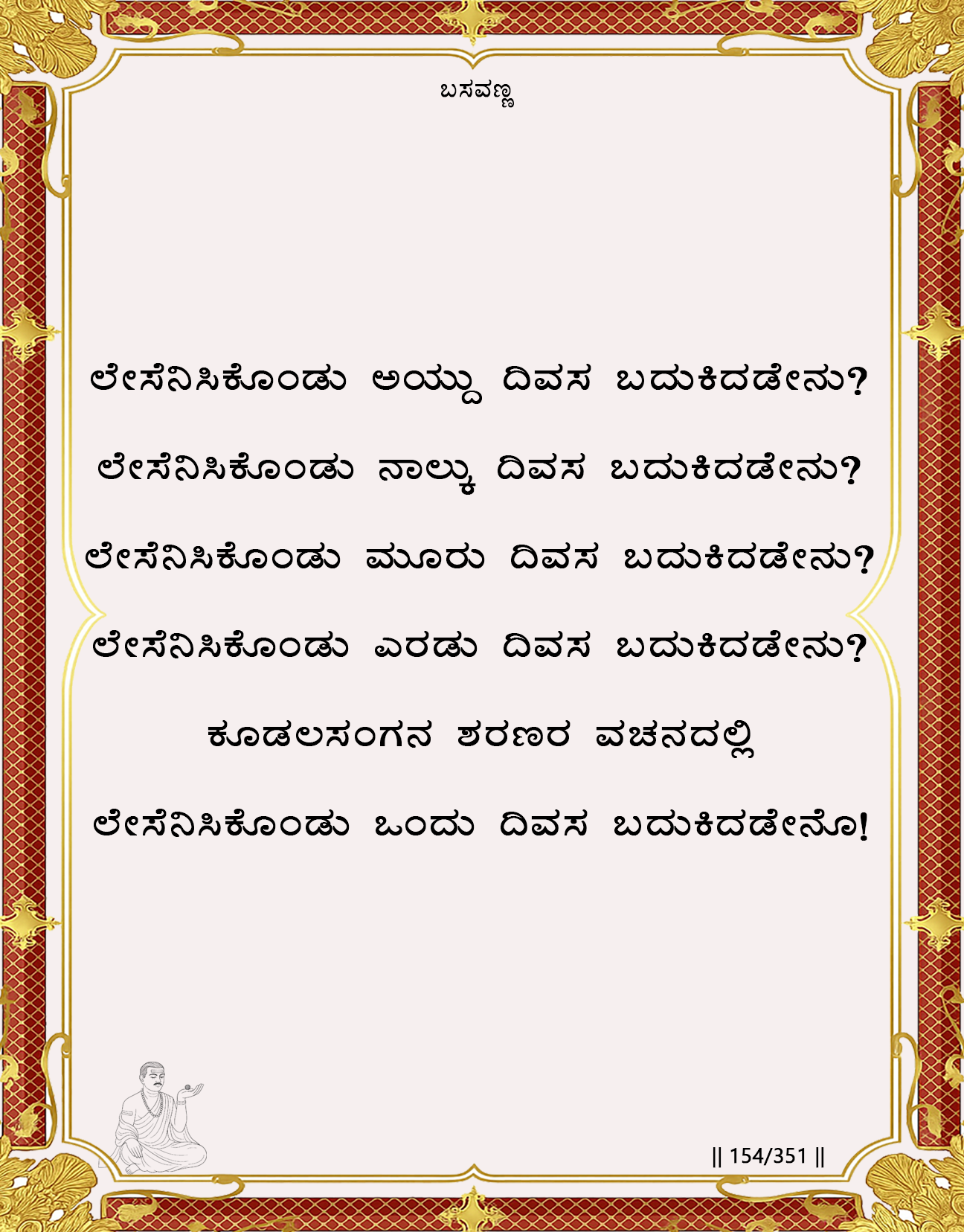
What is the worth of living long
a day, two, three, four, or five
and speaking only
words about the truth,
never living it?
Better one single day,
O Kudalasangama,
when realization burns bright,
when the word becomes flesh,
and life itself becomes the Vachana.
This vachana represents the ultimate criterion for spiritual authenticity the embodiment of truth rather than its mere articulation. Basavanna reveals that spiritual realization is measured not by the duration of one’s spiritual practice or the eloquence of one’s teachings, but by the degree to which truth has become incarnate in one’s daily existence. The teaching establishes that authentic spirituality requires the courage to transform understanding into lived reality, making one’s very life the manifestation of divine truth. Basavanna’s insight here aligns with the Upanishadic wisdom: “Na śabdena, na manasā not by word, not by thought
but by being That, one knows That.”
Spiritual Context
Core Spiritual Principle: Embodiment over Articulation. The highest spiritual value is the existential unification of consciousness (knowledge) and conduct (living). Truth is a state of being, not an object of discourse.
Cosmic Reality Perspective (non-dual, Shiva-Shakti dynamics): From the non-dual perspective, the universe is the dynamic embodiment (Shakti) of the silent, absolute principle (Shiva). Creation is not about the Divine; it is the Divine manifest. To “live the Vachana” is to align one’s individual existence with this cosmic process, becoming a conscious site where the formless principle takes living form.
Historical Reality (Anubhava Mantapa context): This vachana was a direct challenge to the orthodox priestly class and ascetic traditions that prized ritual recitation, scholarly debate, and prolonged austerities over ethical, embodied realization. Within the Anubhava Mantapa, it defined the criterion for membership: not pedigree or learning, but the visible incarnation of divine values in one’s social and personal conduct.
Interpretation
1.The Interrogation of Time (“a day, two, three…”): Time (Kāla) is examined not as a container for accumulation, but as an opportunity for intensity of being. Metaphysically, linear time is a construct of the unawakened mind; enlightened consciousness operates in the “eternal now” (Koodala), where quality of presence annihilates quantitative measure.
2.The Condemnation of “Speaking Only Words”: Speech (Vāc) disconnected from being is identified as Māyā (illusion)a secondary, reflective reality. It creates a veil of concepts that substitutes for direct, lived experience of the Real (Linga).
3.The Revelation of the “Single Day”: This “day” symbolizes the timeless moment of awakening (Sakshātkāra). It is the point where the individual will (Ichchā Shakti) fully aligns with divine will, and knowledge (Jnāna Shakti) becomes activated as transformative power (Kriyā Shakti).
4.”Life itself becomes the Vachana”: This is the state of Sthira-Sthiti (stable abidance). The individual consciousness is so thoroughly saturated with the divine principle that every action, breath, and thought is a spontaneous, authentic expression (Vachana) of that principle. The microcosm (the person) mirrors the macrocosm (the universe as God’s expression).
Practical Implications: It invalidates spiritual performance for social approval. Practice must be inwardly verified by a tangible transformation of one’s character, emotions, and actions in the mundane world. The test of Kayaka (work) and Dasoha (sharing) becomes the real altar.
The Cosmic Reality
Anga (Human Dimension): The human prone to hypocrisy the tendency to dissociate lofty ideas from grounded action. It is the realm of ego that derives status from verbal knowledge and temporal longevity.
Linga (Divine Principle): The inseparable unity of Consciousness and its Manifestation. God is not a concept to be described but the Reality to be lived as. The Linga is the symbolized anchor for this total embodiment.
Jangama (Dynamic Interaction): The fiery, alchemical process of Sangama (union) invoked by calling upon Koodalasangamadeva. It is the moment-by-moment effort and grace required to forge the Anga (self) into a perfect vehicle for the Linga (divine), until the interaction itself becomes the state of being.
Shata Sthala
Primary Sthala: Aikya (Union). The vachana’s ultimate vision is of perfect, non-dual union where “life itself becomes the Vachana.” There is no distinction between the seeker, the path, and the goal.
Supporting Sthala: Pranalingi (Union of Life-Force with the Divine). This stage directly supports the final leap to Aikya. It is the critical turning point where realization “burns bright” the Prana (vital life force) is entirely surrendered to and illumined by the Linga, making embodiment possible.
Practical Integration
Arivu (Awareness Practices): Practice mindful awareness of the gap between your professed values and your instantaneous reactions. Before speaking of a truth, meditate on its feeling in the body and its implication for your next action.
Achara (Personal Discipline): Establish one “small truth” to embody each daye.g., if you speak of non-violence (Ahimsa), practice it in your thoughts when irritated. Let discipline focus on integrity, not ritual form.
Kayaka (Sacred Action): Let your daily work be the primary field for embodying truth. If your truth is compassion, let it shape how you perform your task and interact with colleagues, more than how you pray.
Dasoha (Communal Offering): Offer to the community the living example of an integrated life. Your sharing is not just material but the inspirational offering of a consciousness where word and deed are one.
Modern Application
Spiritual Consumerism & Performative Identity. We live in an age of curated spiritual personas online, podcast wisdom disconnected from life, and the commodification of practices. We often mistake consuming spiritual content for spiritual progress, leading to what Basavanna would see as the ultimate hypocrisy: eloquent speakers on equity who exploit, wellness influencers thriving on anxiety, and leaders preaching unity while fostering division.
Use this vachana as a mirror and a sword. The Mirror: Regularly ask, “In what specific, tangible way did my understanding of ‘X truth’ change my behavior today?” The Sword: Courageously critique spiritual, social, and political systems that reward empty rhetoric over embodied virtue. Choose depth over duration: commit to one embodied practice fully rather than skimming many.
Essence
Better the sun of one true dawn,
where knowing dies in being born,
than an age of shadow-talk,
on every sacred walk.
Let the word in flesh be sown,
and life, its living scripture, own.
O Mover to the Union-State,
Make my one day illuminate.
This vachana operationalizes the quantum principle of wave function collapse. Endless verbalizing about truth keeps it in a superposition of potential states a cloud of possibilities. The act of embodiment is the observation that collapses the wave function: from many potential truths, one actual, lived reality emerges, defining the observer’s existence. The “single day” is that moment of collapse into a definitive, conscious state.
It’s the difference between reading a brilliant cookbook to everyone you meet and actually cooking a nourishing meal. The former might earn you praise as a food expert; the latter transforms you and feeds the hungry. Basavanna says your spiritual worth is measured by the meals you actually cook and share, not by your recitation of recipes.
We all suffer the existential pain of the “integrity gap” the space between who we aspire to be and who we are in our unguarded moments. This vachana names that pain and offers its cure: stop aspiring outwardly and start being inwardly, letting that inner reality dictate your outer action. The universal longing is not for more knowledge, but for the peace that comes when we are no longer at war with ourselves by living a divided life. Where the Spoken Word becomes Living Light and Life itself becomes the Eternal Vachana.

Views: 19