Poetic Rendering

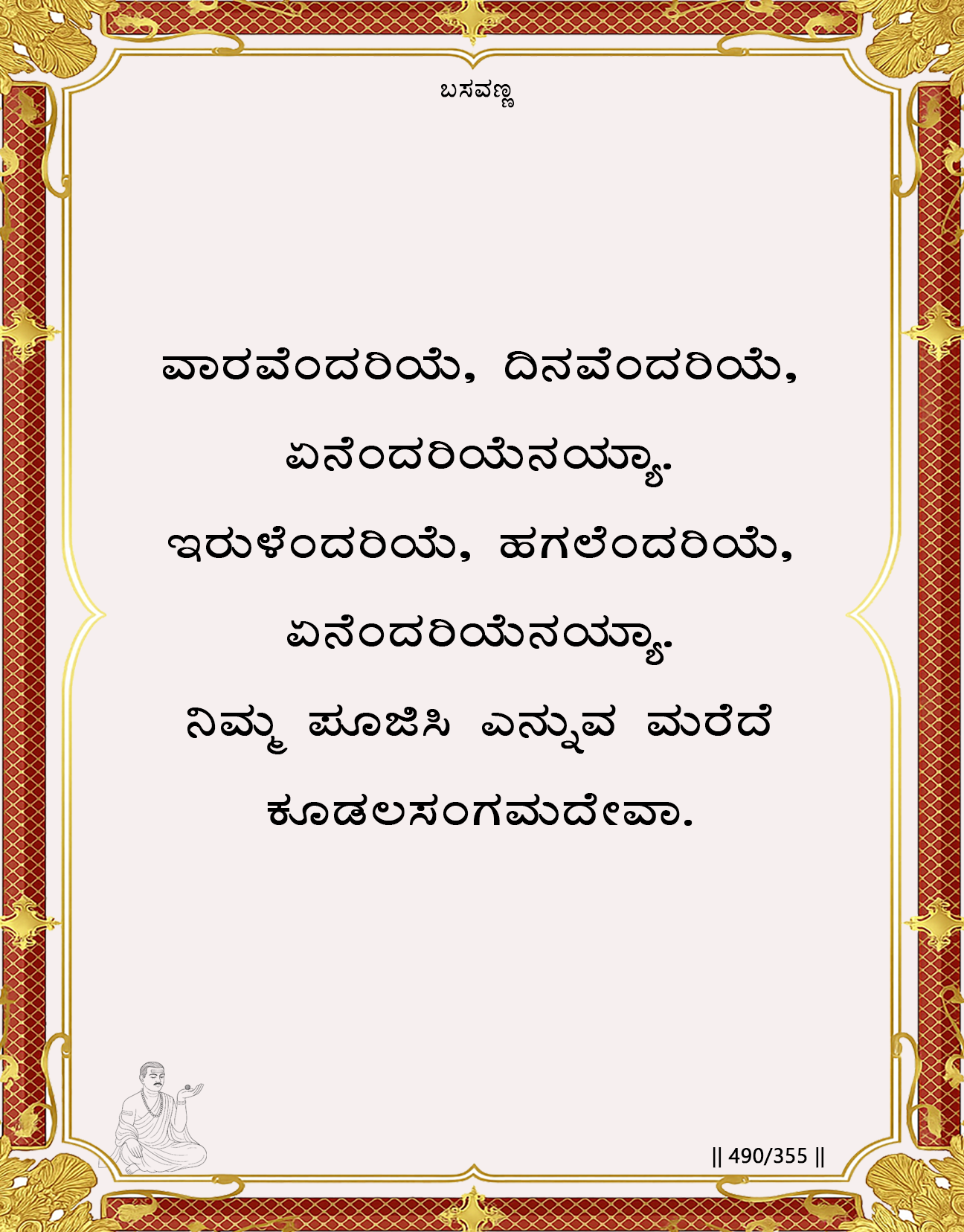
What is a week? What is a day?
What is night, what is dawn?
When my heart rests in You, O Kudalasangama,
all measures of time vanish
there is only the unbroken worship,
the endless pulse of Your name.
This vachana reveals the transcendental state where chronological time (kaala) dissolves into eternal presence (nitya). Basavanna demonstrates that for the realized consciousness, devotion is not a scheduled activity but the very fabric of being. The teaching establishes that when the heart merges with the Divine, artificial divisions of time days, nights, weeks lose their meaning, revealing worship as the continuous rhythm of existence it self Analysis
Spiritual Context
Core Spiritual Principle: Devotion as Timeless Continuum. True worship (Aradhana) is not an event within time but the discovery of the timeless dimension within which all events appear. Spiritual maturity is measured by the continuity of divine awareness, not by the duration or frequency of ritual practice.
Cosmic Reality Perspective (non-dual, Shiva-Shakti dynamics): From the non-dual view, time (Kāla) is a projection of Shaktithe dynamic, creative power that manifests as cycles and sequences. The timeless absolute (Shiva) is the silent substratum. When the heart “rests in You,” individual consciousness (Jiva) aligns with Shiva, and the projected play of time is recognized as non-separate from timelessness. The “endless pulse of Your name” is the Shakti vibrating as the eternal now.
Historical Reality (Anubhava Mantapa context): This vachana challenged rigid ritual orthodoxy that prescribed specific times (Sandhya, festivals) for worship. In the Anubhava Mantapa, it reinforced the revolutionary principle that a sharana’s devotion is a constant inner state, not confined to external schedules. It democratized spirituality, making it accessible to all, irrespective of their ability to observe ritual timings.
Interpretation
1.Interrogation of Constructed Time (“What is a week? What is a day?”): These units are human conventions abstract mental divisions imposed on the continuous flow of existence. Questioning them signifies deconstructing the Vikalpa (mental concept) that creates the illusion of separation between sacred and profane time.
2.Interrogation of Natural Cycles (“What is night, what is dawn?”): Even natural diurnal rhythms, though cosmic, are still relative phenomena within manifestation. The question points beyond the duality of light/dark, activity/rest, to the non-dual awareness that witnesses both without preference.
3.The Catalyst of Surrender (“When my heart rests in You”): The “heart” (Hridaya) is the center of individual feeling and volition. “Resting” (Vishrani) implies a cessation of seeking, striving, and measuring. This surrender is the portal where personal, psychological time dissolves.
4.The State of Timeless Worship (“all measures of time vanish…”): This is the description of Nitya Siddhi (eternal accomplishment). Worship becomes synonymous with existence itselfthe “endless pulse” is the Sphurana (throb) of divine consciousness, experienced as the uninterrupted flow of Nama-Smarana (remembrance of the name).
Practical Implications: This teaching invalidates guilt over “missing” prayer times or meditation sessions. It shifts the focus from performing devotion in time to realizing devotion as the timeless ground of being. Practice becomes about cultivating this resting of the heart continuously, amidst all activities.
The Cosmic Reality
Anga (Human Dimension): The egoic self that lives in the narrative of past and future, segmenting life into achievements, failures, and scheduled spiritual routines. It is the experiencer of Kāla as a binding force.
Linga (Divine Principle): The eternal, unchanging presence that is the source and substance of all moments. It is the “Kudalasangama” the confluence where all rivers of time merge into the ocean of timelessness.
Jangama (Dynamic Interaction): The living process of Samadhinot as a trance, but as the steady abidance where the mind’s oscillations between memory and anticipation cease, and the heart rests in the immediacy of divine presence. This dynamic stillness is the true Jangama, moving beyond all movement.
Shata Sthala
Primary Sthala: Aikya (Union). The culmination where the devotee’s awareness is non-different from the divine. In this union, the relative perception of time fully subsides, revealing the eternal co-existence of the soul and God.
Supporting Sthala: Sharana (Total Surrender). The active gesture of offering the heart is the key that unlocks the door to timelessness. Without this surrender, the mind remains the controller, measuring and managing time, including “spiritual” time.
Practical Integration
Arivu (Awareness Practices): Practice “Timeless Moments.” Throughout the day, pause and ask, “What is time right now?” Feel directly the sensation of the present moment without labeling it as a day or hour. In meditation, drop the timer and rest in awareness itself, not in a duration.
Achara (Personal Discipline): Discipline yourself to break the association between specific clock times and “sacredness.” Let your spiritual practices (prayer, meditation) arise spontaneously from inner calling rather than calendar slots. Use reminders not as schedules but as prompts to return to the timeless heart-rest.
Kayaka (Sacred Action): Perform your work without the pressure of deadlines as psychological tyrants. Instead, immerse fully in the action itself, allowing it to become an expression of the “endless pulse.” This transforms efficiency into flow, and productivity into presence.
Dasoha (Communal Offering): Offer the community the gift of your timeless presence. In interactions, be fully present, not mentally rushed by what’s next. Your calm, time-free demeanor creates a sanctuary for others, offering relief from collective time-anxiety.
Modern Application
Chronological Tyranny and Spiritual Productivity. We live in an age of hyper-scheduling, digital calendars, and the commodification of time. Even spirituality is often framed as a self-improvement project with goals, milestones, and tracked meditation minutes. This leads to “time poverty” and a fragmented consciousness that rarely inhabits the present.
Embracing Deep Time through Heart-Resting. Use this vachana to practice Temporal Disidentification. When feeling rushed or behind schedule, consciously “rest your heart” in the felt sense of being alive right now. Declare: “In this rest, time vanishes.” This disrupts anxiety cycles and fosters a creativity and devotion that are not subject to the clock. It allows for a sustainable spirituality that flourishes in the cracks of busy life by redefining those cracks as gateways to eternity.
Essence
Week, day, night, dawnnames that fall away
when the heart finds its only nest.
In that rest, no before, no after
only the unwavering gaze,
the ceaseless whisper of the Name,
the worship that was never not.
O Confluence of All Moments,
This is the meeting where time forgets itself.
This vachana illustrates the metaphysical principle of temporal superposition. In ordinary consciousness, time exists as a collapsed sequence: past, present, future appear definite and separate. In the state of heart-resting, consciousness enters a superposition where all moments coexist in an eternal now, analogous to the quantum state where particles exist in multiple times simultaneously. The “measurements” (weeks, days) are the act of observation that collapses the wave function into linear time; cessation of measurement returns consciousness to the timeless field.
Imagine time is a river you’re swimming in, constantly fighting the current (past pushing you, future pulling you). Basavanna says: “Stop swimming. Just float and rest your heart on the riverbed (the Divine).” When you do, a miracle happens you realize you are the riverbed, not the swimmer. The river of time still flows above you, but you are the still, eternal ground that holds it. From that place, you see the river’s flow as a play on your own surface.
Our deepest suffering is the feeling of being trapped in time haunted by the past, anxious about the future, and never fully present. Our deepest longing is for the “eternal present,” a state of peace where we are complete and at home. This vachana points to that homecoming. It reveals that our essence is not the time-bound story of our life, but the timeless awareness in which that story appears. Freedom is not about managing time better, but realizing the part of us that time cannot touch. This provides the ultimate solace: in our core, we are already free from the tyranny of the clock and the calendar.

Views: 12