
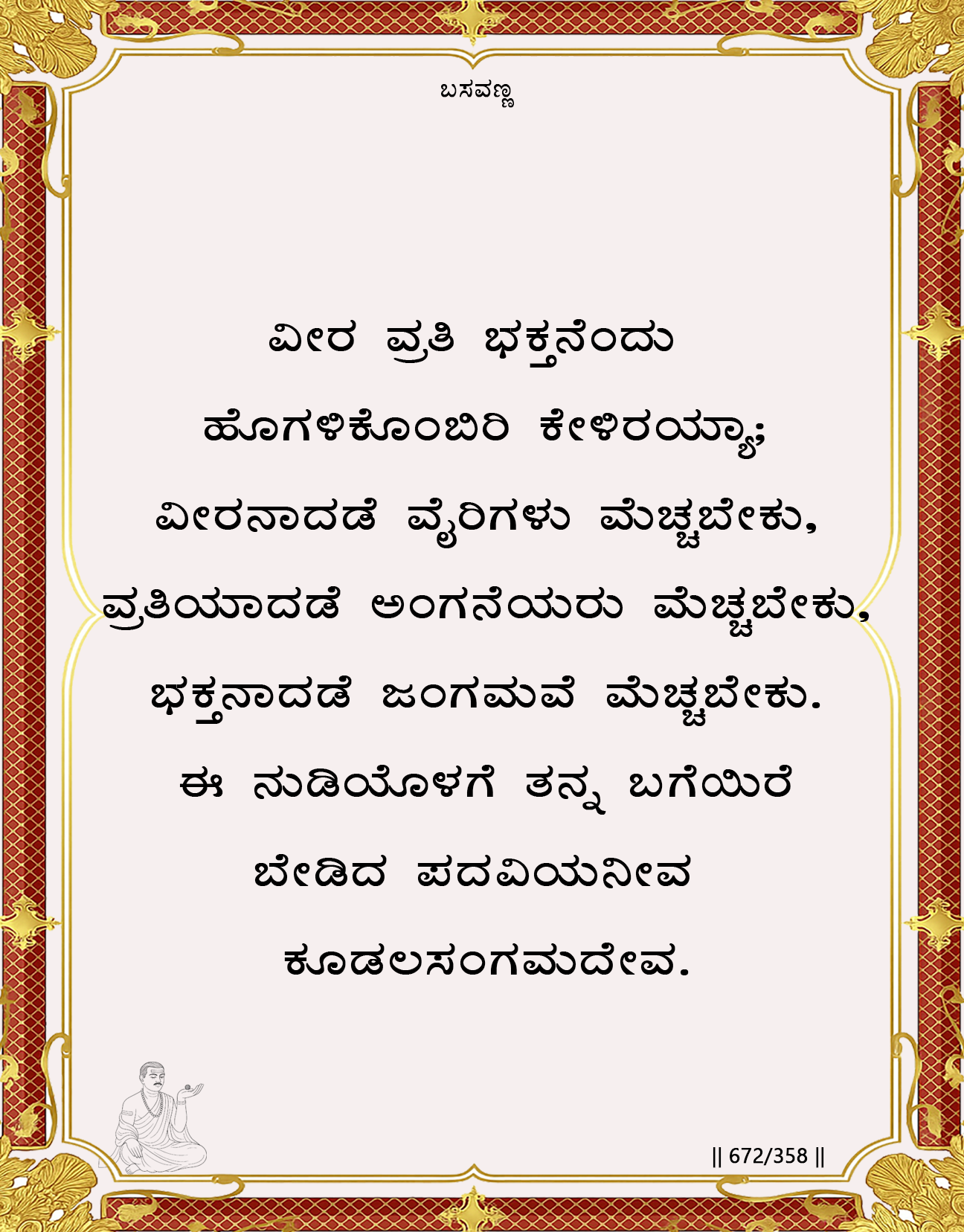
Poetic Rendering

They call him brave
but let his enemies say so.
They call him vowed
let his kin find peace in his promise.
They call him devout
let the Jangama rejoice in his presence.
When words are not masks but mirrors,
when praise fits truth like skin,
then, O Kudalasangama,
let Your grace descend
for the rest is only noise.
This vachana establishes a profound criterion for spiritual authenticity: the verification of inner qualities through external relationships. Basavanna presents a tripartite test of integrity where courage, commitment, and devotion must be validated by those most positioned to judge them adversaries, family, and spiritual masters. The teaching reveals that true spiritual attainment is never self-proclaimed but manifests as tangible blessings in relational dynamics. Basavanna’s teaching transcends religion it is a philosophy of authentic living. “To live truthfully is the greatest prayer; to speak truthfully, the greatest vow.”
Spiritual Context
Core Spiritual Principle: Relational Verification as the Litmus Test of Spirituality. Inner realization must manifest as outer integrity. Authenticity is not a private feeling but a public truth, verified by its impact on the web of relationshipsespecially those of opposition, intimacy, and spiritual guidance.
Cosmic Reality Perspective (non-dual, Shiva-Shakti dynamics): In the non-dual view, the apparent separation between inner self and outer world is illusory. Shiva (the inner principle) and Shakti (its dynamic expression) are inseparable. Therefore, any genuine inner state (Shiva) must naturally and harmoniously express itself (Shakti) in all relational dimensions. Discrepancy indicates a blockage of Shakti by ego (Ahamkara).
Historical Reality (Anubhava Mantapa context): In the radical social experiment of the Anubhava Mantapa, where caste hierarchies were overturned, personal integrity was paramount. This vachana provided a practical, community-based method for accountability. It prevented spiritual hypocrisy and ensured that the revolutionary ideals of the Sharanas were embodied in their dealings with opponents, families, and each other.
Interpretation
1.The Enemy’s Mirror (Courage): An enemy operates from a position of opposition and scrutiny. If even they acknowledge one’s courage, it means the courage is rooted in Dharma (righteous principle), not in personal bravado or aggression. Metaphysically, this reflects the integration of the shadowthe ability to hold one’s truth in the face of adversarial energy without being distorted by it.
2.The Family’s Mirror (Vows): Family represents the realm of intimate Karma and unconditional bonds. If one’s spiritual vows bring peace to the family, it signifies that those vows are aligned with Loka Sangraha (universal welfare), not spiritual ego. This tests whether one’s spiritual practice expands love or contracts it into self-absorption.
3.The Jangama’s Mirror (Devotion): The Jangama (realized moving soul) perceives directly the vibration of consciousness. If they rejoice in one’s presence, it indicates that the devotion is pure (Sattvic), free from ulterior motive or hidden desire (Sankalpa). This is the test of whether one’s Bhakti generates a Sattvic field that nourishes even the awakened.
Practical Implications: Spiritual practice must include conscious engagement with these three relational fields. One must actively seek and humbly receive feedback from critics, loved ones, and mentors. Integrity is a daily practice of aligning action with truth in every context.
The Cosmic Reality
Anga (Human Dimension): The aspirant as a social being, navigating the complex web of relationships. The Anga is tempted to craft different personas for different audiences; the spiritual task is to become one integrated person, transparent and consistent.
Linga (Divine Principle): The absolute standard of Satya (Truth)the divine reality that is perfectly coherent and non-contradictory in all its expressions. The Linga is the anchor that calls the Anga to this same coherence.
Jangama (Dynamic Interaction): The living process of Sadachara (right conduct). It is the moment-by-moment choice to act with integrity, especially when it is difficult, thereby weaving the threads of disparate relationships into a single tapestry of authentic being.
Shata Sthala
Primary Sthala: Maheshwara (Great Lordliness). This stage is characterized by righteous governance and mastery. The three mirrors represent the three key constituencies a “lord” must serve justly: the outsider (enemy), the insider (family), and the transcendent guide (Jangama). Mastery here means earning genuine respect from all three.
Supporting Sthala: Prasadi (Stage of Grace-Receptivity). To pass these tests consistently requires divine grace. The prayer at the end let Your grace descend acknowledges that the integrity sought is a gift of Prasada, granted to those whose hearts are made receptive through honest self-appraisal.
Practical Integration
Arivu (Awareness Practices): Practice “Relational Mindfulness.” In interactions, especially challenging ones, ask: “What truth about me is being reflected here?” Cultivate the ability to receive criticism, family feedback, and spiritual guidance without defensiveness, seeing them as mirrors for growth.
Achara (Personal Discipline): Institute a “Tri-Mirror Review.” Regularly and honestly assess: Have I acted with such fairness that an adversary would respect it? Have my commitments brought peace to my household? Is my devotion sincere enough to uplift my spiritual companions?
Kayaka (Sacred Action): Let your work be a testament to integrated character. Deal fairly with competitors (enemies), honor commitments to colleagues and dependents (family), and perform your duties with a devotional attitude that inspires others (Jangama).
Dasoha (Communal Offering): Offer your community the gift of relational transparency. Be someone whose word is trustworthy, whose presence is unifying, and whose integrity invites others to be their true selves. Foster communities where such mutual reflection is encouraged in love.
Modern Application
The Curated Self and Accountability Deficit. We live in an age of personal branding, social media personas, and echo chambers that shield us from challenging feedback. We often perform virtue for an audience that agrees with us, while our private lives and unseen interactions may tell a different story. This leads to spiritual hypocrisy, fractured relationships, and leaders who are unaccountable.
Embrace the Three Mirrors for Integrated Living. Use this vachana as a tool for Relational Integrity Auditing. Actively seek constructive feedback from a critic (the “enemy” mirror). Regularly check in with family: “Does my spiritual life make your life more peaceful or more stressful?” Find a mentor (Jangama) whose joyful approval you seek not for praise, but as a barometer of your inner state. This practice dismantles the curated self and builds a character that is solid, trustworthy, and truly spiritual.
Essence
Let not my tongue name the virtue,
but let the foe name the courage.
Let not my oath ring in temple halls,
but let it sound as peace in my own walls.
Let not my piety be a show for the crowd,
but a light in which the wise feel proud.
O Truth Itself, Kudalasangama,
when I am seen as what I am,
that is Your graceand all I am.
This vachana maps onto the metaphysical structure of ternary logic. Reality manifests in three fundamental relational modalities: opposition (enemy), harmony (family), and transcendence (Jangama). A coherent truth must hold its integrity across all three modal contexts. Any spiritual quality that collapses under the pressure of one modality is revealed as partial or unrealized. The vachana thus describes a topological test: a true spiritual state is homeomorphic it maintains its essential structure whether mapped onto the space of conflict, intimacy, or wisdom.
Think of a good sword. It’s tested in three ways: against another sword (does it hold its edge?), against the whetstone (does it sharpen well for future use?), and by the master swordsmith (does its craftsmanship bring joy?). Similarly, your courage is tested in conflict, your vows in the grind of daily family life, and your devotion by the discernment of a master. If it passes all three, it’s the real thing.
We all harbor a deep fear of being “found out” that the gap between our self-image and how others see us will be exposed. This vachana reframes that fear into the very path of liberation. It teaches that wholeness is found not by hiding the gap, but by courageously allowing our relationships to reveal it, so we may close it. Our universal longing is to be known and loved for who we truly are. This process turns that longing into a spiritual practice: we become worthy of being known by ensuring that who we truly are is consistent, authentic, and benevolent in every arena of life.

Views: 2