Poetic Rendering

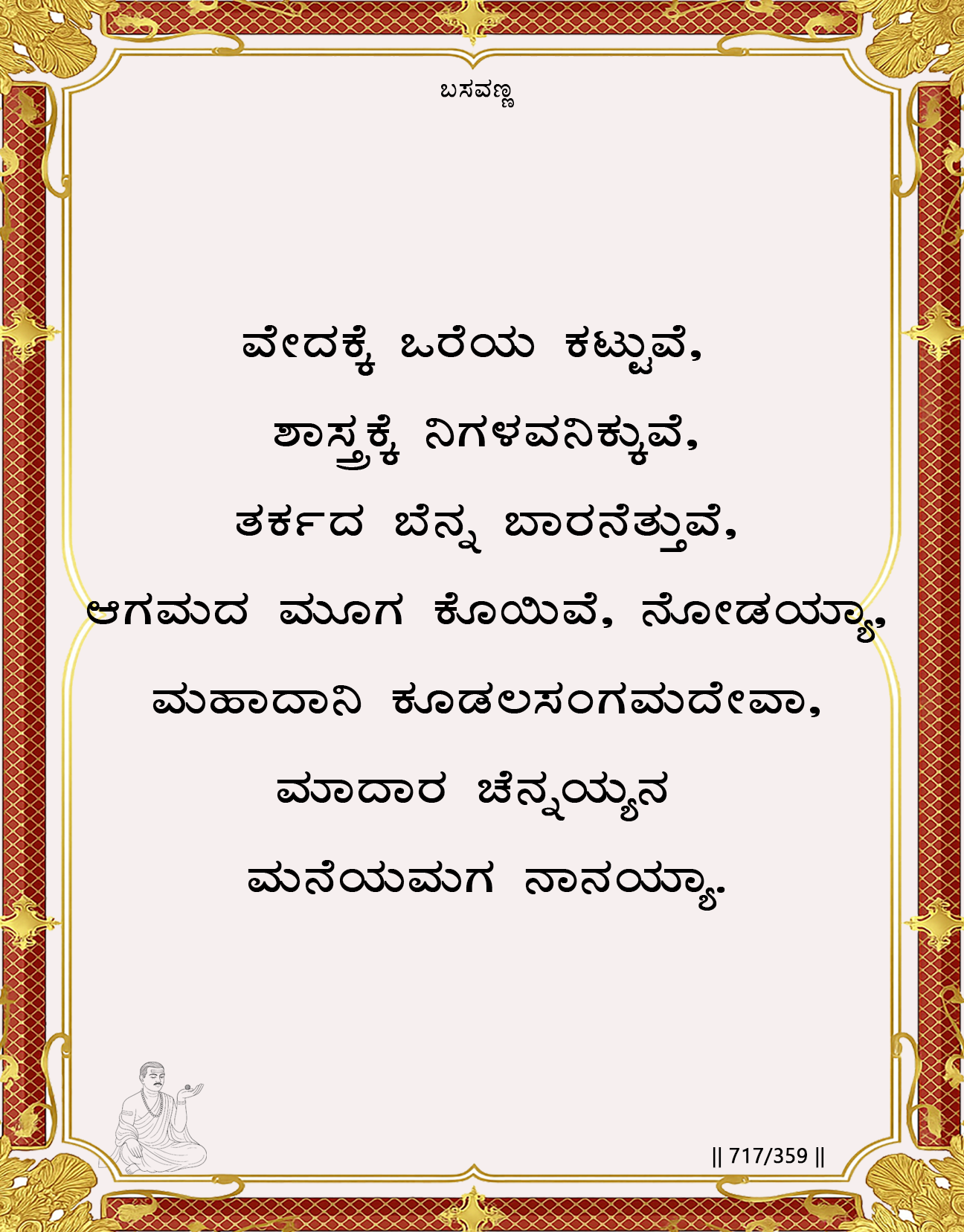
I shall bind the Vedas into one tight knot
and leave the shastras sealed behind shut doors.
I shall break the staff of fruitless debate,
and slice the nose of rituals
that strut without understanding.
For I am the son of Maadara Chennayya
born of those who work with their hands,
who know truth by living it,
not by reciting it.
O Kudalasangama Deva,
You alone are my scripture,
my wisdom,
my world.
Every breath is Your mantra,
every step Your teaching
what need have I for any other book
when You walk within me?
This vachana is Basavanna’s uncompromising proclamation of spiritual freedom. It does not disrespect scripture; it rejects the misuse of scripture by those who wield texts without embodying truth. Basavanna declares: The Vedas and shastras are not supreme unless their essence becomes lived experience. Argument without realization is hollow, and ritual without awareness is lifeless.
Spiritual authority does not come from birth, caste, scholarship, or ritual performance it arises from inner clarity and honest labor. By invoking Maadara Chennayya, Basavanna aligns himself with the humble, the working classes, and the spiritually authentic. He announces that true wisdom is not learned from books but lived through the body, breath, and daily work. Ultimately, Basavanna states that: The Divine within Kudalasangama is the real scripture. All else is commentary. This vachana represents a spiritual revolution where direct experience annihilates hierarchy and restores the sacred as a living presence in every act, every worker, and every awakened heart. Basavanna’s fierce declaration of freedom from blind scripture and ritual arrogance This vachana represents the pinnacle of spiritual revolution the declaration that direct experience of the Divine transcends all scriptural authority and ritual formalism.
Basavanna does not reject sacred texts but liberates them from becoming instruments of oppression and intellectual bondage. He establishes that the awakened heart becomes the living scripture, and conscious labor becomes the highest ritual. This is not nihilism but the ultimate affirmation of spirituality as immediate, embodied truth.
Spiritual Context
Core Spiritual Principle: Anubhava (Direct Experience) as Supreme Authority. The ultimate validation of truth is not textual or ritualistic but existential. Spiritual knowledge must be verified in the laboratory of one’s own lived consciousness and action.
Cosmic Reality Perspective (non-dual, Shiva-Shakti dynamics): The cosmos is the living expression (Shakti) of the divine (Shiva). To privilege static scriptures over this dynamic, self-revealing expression is to favor a map over the territory. Basavanna affirms that Shiva-Shakti is perpetually unfolding as the seeker’s own life; therefore, that life, when fully conscious, is the most authentic scripture.
Historical Reality (Anubhava Mantapa context): This vachana was a theological bombshell in the 12th-century context of Brahminical hegemony, where scriptural knowledge and ritual performance were gatekept by caste. By invoking Maadara Chennayya (a saint from the ‘untouchable’ cobbler community), Basavanna democratized enlightenment and declared the Anubhava Mantapa a space where spiritual authority derives from lived integrity, not birth or scholarship.
Interpretation
1.Binding the Vedas: The Vedas represent Shruti (revealed knowledge). To bind them in a knot is not to discard them but to contain their essence, preventing their infinite expansion from becoming a distraction. It signifies moving from Paroksha Jnana (indirect knowledge) to Aparoksha Jnana (direct knowledge).
2.Locking the Shastras: The shastras represent Smriti (traditional law and commentary). Sealing them away symbolizes transcending the burden of endless regulations and commentaries to access the simple, unmediated truth.
3.Breaking the Staff of Debate: This represents the end of Tarka (logic-chopping) and Vitanda (wrangling). It acknowledges that conceptual debate, while useful, cannot by itself lead to liberation; it often entrenches the ego.
4.Slicing the Nose of Ritual: In ancient India, cutting off the nose was a punishment for dishonesty. Here, it exposes ritual (Kriya) that is performed without understanding (Buddhi) as a form of spiritual fraud, stripping it of its false prestige.
5.Son of Maadara Chennayya: This declaration roots spiritual authority in the lineage of humble, honest labor (Kayaka). It asserts that the clarity born of simple, truthful living is superior to the complexity of scholasticism.
6.You alone are my scripture: This is the positive declaration. The Linga, experienced directly, becomes the living, breathing, walking source of all wisdom.
Practical Implications: Spiritual practice shifts from exegesis of texts to exegesis of one’s own consciousness. Study becomes self-study (Svadhyaya). Ritual is transformed into mindful action. Authority is relocated from external hierarchy to internal discernment validated by lived integrity.
The Cosmic Reality
Anga (Human Dimension): The human being as a potential “living scripture.” When purified of dependency on external constructs, the Anga becomes a transparent medium through which the Linga’s wisdom is authored anew in each moment.
Linga (Divine Principle): The ever-present, self-luminous truth that is its own proof. It requires no external validation because it is the source and substance of all that is. It is the “text” that is never closed, constantly being revealed.
Jangama (Dynamic Interaction): The act of closing the book and opening the heart. It is the dynamic, courageous choice to turn inward and trust the direct perception of the divine moving within one’s own life, making the journey itself the sacred text.
Shata Sthala
Primary Sthala: Aikya (Union). The vachana’s climax“ You alone are my scripture… when You walk within me” describes the non-dual state of Aikya, where the seeker and the sought, the knower and the known, are unified. All external references dissolve in this union.
Supporting Sthala: Sharana (Total Surrender). The entire proclamation is an act of surrender to the inner Linga. The rejection of external authorities is only possible because of a prior, total surrender to the internal authority of the divine.
Practical Integration
Arivu (Awareness Practices): Practice “Reading the Book of This Moment.” In meditation, instead of reciting scriptural verses, attend deeply to the sensations of the breath, the sounds around you, the flow of thoughts. Inquire: “What is the truth being communicated to me right now, directly, without words?”
Achara (Personal Discipline): Let your discipline be the commitment to authenticity. Before engaging in any ritual or recitation, ask: “Is this connecting me to living truth, or is it a hollow repetition?” Simplify practices to those that directly cultivate presence and compassion.
Kayaka (Sacred Action): Transform your daily work into your primary scripture. Approach each task as a verse in the living Vachana of your life. Let the lessons learned through hands-on engagement patience, precision, care be your most valued teachings.
Dasoha (Communal Offering): Share the “living scripture” of your transformed presence. Teach not by quoting texts but by exemplifying integrity, compassion, and wisdom in action. Create communities where truth is validated by lived experience, not by scholarly citation.
Modern Application
Spiritual Consumerism and Information Glut. We drown in spiritual books, podcasts, and online teachings, often mistaking the accumulation of information for growth. This leads to “spiritual bypassing,” where intellectual understanding substitutes for deep character transformation. Similarly, ritual can become performative, divorced from inner meaning.
Embrace the “Inner Library.” Use this vachana to declare independence from spiritual consumerism. Practice a “scriptural fast”: dedicate a period to relying solely on direct meditation, contemplative walks, and mindful work as your sources of wisdom. Evaluate teachings not by their eloquence but by their fruit in your life: Do they make you more present, kind, and free? This cultivates an authentic, self-validating spirituality.
Essence
Tie the holy books shut,
break the arguing stick,
shame the empty rite.
I come from hands that mend soles,
and seek the truth that mends souls.
O Walking Scripture,
since You are the word
my breath speaks,
and the story my feet tell,
why would I look elsewhere
for a book that’s already being written
here, in my very cells?
This vachana enacts a metaphysical paradigm shift from representational to presentational knowledge. Representational knowledge (scriptures, rituals) uses symbols to point to truth. Presentational knowledge is the immediate presentation of truth in consciousness. Basavanna collapses the symbolic map into the lived territory. In quantum terms, it is the shift from describing the particle to being the wave function participating directly in the unmediated reality of the divine field.
Imagine you have spent years studying brilliant guidebooks about a magnificent mountain. Basavanna says, “Tie those books up. Now, step outside and be on the mountain. Feel the wind, climb the rocks, watch the sunrise. You are on the mountain. The mountain itself is now your only guide.” The living experience is the teaching.
We often hide behind external authorities books, experts, rituals because direct responsibility for our own spiritual truth is terrifying. It requires immense courage and self-trust. This vachana speaks to the deep human desire for authenticity to have our inner experience validated as the ultimate authority. It liberates us from the anxiety of “getting it right” according to external standards and invites us into the joyful, scary, and alive process of co-creating our understanding with the divine that moves within us. The truth is not in the past, frozen in ink; it is alive, being written now, in the parchment of our present awareness.

Views: 17