
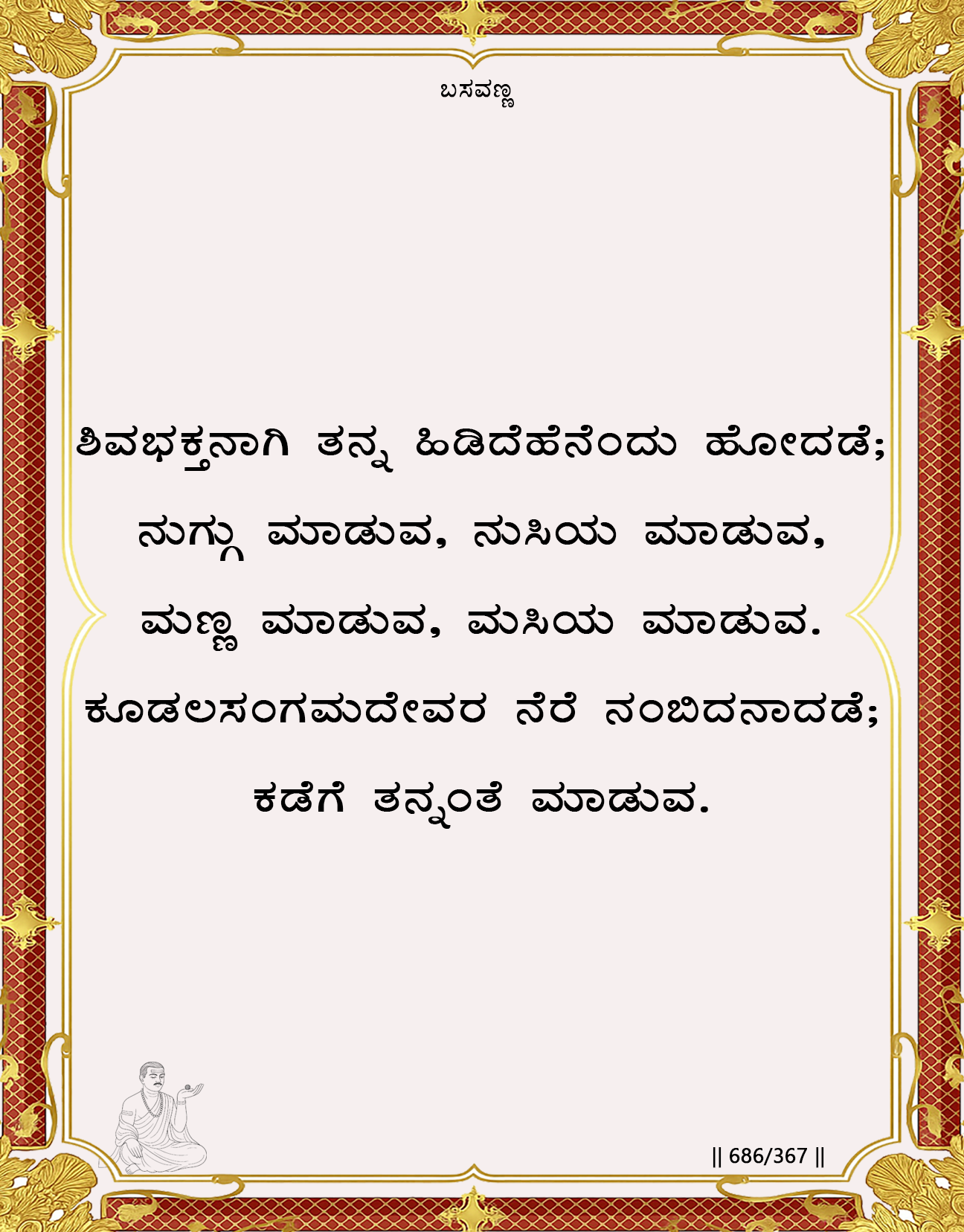
Poetic Rendering

If one claims to be Shiva’s devotee
yet thinks his journey is already complete,
let him know this
he will be struck down,
scraped, humbled,
his earth-born body reduced to dark ash.
For the one who boasts,
the world itself becomes the hammer.
But the one who truly seeks refuge
in Kudalasangamadeva
Him the Lord takes into His own hands,
chisels, shapes, smooths,
and brings forth a form
worthy of Himself.
In this vachana, Basavanna contrasts false self-certainty with true surrender. The person who claims to be a devotee and believes he has already reached the goal becomes spiritually rigid.
Such ego invites life itself to “hammer” him through suffering, humiliation, or the collapse of pride until the false structure crumbles like ash. But the one who humbly seeks refuge in Kudalasangama becomes clay in the divine sculptor’s hands. God Himself shapes such a seeker refining, carving, and polishing into a form that reflects divine consciousness. Core message: Spiritual pride makes one brittle; surrender makes one malleable. The ego builds itself, only to be broken; the devotee allows himself to be built by God, and thus becomes divine.
Spiritual Context
Core Spiritual Principle: Surrender as the Condition for True Formation. The human spirit cannot perfect itself through egoic effort; it can only prepare itself as receptive material for the divine artisan. Spiritual pride interrupts this process by declaring the work finished, forcing a destructive deconstruction.
Cosmic Reality Perspective (non-dual, Shiva-Shakti dynamics): Shiva is the pure, formless consciousness. Shakti is the formative power. The surrendered seeker allows Shakti to work unimpeded by egoic resistance, sculpting the individual form (Anga) into an expression of Shiva. The proud devotee, by claiming a finished form, attempts to freeze Shakti’s dynamic flow. The cosmos (Jagat), as an expression of Shakti, then acts as a hammer to break that rigidity, returning the individual to formlessness (ash) so the process can begin anew.
Historical Reality (Anubhava Mantapa context): In a community of intense spiritual fervor and social revolution, the danger of spiritual pride and claims of superiority would have been real. This vachana served as a vital check, reminding all Sharanas that their identity was one of perpetual becoming in God’s hands, not a badge of accomplishment. It fostered humility and continuous self-examination within the community.
Interpretation
1.”Claims to be Shiva’s devotee yet thinks his journey is already complete”: This is the sin of spiritual finality. It mistakes a stage for the destination and fossilizes the living process of Sadhana. In non-dual terms, it is the ego appropriating the state of Shiva (completion) for itself.
2.”Struck down, scraped, humbled… reduced to dark ash”: This is the inevitable Karmic and existential consequence. “Ash” (Bhasma) is symbolic. While sacred ash (Vibhuti) signifies the burning of impurities and the residue of divine essence, “dark ash” here signifies the burnt-out residue of ego, devoid of life or light. It is a reduction to inert matter.
3.”The world itself becomes the hammer”: The “world” (Samsara) is not merely an illusion but a field of intelligent force (Shakti). When one’s consciousness is out of alignment, this field ceases to be a supportive context and becomes an instrument of correction. Suffering, failure, and humiliation are this hammering action.
4.”The Lord takes into His own hands, chisels, shapes, smooths…”: This is the metaphysics of grace (Prasada). The divine acts not as a distant judge but as an intimate artisan. The tools (chisel, smoother) represent the specific, personalized experiences joys, sorrows, insights, relationships that refine the soul. The process is careful, intentional, and aimed at beauty (“worthy of Himself”).
Practical Implications: The spiritual task is to cultivate malleability and resist the inner voice that says, “I have arrived.” One must learn to distinguish between the confidence of faith and the arrogance of attainment. Every circumstance, especially difficult ones, should be met with the question: “Is this the hammer or the chisel? How can I surrender to its shaping power?”
The Cosmic Reality
Anga (Human Dimension): The raw material either a poorly fired, brittle pot of the ego’s own making, or soft, yielding clay. The quality of the material determines the process it undergoes. Linga (Divine Principle): The master sculptor whose vision and skill are perfect. The Linga is both the artist and the ideal image toward which the sculpture is shaped.
Jangama (Dynamic Interaction): The studio of life where the sculpting happens. It is the relational field where the divine artistry meets the human material. For the surrendered, it is a cooperative process; for the proud, it is a confrontational one.
Shata Sthala
Primary Sthala: Maheshwara (Great Lordliness). The warning is directly for one at this stage. The Maheshwara who begins to believe the “greatness” is their own achievement, rather than a manifestation of divine governance through them, commits the error described. True greatness is knowing one is eternally being shaped.
Supporting Sthala: Sharana (Total Surrender). The positive example is the essence of Sharana. To seek refuge is to consciously offer oneself as the clay, to relinquish control over the final form. This attitude is the safeguard against the Maheshwara’s pitfall.
Practical Integration
Arivu (Awareness Practices): Practice “The Clay Meditation.” In stillness, visualize your body and mind as a lump of clay in warm, skilled hands. Feel the pressure of shaping without resistance. In daily life, when challenged, recall this image: “I am being shaped now.”
Achara (Personal Discipline): Discipline yourself to actively distrust claims of spiritual completion. When you feel pride in a spiritual achievement, consciously offer it back to the sculptor with gratitude. Cultivate the language of “becoming” rather than “being” in your spiritual self-talk.
Kayaka (Sacred Action): Approach your work as the chisel’s stroke. Let difficulties in your craft be understood as precision shaping. Your labor is not you building your name, but the divine hands refining the instrument.
Dasoha (Communal Offering): In community, be a gentle reminder of the shaping process for others. Discourage boasts of attainment. Celebrate humility, vulnerability, and the shared joy of being works-in-progress. Create an environment where it is safe to be “unfinished.”
Modern Application
The Cult of Expertise and Spiritual Branding. In modern spirituality and wellness, there is immense pressure to position oneself as an expert, a guru, a “healed” or “enlightened” brand. Social media fuels this by rewarding the appearance of completion. This creates brittle spiritual identities that are highly susceptible to crisis when life inevitably challenges the perfect image.
Embrace the Identity of the Eternal Apprentice. Use this vachana to reject the pressure to be a finished product. Publicly and privately, embrace the identity of a lifelong learner, a piece of clay in the hands of mystery. When sharing spiritual insights, frame them as “what is shaping me right now” rather than “what I have mastered.” This builds authentic, resilient spirituality that can adapt and grow through all of life’s hammer-blows and chisel-strokes.
Essence
The one who builds a statue of himself
and calls it God’s work
will meet the earthquake.
The one who kneels,
offers his mud,
and feels the fingers in his ribs,
the thumb on his brow
he will rise
not as a maker,
but as a masterpiece,
bearing the fingerprints of light.
This vachana illustrates the metaphysical principle of entropy and negentropy in spiritual formation. The ego, through self-directed effort, creates a state of localized order (the “built” identity) but at the cost of increased systemic entropy it becomes a closed, rigid system disconnected from the divine negentropic flow (the sculptor’s creative intelligence). The “hammer” is the universe’s tendency to maximize entropy, breaking down the false structure. Surrender, however, opens the system to the negentropic influence of the divine, which imports information, pattern, and “form” into the individual, creating a localized increase of order (beauty, worthiness) that is in harmony with the whole.
Imagine two blocks of marble. One is hastily carved by an apprentice into a rigid, self-satisfied figure that he declares perfect. The master sculptor sees it as crude and out of harmony with the grand design; he must smash it to reclaim the stone. The other block is simply placed in the master’s studio. The master works on it for years, with patience and genius, until it becomes a figure of breathtaking beauty that fits perfectly in the cathedral. Basavanna says: don’t be the apprentice who wastes the stone. Be the stone in the master’s studio.
We are terrified of being seen as unfinished, imperfect, or not in control. We want to present a completed self to the world. This vachana speaks directly to that anxiety and reframes it: our dignity lies not in our finished state but in our willingness to be shaped by a higher intelligence. The deepest human longing is to be an object of care, intention, and artistry by a loving creator. This vachana says that longing is fulfilled not by building ourselves up, but by surrendering to the build. It replaces the exhausting burden of self-creation with the profound relief of being created.

Views: 4