Poetic Rendering

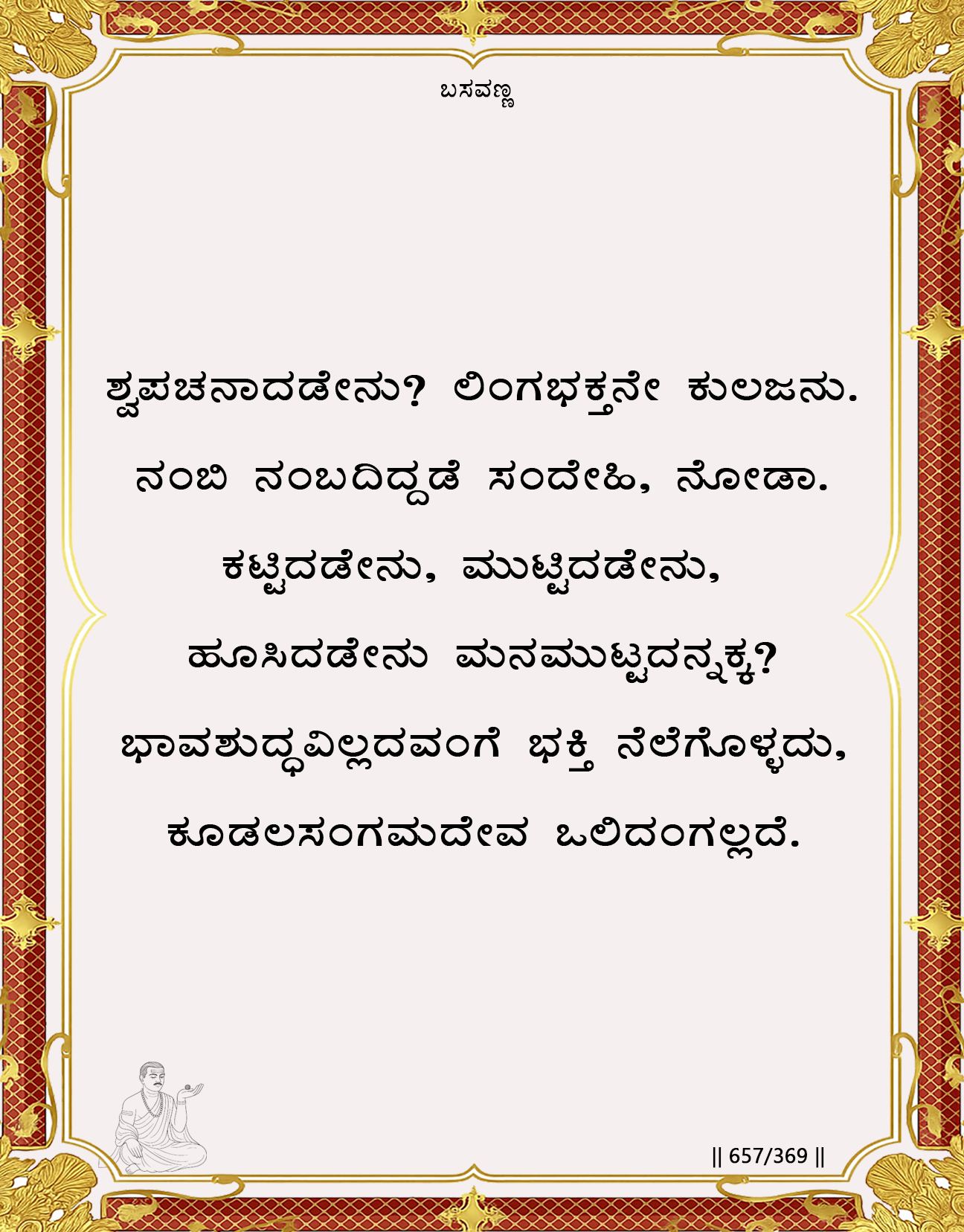
What if one is born in the lowest of castes,
shunned by the world as untouchable?
If he wears the Linga with steadfast devotion,
he is the true noble one
the radiant Bhakta of Shiva.
But if the mind wavers in doubt,
what worth is temple-building,
what meaning is there in touching stone idols,
what purity in ritual acts
if the heart itself remains untouched?
Unless the inner being is cleansed,
unless intention is washed with truth,
unless the mind stands firm in surrender
he is not yet a devotee.
Only when Kudalasangamadeva
bestows His grace
does one’s true caste shine from within.
Summary – Caste Transformed into Inner Purity This vachana dismantles social notions of caste and purity by grounding them in inner transformation rather than birth. Basavanna asserts that: Birth does not determine spiritual worth. Inner devotion, sincerity, and steadfastness in the Linga make a person truly noble and spiritually elevated. External acts building temples, touching idols, performing rituals are meaningless if the mind is impure or devotion unstable. Spiritual caste is a state of consciousness, not a social category. Ultimately, grace (prasada) from Kudalasangama sanctifies and completes the seeker’s transformation. The teaching is a radical affirmation that true dignity arises from wholehearted devotion, and that purity flowers not from lineage, but from the heart awakened in Shiva.
Spiritual Context
Core Spiritual Principle: Authenticity Precedes Action. The purity and steadfastness of the inner being (Antahkarana Shuddhi) is the sole determinant of spiritual efficacy and status. External conduct, whether social or ritual, derives its value and meaning solely from this inner reality.
Cosmic Reality Perspective (non-dual, Shiva-Shakti dynamics): In the non-dual reality, Shiva (Pure Consciousness) and Shakti (Dynamic Energy) are inseparable. Here, social hierarchies and ritual complexities are projections of a fragmented, dualistic mind. True worship is the alignment of individual consciousness (Shakti as the seeking mind) with the Divine Principle (Shiva as the Linga), resulting in a grace-dispensing union (Shiva-Shakti as Kudalasangamadeva) that dissolves all illusory divisions.
Historical Reality (Anubhava Mantapa context): This was a direct, public challenge to the orthodoxy of 12th-century Karnataka. It weaponized spirituality to dismantle social apartheid, asserting that a so-called “untouchable” with steadfast devotion was more spiritually elevated than a Brahmin with doubt. It redefined the community (Sangha) not by birth but by the shared inner qualification of sincere seeking.
Interpretation
1.”What if one is born in the lowest of castes…”: This immediately shifts the locus of identity from the physical body and its social tags (Deha and Jati) to the conscious soul (Anga).
2.”If he wears the Linga with steadfast devotion…”: “Wears” (dharisi) implies a permanent, internalized union, not a physical ornament. Steadfastness (nirantara) indicates a continuous, unbroken flow of consciousness toward the Divine, establishing a new, spiritual ontology.
3.”what worth is temple-building…”: External acts are revealed as inert (jada) if they are not expressions of an inward-turned, stable consciousness. The stone idol is symbolic of any religious form devoid of the animating spirit of devotion.
4.”Unless the inner being is cleansed…”: Cleansing (kalpisi) is an alchemical process of intention (ichche), not physical ablution. It is the preparation of the vessel (the human heart) to receive.
5.”Only when Kudalasangamadeva bestows His grace…”: This is the culmination. Grace is not a reward for effort but the spontaneous flowering of the Divine within the prepared heart. The “true caste” is the revealed, luminous nature of the soul itself.
Practical Implications: It demands a radical audit of one’s spiritual life: Are my practices authentic expressions of my heart, or are they social performances? It invalidates religious arrogance based on ritual proficiency or lineage. The seeker’s primary work shifts from external doing to internal being and attunement.
The Cosmic Reality
Anga (Human Dimension): The human condition is characterized by two possibilities: the bondage of wavering doubt (sandeha) rooted in external identification, or the freedom of unwavering faith (nishtha) rooted in internal connection. The Anga is the field where this battle is fought.
Linga (Divine Principle): The Linga is the unwavering, absolute pole of consciousness. It is the constant against which the mind’s steadfastness is measured. It is also the source of the grace that resolves the dichotomy, as Kudalasangamadeva.
Jangama (Dynamic Interaction): The Jangama is the critical movement from external ritual (building temples) to internal worship (steadfast wearing of the Linga). It is the dynamic process of the mind becoming still and one-pointed, which in turn invites the descending dynamic of grace, culminating in the sacred union (Sangama) that re-creates the individual.
Shata Sthala
Primary Sthala: Prasadi. This is the definitive stage articulated. The seeker stands in a state of reception, where all self-generated merit from birth or action is nullified. Their true identity the “radiant Bhakta” is bestowed by grace, marking a transition from the practice of devotion to the state of being a divine expression.
Supporting Sthala: Bhakta. The steadfast wearing of the Linga is the characteristic discipline of the Bhakta stage. However, Basavanna shows that even this steadfastness is not a personal achievement but the fertile ground prepared for the seed of grace. Thus, Bhakta is the necessary antecedent to Prasadi.
Practical Integration
Arivu (Awareness Practices): Cultivate constant self-inquiry: “Is my mind steady on the Linga, or is it wavering toward social approval, ritual correctness, or doubt?” Watch the tendency to derive spiritual status from external acts.
Achara (Personal Discipline): The core discipline (Achara) is nirantara linga dharanethe unbroken remembrance of the Divine Principle. This replaces reliance on periodic rituals or pilgrimages as primary spiritual anchors.
Kayaka (Sacred Action): All work, including temple-building or ritual performance, must be reconsecrated as Kayaka only if it flows from and is sustained by that inner steadfastness. Otherwise, it is mere labor.
Dasoha (Communal Offering): The greatest Dasoha is to uphold and radiate this truth that inner devotion transcends all birth-based hierarchy thereby creating a community (Sangha) based on shared spiritual integrity, not shared social rank.
Modern Application
The pervasive “performance of authenticity” where identity and worth are curated through social media, professional titles, consumer choices, or even spiritual branding. This creates deep existential insecurity, as worth is contingent on external validation and comparison, leading to anxiety, tribalism, and inner fragmentation.
This vachana offers liberation from the “identity marketplace.” It instructs us to anchor our worth not in any constructed identity (national, racial, professional, or even religious) but in the steadfast quality of our connection to our own deepest principle (the Linga). It frees us to perform actions without being attached to the social caste they might assign us.
Essence
Born low, born high the world’s script is a lie.
The only lineage runs from a steady heart to the sky.
Temples of stone, rites performed alone,
Are dust in the wind if the mind has flown.
But wear the Light with unwavering thread,
Till grace descends and all false self is dead.
Then behold your caste: a soul, awake, widespread.
This vachana operates on the metaphysical principle of inversion and reconstitution. It inverts the worldly value system (birth/action -status) and reconstitutes it in the consciousness dimension (steadfastness/grace -being). It maps the quantum leap from the probability cloud of social identities (all possible “castes”) to the collapsed wavefunction of the true, grace-revealed self.
Imagine two radios. One is ornate, gold-plated, and built in a famous temple, but its internal receiver is broken. The other is plain, made of simple materials, and built in a hut, but its tuner is perfectly locked onto the transmission frequency. The second radio alone delivers the music. Your birth and rituals are the casing; your steadfast devotion is the tuned receiver; the music is grace.
Every human psyche seeks an unshakable ground of dignity beyond the accidents of circumstance. We fear that without our achievements, titles, or affiliations, we are nothing. This vachana reveals that our fundamental dignity is not earned or bestowed by society, but accessed and realized through single-pointed, sincere connection to the Source. It is the truth that frees us from the exhausting performance of being someone, allowing us to simply be in devotion.

Views: 5