Poetic Rendering

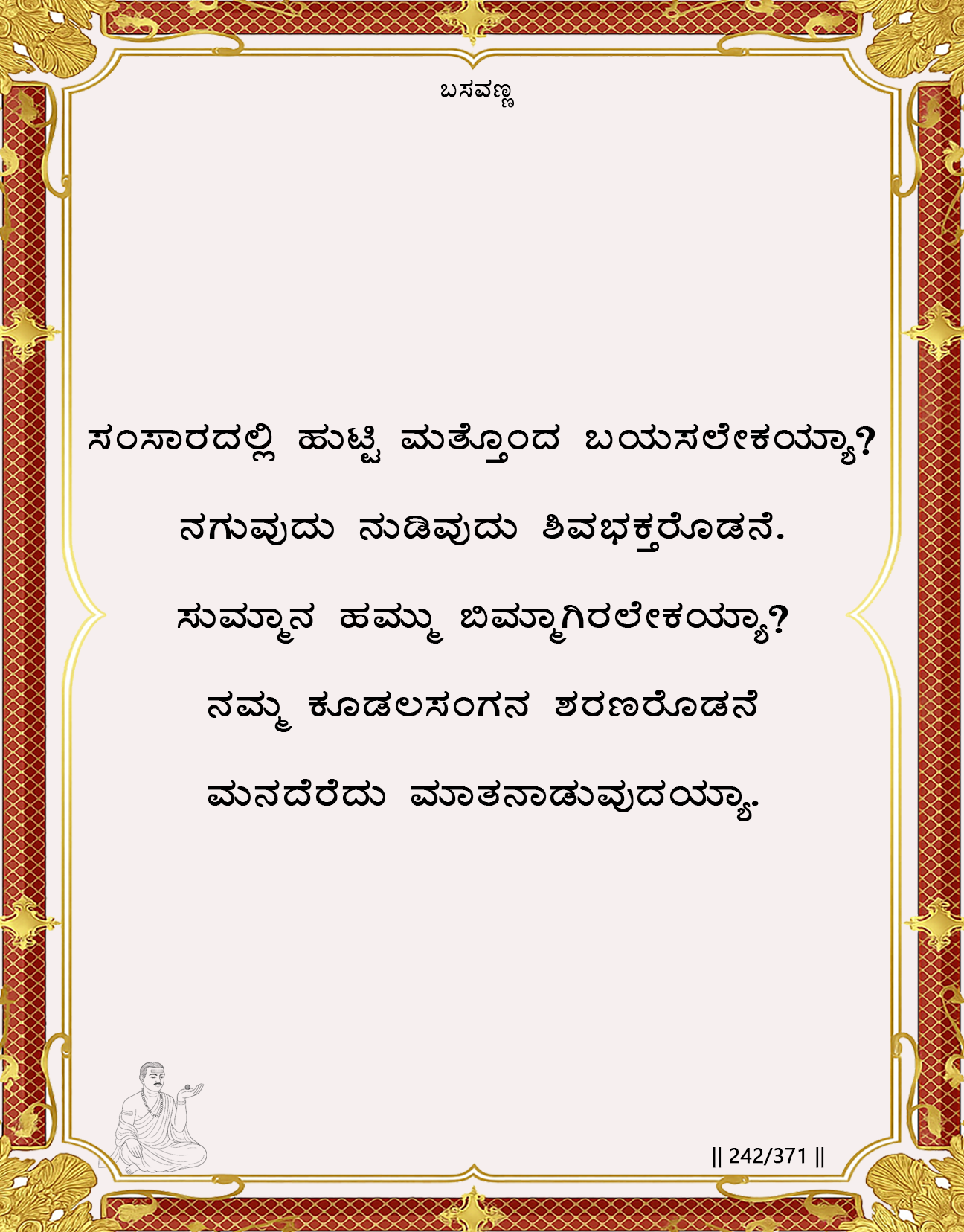
Why take birth in this passing world
only to gather and guard
what slips through our fingers again and again?
What value is there in such a life?
Far better to sit, to laugh, to speak openly
with the true Sharanas of Shiva
to cast off pride, crookedness, and hidden motives,
and live in the simplicity of a cleansed heart.
For what is life worth
without this sacred companionship,
without the speech made pure
in the company of the awakened?
O Kudalasangama,
grant me the grace of words
that flow honest and free
among Your devotees.
This vachana reveals Basavanna’s radical revaluation of what constitutes wealth, meaning, and purpose. He contrasts two economies: 1. The Economy of Samsara A cycle of endless gaining and losing, Driven by fear, attachment, and false pride, Ultimately leading to exhaustion and emptiness. Basavanna calls this a futile way to spend one’s birth. 2. The Economy of Awakening The priceless treasure of satsanga company of realized Sharanas. A space where: pride dissolves, crookedness falls away, speech becomes pure, and the heart becomes transparent to truth.
He teaches that true spiritual transformation does not occur in isolation but in the presence of awakened beings whose very company reshapes one’s consciousness. Thus, the real wealth of life is not property or status, but open-hearted communion with the devotees of Shiva, a field of grace where the soul matures and aligns with Kudalasangamadeva.
Spiritual Context
Core Spiritual Principle: Awakening is Relational. The transformation of consciousness from egoic isolation (ahamkara) to liberated unity (aikya) is catalyzed and sustained within the crucible of authentic spiritual community (satsanga). The self is mirrored, polished, and ultimately dissolved in the company of the awakened.
Cosmic Reality Perspective (non-dual, Shiva-Shakti dynamics): In non-duality, the One (Shiva) expresses as the Many (Shakti as the world and beings). To seek the One in isolation from the Many is a contradiction. Satsanga is the practical recognition of this truth: the Divine (Linga) is most accessible and dynamically active (Jangama) in the communion of hearts turned toward it. The “laughter and speech” among Sharanas is the playful, creative expression (Shakti) of the shared silent awareness (Shiva).
Historical Reality (Anubhava Mantapa context): This vachana is the social blueprint for the Anubhava Mantapa. It defines the revolutionary “wealth” of the community: not land or ritual authority, but the quality of relational truth among its members. It explicitly counters the caste-bound, hierarchical, and often secretive religious societies of the time with a model based on open-hearted egalitarian fellowship.
Interpretation
1.“Why take birth… only to gather and guard what slips through our fingers?”: This questions the foundational logic of samsara. “Gather and guard” identifies the twin actions of desire and fear that fuel the ego-economy. “Slips through our fingers” acknowledges the metaphysical law of impermanence (anitya) that ensures this economy’s ultimate bankruptcy.
2.“Far better to sit, to laugh, to speak openly with the true Sharanas…”: “Sit” implies equality and presence. “Laugh” signifies the joy and lightness that come when the burden of egoic accumulation is dropped. “Speak openly” (nillidamme) is the keyit means speech without a hidden, selfish agenda (arivu), where language becomes a transparent vehicle for truth, not manipulation.
3.“to cast off pride, crookedness, and hidden motives…”: These are the specific “transaction costs” of the ego-economy. Pride (ahamkara) is the internal currency of separation. Crookedness (kautilya) is the transactional deceit. Their abandonment is not austerity but the necessary divestment to enter the new economy.
4.“O Kudalasangama, grant me the grace of words…”: The culmination is a prayer for grace, not for material or even solitary spiritual gain. The desired grace is the capacity for relational authenticity the ability to let words flow from the unified source (Kudalasangama) rather than from the calculating, separate self.
Practical Implications: It forces a prioritization: invest time and heart in authentic spiritual community. It redefines spiritual practice to include the conscious cultivation of truthful, ego-free communication. It warns that solitary asceticism or scholarship, if devoid of this relational component, may simply be another form of hoarding (spiritual capital).
The Cosmic Reality
Anga (Human Dimension): The Anga is an entity capable of two postures: contraction (around “my” possessions and status) or expansion (into “our” shared truth). Its fundamental choice is between these two orientations, which determine its entire experience of reality.
Linga (Divine Principle): The Linga is the gravitational center that pulls individuals out of their isolated orbits and into a shared constellation. It is the “true” in “true Sharanas” the authentic divine anchor that validates and purifies their communion, preventing it from devolving into mere socializing.
Jangama (Dynamic Flow): The Jangama is the living circuit of grace established in satsanga. It is the flow of “open-hearted speech” and shared laughter. This dynamic interaction is where the Linga becomes actively manifest; it is not just discussed but performed in relationship, making the community itself a Jangama.
Shata Sthala
Primary Sthala: Sharana. The vachana is a manifesto for the Sharana stage. The Sharana’s life is defined by this “economy of awakening.” Their practice is the cultivation of this sacred companionship and the embodiment of open-heartedness. The prayer is the Sharana’s prayer for the perfect expression of their state.
Supporting Sthala: Aikya. The state of Aikya (non-dual unity) is the implicit goal and the natural atmosphere of perfect satsanga. When Sharanas meet without any pride or crookedness, the boundaries between Anga and Anga soften, reflecting the ultimate unity of all Angas in the Linga. Thus, satsanga is both the practice of the Sharana and the gateway to Aikya.
Practical Integration
Arivu (Awareness Practices): Practice noticing when your speech or actions are motivated by the “gather and guard” economy (seeking approval, proving worth, hiding vulnerability) versus the “open-hearted” economy (sharing truth, expressing joy, offering connection).
Achara (Personal Discipline): Make it a discipline to regularly engage in satsangato seek out and prioritize time with those who inspire authenticity and reflect your highest self. Consciously drop “pride and crookedness” as prerequisites for entry.
Kayaka (Sacred Action): View your work as an offering that sustains not just you but the community of seekers. Let your labor contribute to creating and holding spaces where open-hearted fellowship can flourish.
Dasoha (Communal Offering): Your greatest dasoha is your authentic self offered in relationship. Offer your listening, your truthful speech, and your joyful presence to the community. Protect the relational space from gossip, judgment, and egoic competition.
Modern Application
“Transactional Relating” and “Spiritual Isolation.” We live in a hyper-transactional world where even relationships can become calculated for social capital, networking, or emotional gratification. Concurrently, modern spirituality is often commodified and consumed individually (apps, online courses), leading to profound isolation despite connectivity. This creates loneliness amidst crowds and a hunger for genuine communion.
This vachana liberates us from the poverty of transactional living. It invites us to found our lives on the “economy of awakening” to invest in small, intentional communities of truth (digital or physical) where we practice showing up without pretense. It transforms networking into satsanga, and communication from broadcasting a persona to sharing from the heart. The true social media becomes the community of Sharanas.
Essence
To be born, to clutch dust, to mourn its flight
Is this the purpose of the soul’s brief light?
No. Let the gathered gold of men depart.
True wealth is laughter from a naked heart,
A word uncurled from any hidden art,
Spoken in the circle where all selves unbind.
This is the fortune that the wise seek out:
The priceless, shared awakening of the mind.
This vachana reveals the holographic principle of spiritual community. In genuine satsanga, each individual (Anga) is not just a separate unit but a focal point containing and reflecting the whole (Linga). The “open-hearted speech” is the information exchange that maintains the coherence of this holographic field. The community itself becomes a macroscopic Jangamaa unified, dynamic expression of the divine, where the transformation of any part resonates through and uplifts the whole.
Imagine two types of gardens. In one, each plant is in its own isolated pot, competing for the best spot on the shelf, needing individual care. In the other, plants grow together in open soil, sharing nutrients through a fungal network, sheltering each other, creating a shared microclimate that helps all thrive. The first is the economy of isolation; the second is the economy of awakening. The Sharanas are the forest, not the potted plants.
We are inherently relational beings who wither in isolation and flourish in authentic connection. Our deepest fear is not lack of material wealth, but existential loneliness the terror that no one sees or knows our true self. This vachana addresses that core fear by asserting that the very purpose of life is to find and co-create spaces where we can be truly seen, known, and accepted in our essence, and that in doing so, we participate in the divine itself. It teaches that we save our souls not alone, but together.

Views: 16