Poetic Rendering

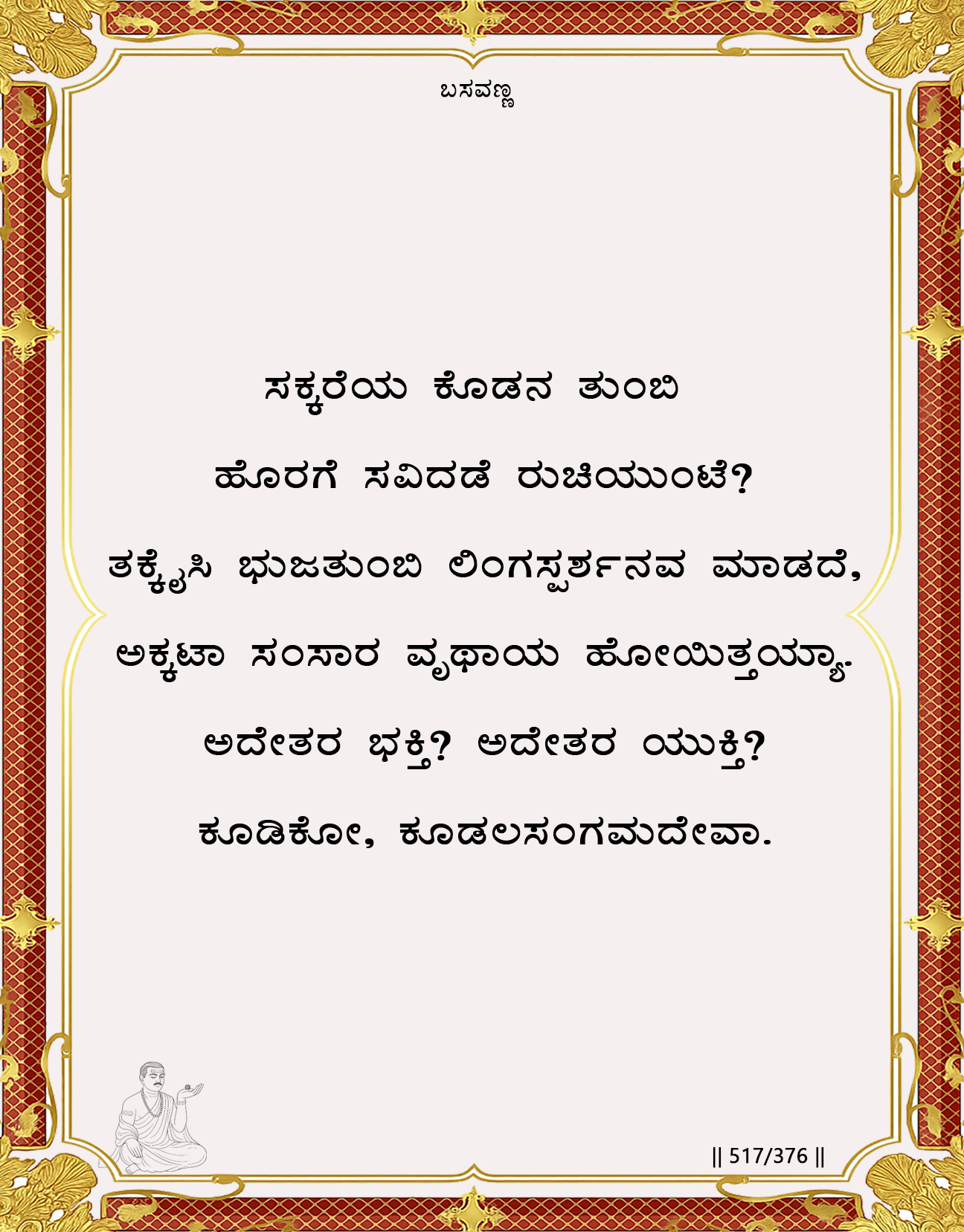
What use is a pot brimming with sugar
if the tongue never tastes its sweetness?
In the same way,
if the arm does not clasp the Linga close in living worship
if devotion is only thought, only talk
then this vast journey of worldly life
turns dry and bitter on the tongue.
What other worship is there?
What other wisdom can surpass this?
Draw me in,
O Kudalasangama
let me taste You,
not just look at Your name.
SummaryThe Untasted Sugar: From Idea to Embodied Realization This vachana reveals one of Basavanna’s most important spiritual principles: truth must be tasted, not merely admired. Just as a pot of sugar is meaningless when left untouched, so too is a life filled with philosophical discussion, scriptural learning, or ritual performance without direct union with the Divine. Basavanna exposes the central trap of spiritual life: Knowing about the truth is not the same as knowing the truth. Here: Knowledge without experience is bitter. Devotion without intimacy is hollow. Worship without embodiment is empty motion. The Linga is not meant to be observed from a distance it is meant to be held, touched, embraced, lived, so that the seeker dissolves into the sweetness of realization. In saying, “Take me in, O Kudalasangama,” Basavanna expresses the longing for the flavor of direct experience where the boundary between worshipper and worship melts, and truth is tasted with the whole being. This vachana is a call to move from: theory to taste, symbol to experience, admiration to absorption, knowing to becoming. Here lies the heart of Basavanna’s path: Realization is not a concept. It is a flavor, a sweetness, a direct experience of the Divine.
Spiritual Context
Core Spiritual Principle: Realization is a Sensory Event of Consciousness. Truth (satya) must be realized as flavor (rasa). Spiritual maturity is measured not by the breadth of knowledge but by the depth of assimilation. The Divine is to be known as one knows sweetnessimmediately, non-conceptually, and transformatively.
Cosmic Reality Perspective (non-dual, Shiva-Shakti dynamics): The pot of sugar is Shakti as the manifest universe and the human body-mind the container of divine potential. The sweetness is Shiva, the pure essence. The separation between pot and sweetness is maya. The act of tasting is the recognition of non-difference: the substance (sugar/Shiva) and the experience of it (sweetness/Ananda) are one. “Drawing in” to Kudalasangama is the dissolution of the subject-object division in the act of tasting itself.
Historical Reality (Anubhava Mantapa context): This was a direct challenge to the scholastic Brahminical tradition, which prioritized scriptural mastery (jnana) and ritual precision (kriya) often divorced from transformative personal experience. It defined the Lingayoga path as fundamentally empirical and experimental path of direct tasting (anubhava). The Anubhava Mantapa itself was to be a community where truth was shared as a common, tasted experience, not debated as an abstraction.
Interpretation
1.”What use is a pot brimming with sugar if the tongue never tastes its sweetness?”: This establishes the central epistemological point: utility and value lie in function and experience, not in possession or proximity. The “tongue” represents the organ of direct experience (anubhava indriya), beyond the eyes of intellect.
2.”if the arm does not clasp the Linga close in living worshipif devotion is only thought, only talk…”: “Arm” symbolizes capacity for action and embrace. “Clasping close” implies intimacy, unity, and internalization. Basavanna distinguishes between devotion as a mental or verbal activity (bhavana or katha) and devotion as an embodied state of union (aikya).
3.”then this vast journey of worldly life turns dry and bitter on the tongue.”: This is the karmic consequence. Without the foundational sweetness of direct divine experience, all other experiences pleasure and pain lack a unifying context of meaning and become ultimately unsatisfactory (duhkha), leaving a bitter aftertaste.
4.”What other worship is there? What other wisdom can surpass this?”: These are not questions but definitive statements. They declare all other practices preparatory and all other knowledge provisional. The summit of spiritual endeavor is this direct tasting.
5.”Draw me in, O Kudalasangamalet me taste You…”: The final plea is for grace to complete the process. The seeker actively strives (“clasp the Linga”), but the final dissolution into the tasted reality is an act of gracebeing “drawn in.” The taster becomes the taste.
The Cosmic Reality
Anga (Human Dimension): The Anga is the tongue of consciousness. Its fundamental purpose is to taste. When it tastes only worldly phenomena, it knows bitterness. Its destiny is to discover its capacity to taste the fundamental sweetness (the Linga) underlying all phenomena.
Linga (Divine Principle): The Linga is the sweetness (madhurya). It is not just an object that has sweetness; it is sweetness itself as a metaphysical principle the essential quality of divine reality that is bliss (ananda).
Jangama (Dynamic Flow): The Jangama is the process of degustation. It is the flowing of attention from the form of the pot to the essence of the sugar, from the symbol of the Linga to the reality it signifies. It is the dynamic act of worship that bridges the gap and allows the essence to transfer into the being of the worshipper.
Shata Sthala
Primary Sthala: Pranalingi. The vachana’s core imperative to internalize the divine as one’s very sustenance is the definition of Pranalingi. The Linga has moved from the hand to the heart, and from the heart to every cell as the nourishing essence. “Tasting” is the continuous experience of this state.
Supporting Sthala: Aikya. The final plea, “Draw me in,” points toward Aikya. In perfect tasting, the distinction between the taster, the act of tasting, and the sweetness collapses. The sugar assimilates into the body; the Divine assimilates the devotee. This is non-dual union.
Practical Integration
Arivu (Awareness Practices): In meditation or daily life, shift from thinking about awareness to tasting awareness itself. Inquire: “What is the flavor of my consciousness right now? Can I taste the silent presence behind my thoughts?” Seek the sweetness of pure being.
Achara (Personal Discipline): Transform ritual worship (puja) from an external procedure to an exercise in sacred tasting. When offering water, food, or light to the Ishtalinga, do it with the intention of inwardly tasting the divine qualities they representpurity, nourishment, illumination.
Kayaka (Sacred Action): Imbue your work with the question: “Can I taste the sacred in this activity?” Find the “sweetness” or intrinsic meaning in the labor itself, not just in its result. Let work be a channel to taste the creativity and intelligence of the divine.
Dasoha (Communal Offering): Share spiritual fellowship not as an exchange of ideas but as a sharing of “taste.” Speak from direct experience. Create spaces (like the Anubhava Mantapa) where the primary currency is authentic, tasted realization, not doctrinal argument.
Modern Application
“Spiritual Consumerism and Information Gluttony.” We collect spiritual teachings, podcasts, and workshops like pots of sugar, filling our libraries but never sitting down to taste. We confuse data with nourishment, leading to bloated minds and starved souls. We prefer the safety of analyzing the menu to the risk and commitment of the meal.
This vachana liberates us from the endless accumulation of spiritual content. It commands: Stop collecting pots. Start tasting. Choose one simple practice (like Istalinga dharane) and commit to it not as a task but as a tasting. Prioritize depth of experience over breadth of knowledge. In a world of endless spiritual options, it advocates for a monasticism of the heart: a deep, committed relationship with one truth, tasted to its core.
Essence
A thousand pots of crystal sugar, white and deep,
Are just a burden for the eyes, if the tongue’s asleep.
For thought is but the sight, and talk the empty sound,
Of a sweetness that is never found.
Let mind be still, let concept cease its art,
And draw the essence deep into the heart.
One taste of That, and you will truly know:
All other wisdom is a shadow-show.
This vachana illustrates the epistemological shift from representational to participatory knowing. Representational knowledge (seeing the pot) treats reality as an object separate from the knower, mediated by symbols and concepts. Participatory knowledge (tasting the sugar) is unmediated, immediate, and transformative it alters the knower by incorporating the known. Basavanna asserts that the Divine can only be known participatorily; any representational knowledge of it is, by definition, incomplete and ultimately bitter.
Imagine studying the chemical formula, cultural history, and agricultural process of honey. You become an expert on honey. But until you put it on your tongue, you do not know honey. You know about it. Spirituality as information is knowing the formula. Spirituality as realization is tasting the honey. Basavanna says your life will remain bitter until you stop being a librarian of honey-books and become a bee.
We are wired for experience, not just information. Our deepest satisfaction comes not from understanding love theoretically but from feeling it; not from reading about beauty but from seeing it. This vachana applies this to the ultimate object: the Divine. It recognizes our spiritual dissatisfaction as a symptom of living on descriptions of food while starving for the meal. It points to the only cure: to close the eyes of the mind and open the mouth of the soul, and to be fed by the reality we have spent our lives reading about. The sweetness we seek is not a metaphor; it is the very nature of consciousness when it tastes its own source.

Views: 4