

Summary
Basavanna asks what is gained by reading about dual and non-dual if such reading does not become inner transformation. The issue is not the vocabulary of doctrine, but the failure of doctrine to melt separation within the seeker.
He then gives two necessary measures. First, the Sharanas must melt within. Their presence, word, and way of living must enter the heart, not remain outside as admiration or discussion. Second, Sthavara and Jangama must be known as one. The fixed Linga and the moving living presence cannot remain divided in the seeker’s vision.
Without this inward melting and this recognition of unity, words become only a garland. They may be arranged beautifully, but they do not transform. The Aikya source states that the “garland of words” signifies accumulated doctrine without realization, and that reading of dual and non-dual remains incomplete until Sharana-presence enters as lived transformation and Sthavara-Jangama are known as one.
Imagery & Symbolic Relevance
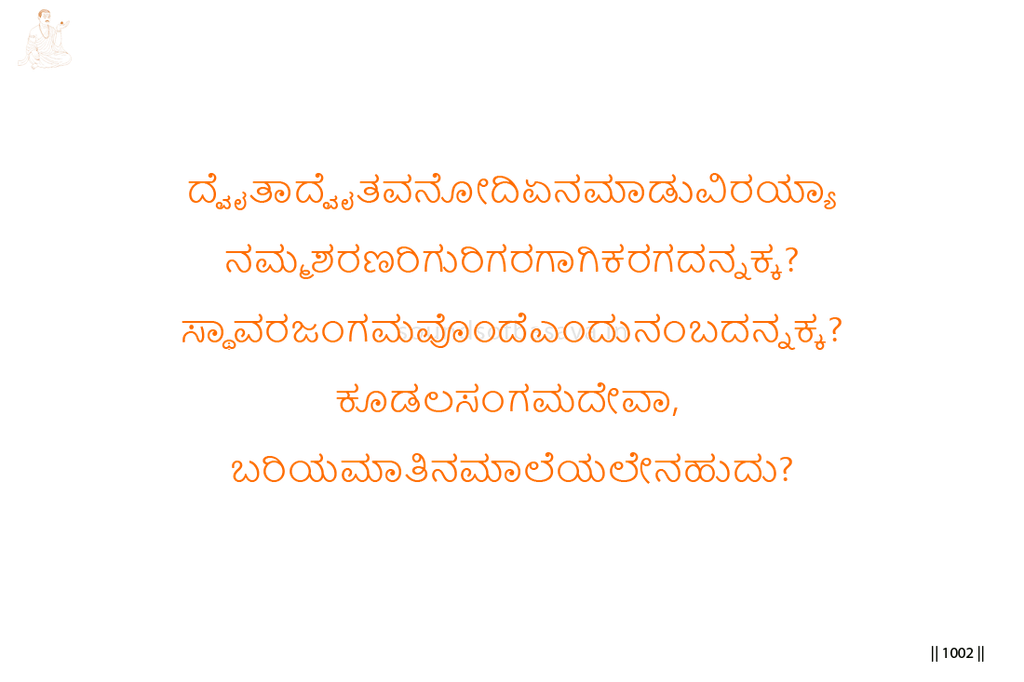
The opening question, “What will you do by reading of dual and non-dual?” gives the first movement of the vachana. Basavanna does not begin by praising learning. He tests its fruit. If reading does not dissolve division, it remains unfinished.
The terms “dual” and “non-dual” represent spiritual categories and doctrinal understanding. Basavanna does not reject them as words. He asks what they accomplish when they remain only read, discussed, or repeated.
The line about “our Sharanas melting within” gives the first true requirement. The Sharana must not remain outside the seeker as an object of praise. The Sharana’s truth must enter inwardly and soften the self that still stands apart.
The word “melting” is important. It suggests that hardness must dissolve. Spiritual speech cannot remain hard, separate, and self-protective. The presence of the Sharanas must enter deeply enough to change the inner condition.
The line about believing Sthavara and Jangama to be one gives the second requirement. Sthavara is the fixed sacred presence; Jangama is the moving sacred presence. If these are held apart, the seeker’s seeing remains divided.
This continues the teaching of the previous vachana. In Vachana 187, Basavanna says to look at the Jangama, for the Linga is present within Jangama, and that Sthavara and Jangama are one. Vachana 191 now tests whether that teaching has become lived conviction, not merely spoken doctrine.
The final image is the “garland of empty words.” A garland is arranged and displayed, but if made only of words without realization, it remains ornamental. Basavanna’s question is severe: what use is such a garland before Kudalasangama Deva?
Together, the lines show the difference between doctrinal speech and lived recognition. Dual and non-dual may be read; Sharanas may be praised; Sthavara and Jangama may be discussed. But unless the self melts and division ends in seeing, the words remain empty.
Lingayoga
In Lingayoga, this vachana teaches that sacred understanding must become lived transformation. The seeker should not substitute reading, terminology, or doctrinal correctness for inward melting.
The practice-point is direct: let the word of the Sharanas enter the heart. Let Sthavara and Jangama be recognized without division. Let speech become lived seeing.
The source states that conceptual study alone cannot dissolve division, and that realization must become direct seeing. Therefore the seeker must examine whether spiritual language has softened the self or merely decorated it.
Editorial Commentary
This vachana should not be read as a rejection of study. Basavanna is not dismissing the language of dual and non-dual. He is rejecting study that does not transform.
The strongest image is the garland of empty words. Words may be many, refined, and sacred in appearance, yet still empty if the Sharanas have not melted within and if Sthavara and Jangama are not known as one.
Related Vachana
Supporting Vachana
Sharana Sthala Vachana 1216 — The Alchemy of Integrity
Sharana Vachana 1216 supports this Aikya vachana by insisting that speech must be lived. It teaches that one must speak only what can be lived, and then live according to what has been spoken. Sacred language must not outrun conduct, because Kudalasangama Deva does not receive divided living as truth.
Aikya Vachana 191 carries this same concern into the field of doctrine. In Sharana Vachana 1216, the gap between word and walk must close. In Aikya Vachana 191, even the reading of dual and non-dual becomes useless if it does not melt the self through Sharana-presence and bring the seeker to recognize Sthavara and Jangama as one.
Advancing Vachana
Aikya Sthala Vachana 1235 — The Symphony of the Integrated Self
Aikya Vachana 1235 advances this teaching within Aikya Sthala. In Vachana 191, Basavanna warns that doctrine without inward melting becomes only a garland of empty words. In Vachana 1235, the integration becomes explicit: conduct must reveal the beauty of speech, and speech must reveal the beauty of conduct. The source also warns that people may hide inner fragmentation beneath spiritual language and divine appearance.
Thus Vachana 191 exposes empty doctrinal speech, while Vachana 1235 shows the fulfilled state where speech and conduct reveal one another. The garland of empty words gives way to integrated living before Kudalasangama Deva.
