

Summary
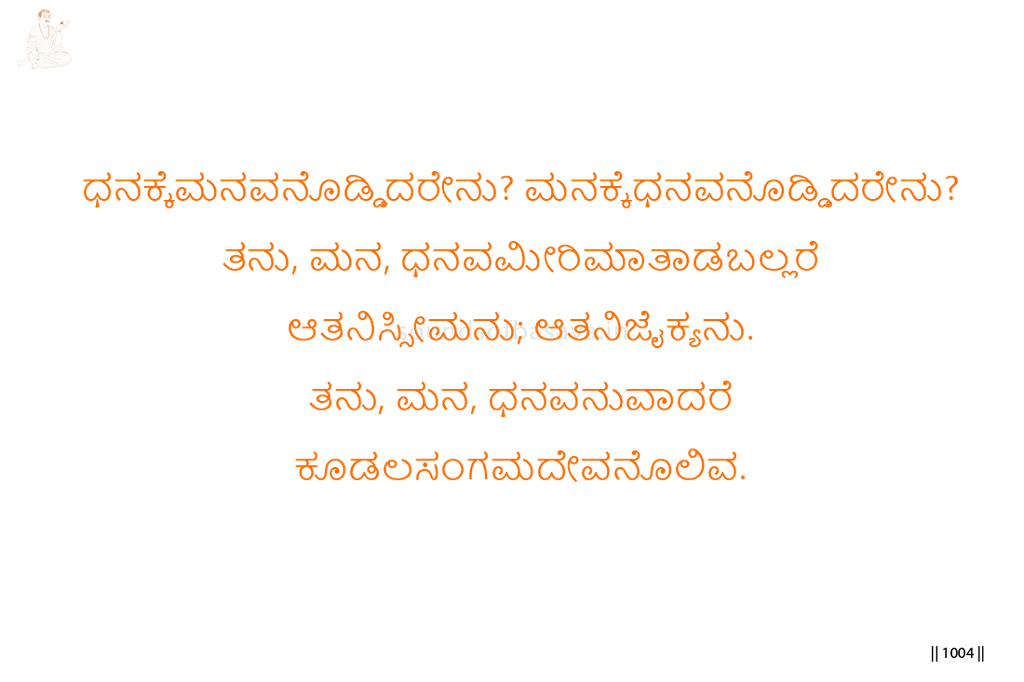
Basavanna questions two forms of misalignment: the mind being given over to wealth, and wealth being placed before the mind. In either case, one part of life begins to dominate another.
He then gives the true measure. The one who can speak after crossing body, mind, and wealth is boundless and is the true one in Aikya. The source explains that this crossing is not rejection of body, mind, and wealth, but crossing beyond identification with them.
The final line gives the positive state: when body, mind, and wealth stand in rightful harmony, Kudalasangama Deva abides there. The teaching is not anti-worldly rejection, nor attachment to possessions, but ordered integration where none of the three enslaves the other.
Imagery & Symbolic Relevance
The first question asks: what comes from placing the mind before wealth, or giving the mind over to wealth? This is the condition where the mind becomes occupied by possession, gain, preservation, or anxiety. Wealth then becomes a center that commands thought.
The second question asks: what comes from placing wealth before the mind? This reverses the same disorder. Wealth may appear to serve the mind, but if it becomes the means by which the mind seeks importance, comfort, or control, the division remains.
The two questions together expose misplaced submission. Basavanna does not condemn wealth by itself, nor the mind by itself. He questions the disorder in which mind and wealth begin to rule one another.
The phrase “crossing body, mind, and wealth” gives the turning point. Body, mind, and wealth are the practical field of embodied life. To cross them does not mean to destroy or abandon them. The source states that crossing means transcending identification with them.
The one who can speak after such crossing is called boundless. Boundlessness here does not come from possessing more. It comes from no longer being limited by body-claim, mind-claim, or wealth-claim.
The phrase “true Aikya” gives the inner measure of the vachana. Aikya is not merely spoken as an idea. It is shown when these three no longer define the self or divide life into competing claims.
The final line says that when body, mind, and wealth are in rightful harmony, Kudalasangama Deva abides there. Harmony is therefore the positive condition. The three are not denied; they are rightly placed.
Together, the lines move from disorder to crossing, and from crossing to harmony. The mind must not be enslaved by wealth; wealth must not become the mind’s master; body, mind, and wealth must not remain self-identities. When they are rightly ordered, they become transparent to Kudalasangama Deva’s abiding presence.
Lingayoga
In Lingayoga, this vachana teaches the seeker to examine the relation between body, mind, and wealth. The question is not whether one has a body, mind, or wealth, but whether one is identified with them or ruled by their imbalance.
The practice-point is direct: do not let wealth govern the mind, and do not let the mind use wealth as its false center. Let body, mind, and wealth stand in rightful proportion before Kudalasangama Deva.
The source states that the goal is not to reject any of the three, but to bring them into harmony, cross beyond identification with them, and let the Divine abide in that harmony.
Editorial Commentary
This vachana should be read as a teaching on integration, not as a command to despise the world. Basavanna’s correction is precise: body, mind, and wealth become dangerous when any one becomes the center of identity or domination.
The last line must govern the reading. Kudalasangama Deva abides not in imbalance, not in possession, not in rejection, but where body, mind, and wealth have been crossed as false identities and brought into rightful harmony.
Related Vachana
Supporting Vachana
Sharana Sthala Vachana 896 — The Refusal of the Illusion of Possession
Sharana Vachana 896 supports this Aikya vachana by refusing ownership-language around body, mind, and wealth. There, body, mind, and wealth are seen as a mirror in which the illusion of “mine” and “Yours” arises, and Basavanna asks not to leave Kudalasangama Deva’s sacred feet.
Aikya Vachana 216 carries this concern forward. In Sharana Vachana 896, the illusion of ownership around body, mind, and wealth is refused. In Aikya Vachana 216, these three are not merely refused as possessions; they are crossed as identities and brought into rightful harmony where Kudalasangama Deva abides.
Advancing Vachana
Aikya Sthala Vachana 955 — The Self-Luminous Beyond All Acts
Aikya Vachana 955 advances this teaching within Aikya Sthala. In Vachana 216, body, mind, and wealth are crossed and harmonized so that Kudalasangama Deva may abide there. In Vachana 955, Basavanna moves beyond gain and loss, giving and taking, action and measure, and all frameworks through which consciousness counts or defines itself.
Thus Vachana 216 establishes rightful harmony in the practical field of body, mind, and wealth, while Vachana 955 shows the deeper radiance beyond all such measurable categories. What is harmonized in Vachana 216 is transcended in Vachana 955 as self-luminous presence before Kudalasangama Deva.
