Poetic Rendering

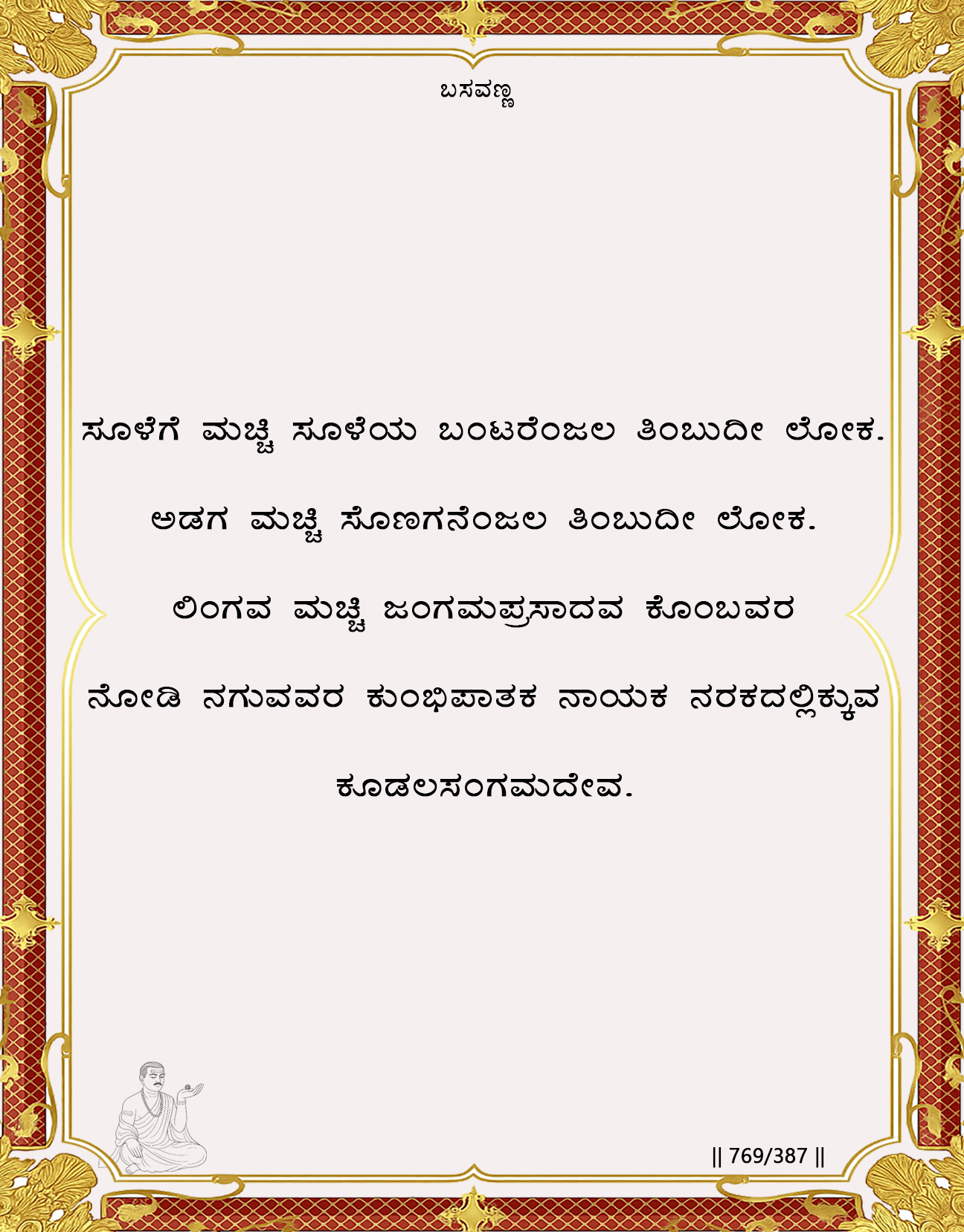
The courtesan conceals her sin,
yet those who cling to her
share in her hidden feast.
The thief conceals his theft,
yet the greedy who follow him
share in his secret feast.
But those who receive the Jangama’s sacred prasada
with hearts anchored in the Linga
they feast in the open light, free of shame.
And those who scorn such purity,
who mock this holy offering
they cast themselves
into the darkest abyss,
says Kudalasangama.
In this vachana, Basavanna contrasts two kinds of feastsone born of hidden vice and the other of sacred devotion. He shows how people readily join the secret indulgences of the courtesan and the thief, sharing in actions that are concealed because they are rooted in impurity. Though such deeds are hidden, their influence inevitably spreads to anyone who participates. In contrast, the feast shared with the Jangamathe living embodiment of Shiva’s moving presence is pure, open, and fearless. Those who take this prasada while their hearts dwell in the Linga are transparent, unashamed, and spiritually protected. Basavanna’s central teaching here is about the quality of association and its moral consequences:
- Hidden actions born of desire or greed draw those who partake into the shadows.
- Sacred actions performed in the light elevate those who join them.
- And those who mock purity, who deride devotion and the Jangama’s grace, fall not by divine punishment but by the weight of their own ignorance, sinking into a self-created “hell.”
The vachana ultimately affirms that one’s inner orientation and chosen company determine the nature of the “feast” one consumes either the food of corruption or the nourishment of liberation.
Spiritual Context
Core Spiritual Principle: Transparency is Liberation; Secrecy is Bondage. Spiritual progress is measured by the movement from hidden, shame-driven actions to open, grace-receiving transparency. What is concealed (sin, motive, greed) binds us in a hell of fragmentation; what is openly offered and received in devotion liberates.
Cosmic Reality Perspective (non-dual, Shiva-Shakti dynamics): The “hidden feast” is Shakti energy trapped in the contracting, concealing patterns of tamas (ignorance) and rajas (passion). The “open feast” is the same Shakti, freely flowing as sattva (purity) and openly circulating as divine nourishment (prasada). The Linga (Shiva) is the still center that makes this open circulation possiblethe source that requires no concealment. To mock the open feast is to actively reject the free flow of Shakti toward unity, choosing instead the entropic dissipation of energy in secrecy.
Historical Reality (Anubhava Mantapa context): This vachana was the social charter for the Lingayoga community. It defined their revolutionary experiment: to create a society based on the “open feast” of transparent living and shared grace, in direct opposition to the orthodox social order, which was seen as a “hidden feast” of caste hypocrisy, ritual exclusivity, and economic exploitation. The Anubhava Mantapa aimed to be a community where, as Basavanna describes, one could “stand in the light, beyond shame,” having replaced hidden sins with open accountability and shared prasada.
Interpretation
1.”The courtesan conceals her sin, yet those who cling to her share in her hidden feast.”: The “courtesan” represents the bargaining consciousness that exchanges integrity for temporary gain. The “sin” is the hidden compromise. Those who “cling” are complicit, validating and participating in a economy of deceit. The “feast” is the fleeting pleasure bought with self-respect.
2.”The thief conceals his theft, yet the greedy who follow him share in his secret feast.”: The “thief” represents the consciousness of lack that takes what isn’t offered. The “theft” is the act of appropriation. The “greedy” followers are those who benefit from or admire such appropriation without questioning its source. This feast is built on the instability of ill-gotten gains.
3.”But those who receive the Jangama’s sacred prasada with hearts anchored in the Lingathey feast in the open light, free of shame.”: This presents the antithesis. “Hearts anchored in the Linga” signifies inner alignment with truth. “Receiving prasada” is accepting grace as a gift, not a transaction. This feast occurs in the “open light” of conscious awareness, leaving no residue of shame because nothing is hidden or stolen.
4.”And those who scorn such purity… cast themselves into the darkest abyss…”: This states the law of karmic cause and effect. “Scorning purity” is an active choice to reject the open, liberating economy. The “abyss” is not a punishment inflicted by God, but the natural, self-created state of isolation, cynicism, and alienation that results from cutting oneself off from the nourishing flow of grace.
The Cosmic Reality
Anga (Human Dimension): The Anga is the banquet hall. It can be set for a secret, exclusive meal that leaves waste and guilt, or for an open, celebratory feast that nourishes all. The Anga’s owner chooses the caterer and the guest list.
Linga (Divine Principle): The Linga is the sun. The “open light” is its nature. It cannot shine secretly; it illuminates everything without discrimination. To feast in its light is to align with this nature of unconditional giving.
Jangama (Dynamic Flow): The Jangama is the server at the open feast, distributing the prasada. Their presence makes the abstract grace of the Linga tangible, immediate, and communal. They operationalize the alternative economy.
Shata Sthala
Primary Sthala: Sharana. The state of being describe deceiving prasada with an anchored heart, living beyond shame is the fruit of the Sharana stage. The Sharana has fully taken refuge, exiting the hidden economy of the ego.
Supporting Sthala: Maheshwara. The discernment to see the two feasts for what they are and to condemn the hidden one is the clear-eyed wisdom of the Maheshwara. This stage involves the responsibility to protect the community from the corrosive influence of the “hidden feast.”
Practical Integration
Arivu (Awareness Practices): Cultivate “feast awareness.” In daily life, ask: “Am I partaking in a hidden feast right now? (e.g., gossip, cynical complaint, secret indulgence) Or am I open to receiving and sharing grace?” Notice the somatic feeling of eachcontraction vs. expansion.
Achara (Personal Discipline): Practice radical transparency in safe community. Begin to share one hidden thought or fear with a trusted spiritual friend. Gradually reduce the areas of life you feel the need to conceal.
Kayaka (Sacred Action): Ensure your work contributes to the open economy. Does your labor create products/services that are honest, beneficial, and fairly exchanged? Or does it rely on hidden costs, exploitation, or deceit?
Dasoha (Communal Offering): Actively participate in and contribute to the “open feast” of your Sangha. Share food, time, and wisdom openly. Create a culture where prasada (in all forms) circulates freely, and where hidden agendas are gently brought to light with compassion.
Modern Application
“The Institutionalization of the Hidden Feast.” Modern consumer capitalism and social media often run on hidden economies: data theft, greenwashing, curated personas, virtue signaling, and exploitative supply chains. We are constant participants in feasts whose true cost is concealed, leading to collective shame, anxiety, and ecological crisis.
This vachana calls for conscious divestment from hidden economies and investment in transparent ones. It means supporting ethical businesses, practicing digital minimalism, and fostering local communities of mutual aid. It validates the feeling of unease about modern life as a soul’s rejection of the “hidden feast,” and points toward building pockets of open, grace-based livingmodern Anubhava Mantapas.
Essence
Two tables stand: one in shadow, one in light.
The first serves stolen, secret, rich delight
To those who hide, and those who cling in shame.
The second serves a grace that bears no name,
To hearts laid open, anchored in the True,
Who take the offered gift, and make it new.
Choose now your feast, for by your chosen fare
You build your heaven, or your self-made snare.
This vachana applies the thermodynamic principle of closed vs. open systems to consciousness. A hidden, deceitful action creates a closed system: energy is trapped in maintaining the deception, leading to increased internal disorder (shame, guilt, entropy). An open, gracious action creates an open system: energy (grace) flows in, is transformed (into prasada), and flows out, sustaining order and complexity (fearlessness, community). Hell is the high-entropy state of a consciousness closed in on itself; liberation is the low-entropy, coherent state of a consciousness in open exchange with the source.
Imagine two gardens. One is tended secretly at night with stolen water and fertilizers; it may bloom briefly, but the gardener lives in fear of discovery, and the soil becomes toxic. The other is tended openly in the sunlight with shared compost and rainwater; it thrives sustainably, and the gardener enjoys the community’s respect and help. Your consciousness is the garden. Your actions are the tending. Basavanna says: you cannot have a healthy garden if you are always gardening in the dark with stolen supplies. Come into the open, use what is freely given, and share the harvest.
We are wired for both belonging and integrity. The “hidden feast” offers a counterfeit belonging at the cost of integrity, leaving us feeling isolated and ashamed. The “open feast” demands integrity and offers true belonging in the light of shared truth. This vachana speaks to the deep relief we feel when we finally stop hiding when we confess, when we are authentic, when we receive help without pretense. It identifies the root of social and personal evil not in the act itself, but in the hiding of the act. The path to healing, therefore, is not perfection, but transparency: bringing our shadows into the gracious light of the Linga and the compassionate community of the Jangama.

Views: 6