

Summary
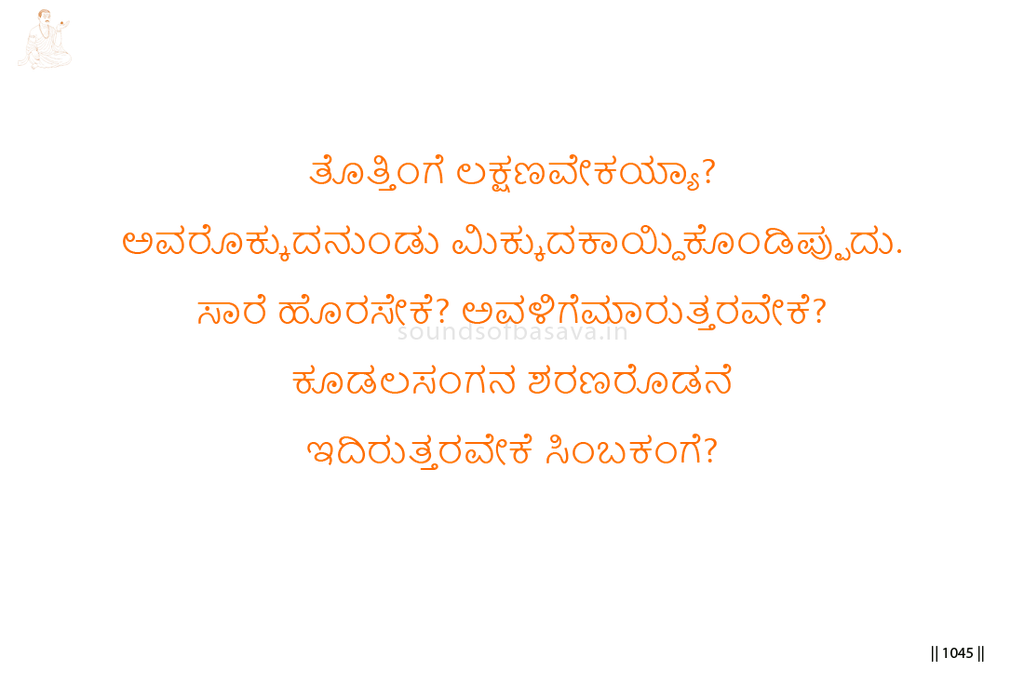
Basavanna asks why a servant needs a mark. This continues the concern of the previous vachana, but moves more sharply: what has become inwardly lived does not need to be displayed outwardly.
The servant has received, assimilated, and lives by what has been given. That received and lived truth itself is the sign. To seek another mark would turn living service into self-presentation.
The final movement asks why anything should be cast outward, shown, or made into a counter-claim before Kudalasangama’s Sharanas. For the true servant, quiet nearness with the Sharanas is enough.
Imagery & Symbolic Relevance
The first image is the servant. A servant is not known by ornament, title, or outer display. The servant is known by service itself.
The question “why seek a mark?” gives the first teaching. Basavanna does not reject sacred signs in general. Here he asks why an additional mark is needed when servanthood has already become real.
The second image is receiving what is given. The servant does not invent his own path or claim an independent position. He receives from those who have lived the truth.
The third image is assimilating what is received. The received truth must not remain outside as borrowed speech or visible sign. It must enter life and become one’s way of being.
The phrase “what remains” carries the humility of reception. The servant does not demand the first place or seek honor. Even what remains from the Sharanas is held as enough.
The question “why cast it outward?” gives the next movement. What has been inwardly received should not be thrown outward as display. Basavanna is guarding the servant from turning spiritual assimilation into exhibition.
The question “why show it?” deepens the warning. Display can allow the ego to return even after true receiving. What should breathe silently in life can become a banner of self-importance.
The final image is being with Kudalasangama’s Sharanas. The servant does not need to stand before them with counter-claim, self-proof, or visible assertion. To remain near them in humility is itself the fulfilment of the servant’s place.
Lingayoga
In Lingayoga, this vachana teaches that received truth must become lived being, not outward exhibition.
The practice-point is direct: do not seek a mark to prove service. Let service itself become the mark. Let what is received from the Sharanas become conduct, humility, and quiet nearness.
This vachana also warns against subtle self-display. Even after inner assimilation, the ego may return through the wish to be seen as one who has received. Basavanna therefore places the servant in silent nearness with Kudalasangama Deva’s Sharanas.
Editorial Commentary
This vachana should be read as a correction of spiritual self-presentation. Basavanna does not dismiss marks, signs, or sacred belonging. He asks whether the true servant requires outward proof after the received truth has become life. The force of the vachana lies in its restraint: what is lived does not need to be advertised; what is received from the Sharanas is fulfilled by remaining near them without claim.
Related Vachana
Supporting Vachana
Sharana Sthala Vachana 466 — The Least Among Servants
Sharana Vachana 466 supports this Aikya vachana by placing Basavanna in the lowest servant-position before Kudalasangama’s Sharanas. There, he receives even the leftover without turning away and calls himself a servant among servants.
Aikya Vachana 468 carries that humility further. The servant who has received and assimilated what comes from the Sharanas does not need an outer mark to prove himself. The servant’s true sign is the received truth lived quietly.
Advancing Vachana
Aikya Sthala Vachana 473 — Lifted into the Embrace
Vachana 468 shows the true servant remaining humbly with Kudalasangama Deva’s Sharanas, without seeking an outward mark, display, or counter-claim.
Vachana 473 advances this into complete belonging. Basavanna lives in the house of Shiva’s Sharanas, receives what comes from them, and preserves it inwardly until imagined construction breaks, Bhava-bandhana falls away, and karma becomes pure.
Thus quiet servanthood and humble reception mature into Divine recognition, as Kudalasangama Deva calls Basavanna near and lifts him into His embrace.
