

Summary
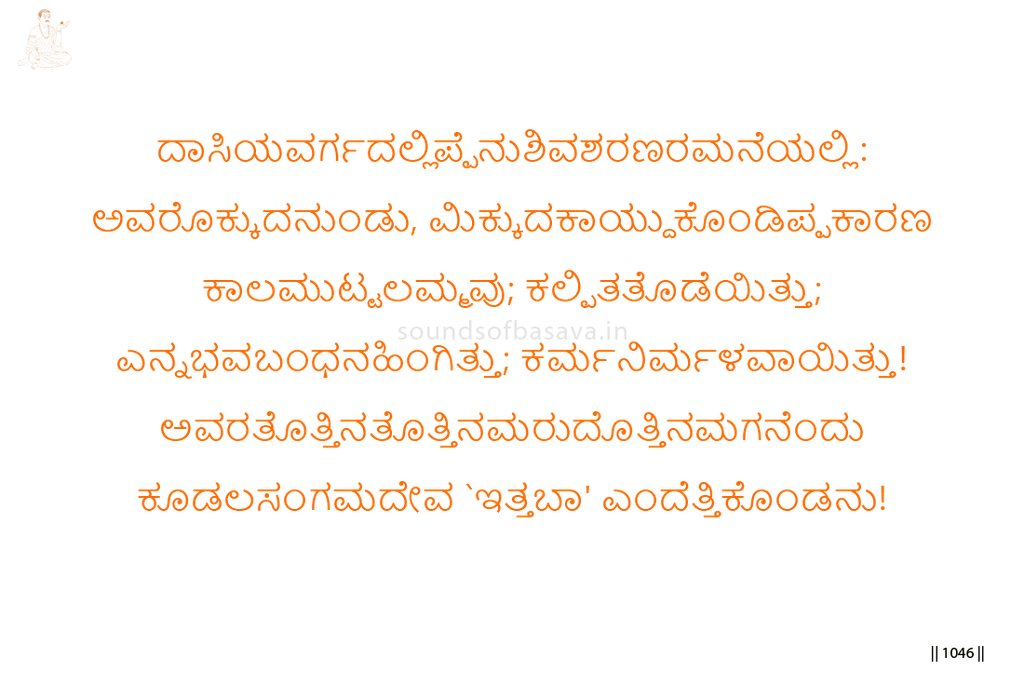
Basavanna says that he lived in the house of Shiva’s Sharanas as one among the serving women. He does not stand as knower, teacher, or claimant. He stands as a receiver within the household of those who have lived the truth.
He partakes of what the Sharanas have received and lived, and he holds within what remains. This receiving is not outward borrowing. What is received from the Sharanas is retained inwardly until it ripens.
Through this inward holding, time loses its hold, imagined construction breaks, the bond of becoming falls away, and karma becomes pure. Basavanna is no longer shaped by the old burden of becoming.
The final image gives the fulfilment. Kudalasangama Deva receives him as the child of the servants of His servants, says, “Come here,” and lifts him into the embrace. The one who became a receiver in the Sharanas’ house is recognized as belonging to the Divine household itself.
Imagery & Symbolic Relevance
The first image is the house of Shiva’s Sharanas. The house is not merely a building. It is the living field of Sharana-sanga, where received truth is lived and transmitted.
Basavanna’s place in that house is among the serving women. This is a posture of complete humility. He does not enter as one who possesses knowledge or status. He enters as one who receives.
The serving woman image is important because it removes self-claim. Basavanna does not present himself as central. He becomes one who belongs by service, receptivity, and nearness.
The next image is partaking of what the Sharanas have received and lived. The Sharanas are not merely speakers of teaching. What they have received has become life. Basavanna receives from that lived truth.
The phrase “what remained, I held within” gives the inward action of the vachana. What is received is not displayed or immediately spent. It is held, allowed to settle, and allowed to transform being.
Time falling away is the next image. The source-supported meaning is that the hold of kāla loosens when what is received from the Sharanas is truly assimilated.
The breaking of the imagined construction follows. Kalpita, the constructed or imagined formation, is shattered. The mind’s projected reality does not remain intact before the ripening of received truth.
The breaking of bhava-bandhana gives the next movement. The bond of becoming falls away. This is not presented as self-achievement, but as the fruit of humble participation in the Sharanas’ house.
Karma becoming pure completes the inner transformation. Action is no longer burdened by the old knot of doership and becoming. It becomes purified through the collapse of self-claim.
The final image is being called as the child of the servants of the servants. This is not ordinary lineage. It is spiritual belonging through Sharana-sanga and service.
The words “Come here” are the decisive call. Kudalasangama Deva does not merely approve from afar. He calls the receiver near.
Being lifted into the embrace is the fulfilment of the vachana. The seeker who entered as servant is received as child. Humble nearness to the Sharanas ripens into Divine acceptance.
Lingayoga
In Lingayoga, this vachana teaches that the seeker must become a receiver in the house of the Sharanas. Truth is not grasped by self-claim; it is received, held, and allowed to ripen.
The practice-point is direct: remain near the Sharanas, partake of what they have received and lived, and hold it within until it transforms being. Do not turn received truth into display or status.
This vachana also shows the purification of action. When self-claim falls, karma becomes clear. When imagined construction breaks, bhava-bandhana loosens. The seeker is not lifted by self-effort alone, but by belonging, humility, and received grace before Kudalasangama Deva.
Editorial Commentary
This vachana should be read as the fulfilment of humble reception. Basavanna does not claim realization as possession. He enters the Sharanas’ house, receives what they have lived, holds it inwardly, and is transformed through that reception. The final embrace is therefore not sudden reward; it is Divine recognition of one who has become fully receptive within the living lineage of the Sharanas.
Related Vachana
Supporting Vachana
Sharana Sthala Vachana 1090 — Uniting with the Sharana
Sharana Vachana 1090 supports this Aikya vachana by showing Basavanna joined to the Sharanas of Kudalasangama and declaring that he will cross bhava through that joined life. The Sharana source itself prepares Vachana 473 as its Aikya fulfilment: there, Basavanna receives what the Sharanas have lived, holds it within, and the bonds of becoming fall away before Kudalasangama Deva lifts him into His embrace.
In Sharana Vachana 1090, the movement is toward crossing bhava through union with the Sharanas. In Aikya Vachana 473, that movement ripens into full belonging, purification, and Divine acceptance.
Advancing Vachana
Aikya Sthala Vachana 475 — The Joy Beyond Liberation
Aikya Vachana 475 advances this teaching because the Aikya source itself places Vachana 473 within its continuation field, where reception culminates in belonging. In Vachana 473, Basavanna enters the house of Shiva’s Sharanas, receives what they have lived, holds it within, and is lifted by Kudalasangama Deva into His embrace.
In Vachana 475, that belonging opens into the joy of being sustained among Kudalasangama Deva’s Sharanas, a joy greater than Salokya, Samipya, Sarupya, or Sayujya. Thus the embrace of Vachana 473 advances into the shared sacred life of the Sharanas, where fulfilment is not private liberation but lived fellowship before Kudalasangama Deva.
