

Summary
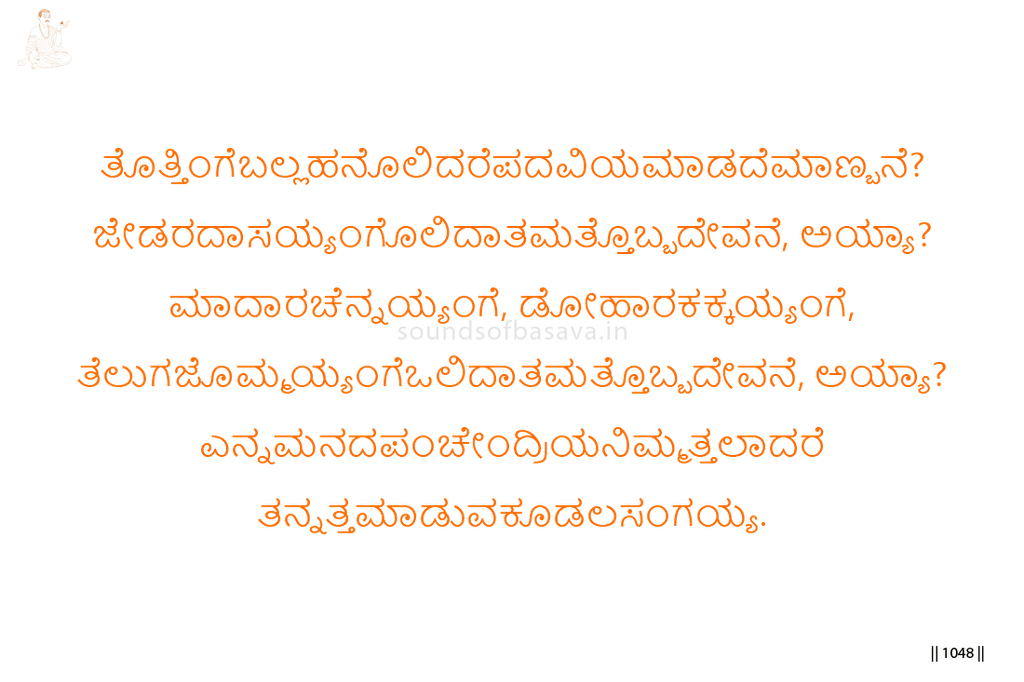
Basavanna begins by questioning whether spiritual standing can be claimed apart from steadfast service. He then rejects the idea that the Divine could differ according to the person who receives His grace.
He asks whether there is one God for Jedara Dasayya and another for Madara Chennayya, Dohara Kakkayya, or Telugu Jommayya. The repeated question makes the teaching unmistakable: Kudalasangama Deva cannot be divided according to birth, work, lineage, or social identity.
The final movement turns inward. When the mind moves through the five senses, Kudalasangama Deva draws it toward Himself. The division seen outwardly therefore has its corresponding source within the scattered mind.
The Aikya teaching is direct: the Lord is one, the Divine relation is indivisible, and the mind and senses must be gathered back into Kudalasangama Deva.
Imagery & Symbolic Relevance
The opening question concerning service and spiritual standing establishes the first measure of the vachana. Spiritual position cannot remain an empty claim. It must be joined to lived devotion and service.
The repeated question, “Is there another God?” forms the central structure. Basavanna does not argue at length against division. He exposes its impossibility by asking whether the Lord who showed grace to one Sharana could be different from the Lord who showed grace to another.
Jedara Dasayya is named first. His presence makes the teaching concrete: Divine grace cannot be separated according to work or social designation.
Madara Chennayya, Dohara Kakkayya, and Telugu Jommayya are then named together. Basavanna does not refer to an undefined humanity in general. He places particular Sharanas before the one Lord and asks whether a different God could belong to each.
Their names therefore become the living answer to social division. The same Kudalasangama Deva is present in relation to every Sharana.
The mind and the five senses form the inward image. The senses carry awareness toward many objects, while the mind may begin to separate, compare, and divide what it encounters.
Kudalasangama Deva drawing this movement toward Himself completes the vachana. What becomes scattered through the mind and senses is gathered into one Divine center.
Together, the images move from spiritual standing, to the named Sharanas, to the impossibility of different Gods, and finally to the inward gathering of the mind and senses in Kudalasangama Deva.
Lingayoga
In Lingayoga, this vachana teaches that the Anga must not divide the Linga according to birth, occupation, lineage, or social identity.
The same Kudalasangama Deva who is present for one Sharana is present for every Sharana. The Linga cannot become one reality for the socially honoured and another for those placed elsewhere by inherited classification.
The inward practice-point lies in the final line. When the mind moves outward through the five senses and begins to create division, it must be gathered toward Kudalasangama Deva.
Aikya here does not erase the individual names of the Sharanas. Jedara Dasayya, Madara Chennayya, Dohara Kakkayya, and Telugu Jommayya remain distinctly named. What disappears is the belief that their distinct social identities can divide the Lord who receives them.
The practice-point is direct: do not divide the Divine through human classification. Let the mind and senses return to the one Kudalasangama Deva.
Editorial Commentary
This vachana should be read as both an outward and inward correction.
Outwardly, Basavanna rejects the idea that social identity can determine a person’s Divine relation. Inwardly, he identifies the mind moving through the five senses as the field where division arises.
The named Sharanas must remain central. They are not illustrations added to a general teaching; they are the concrete means through which Basavanna shows that there cannot be one God for one person and another God for another. The closing movement prevents the vachana from remaining only a social declaration. The division projected upon human beings must also be corrected within the mind before
Related Vachana
Supporting Vachana
Sharana Sthala Vachana 745 — The Lineage of Truth
Sharana Vachana 745 prepares this teaching by challenging birth-based gotra and inherited lineage. When asked to name the true lineage, Basavanna gives the names of Madara Chennayya and Dohara Kakkayya.
Vachana 476 carries that Sharana teaching into Aikya. Vachana 745 establishes Chennayya and Kakkayya as the true lineage one may speak before Kudalasangama Deva. Vachana 476 then asks whether the God who showed grace to them could be different from the God of any other Sharana.
The movement is direct: Sharana Vachana 745 replaces inherited lineage with Sharana-lineage; Aikya Vachana 476 reveals the one indivisible Lord of that entire lineage.
Advancing Vachana
Aikya Sthala Vachana 1064 — Beyond the Threefold Impurity
Aikya Vachana 1064 advances this teaching by showing the fuller condition in which inherited classification has lost its authority.
In Vachana 476, Basavanna rejects the idea of different Gods for Sharanas of different social identities and gathers the mind and five senses toward Kudalasangama Deva.
In Vachana 1064, this recognition deepens into Linga-Aikya. Shiva-bhakti itself becomes the body of the devotee, and former caste, former stage of life, and ritual impurity no longer apply.
Thus the one God revealed through the named Sharanas in Vachana 476 advances into the state where inherited distinction has no remaining ground before Kudalasangama Deva.
