

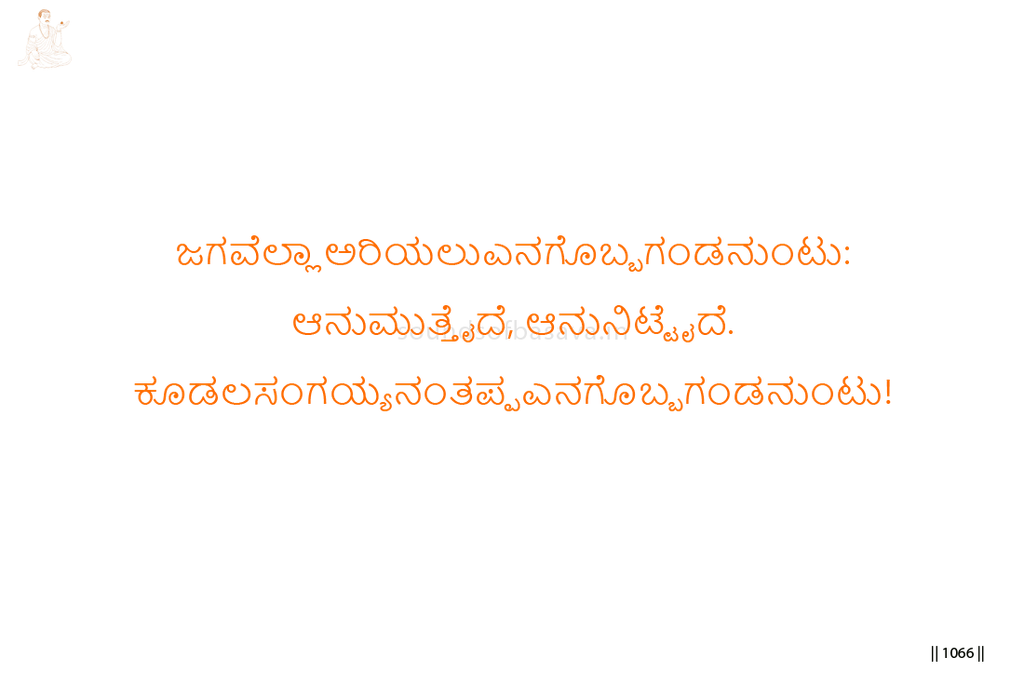
This vachana exposes a timeless truth of spiritual law: the greatest suffering is not inflicted by an external force but by one’s own ignorance, ego, and irreverence. Basavanna uses striking, almost shocking images scratching one’s cheek with a serpent’s fang, grooming hair with burning embers, or playfully grabbing a live tiger’s whiskers to show that certain actions inevitably produce their own destruction. In the same way, mocking or belittling the Sharanas those who live in unity with Kudalasangamadeva is not merely an ethical error; it is an act of self-harm. To scorn the devotees is to scorn the very consciousness that sustains one’s own life. The consequences arise automatically, like the violent heat released when burnt lime touches water. The resulting agony is not divine punishment but the natural ignition of one’s own inner poison.
At the heart of this vachana lies a profound spiritual principle: In a universe permeated by the Linga, every act of alignment brings harmony, and every act of separation brings self-created fire. Thus, Basavanna dismantles any idea of an external hell or punitive deity. The real “hell” is an inward combustion of ego brought about by one’s own contempt, arrogance, and mockery. And the real liberation is the natural state revealed when one chooses reverence, humility, and alignment with the divine presence alive in the Sharanas. This vachana is therefore both a warning and a mirror: Do not strike at the sacred, for the blow lands only on yourself.
Spiritual Context
Core Spiritual Principle: Suffering is not punishment imposed by an external deity but the intrinsic, automatic consequence of actions rooted in egoic separation. Disrespect toward those aligned with the Divine generates a self-created combustion within the heart, as inevitable as chemical reaction.
Cosmic Reality Perspective: In the non-dual Shivayoga, all phenomena are modulations of Shiva-Shakti consciousness. Mocking a Sharana is a denial of the Linga within them a rejection of unity itself. This denial creates violent friction within the individual’s own consciousness, like a wave attempting to reject the ocean, resulting only in its own turbulent dissolution.
Historical Reality (Anubhava Mantapa Context): In 12th-century Kalyana, the Sharanas faced ridicule from orthodox quarters for their egalitarian practices and direct spirituality. This vachana fortified the community by reframing persecution as the persecutor’s self-harm, not as validation of the Sharanas’ weakness. It encouraged steadfast compassion, knowing that mockers were only igniting flames within their own hearts.
Interpretation
1.Scratching with a serpent’s fang: The fang represents poisoned speech/thought (vishavak). The cheek symbolizes one’s own well-being. Using poison to address a minor itch (the urge to mock) injects venom directly into one’s own system a literal embodiment of harmful karma.
2.Untangling hair with an ember: Hair symbolizes entangled life situations or thoughts. The ember represents aggressive, fiery action born of scorn. Applying scorn to complexity burns the very structure one seeks to order, leaving only ashes.
3.Grabbing a tiger’s whiskers for play: The tiger is primal divine power; its whiskers are a sacred, dangerous aspect. Treating the sacred with frivolous disrespect invites self-annihilation, as the playful ego underestimates the reality it toys with.
4.Binding burning lime and jumping into water: Lime (chuna) when burned becomes quicklime, which reacts violently with water to produce intense heat and caustic slaked lime. This is an alchemical metaphor: the ingredients of mockery (burning ego) combined with the water of life (the context of divine presence) trigger an explosive reaction within the individual’s own psychic body.
Practical Implications: Cultivate reverence as a protective discipline. Before speaking critically of any being, pause to inquire: “Is this arising from my own insecurity? Will this utterance create inner peace or inner combustion?” Actively practice seeing the Linga in all, especially in those whose devotion differs from your own.
The Cosmic Reality
Anga (Human Dimension): The mocker operates from the contracted identity of the separate ego. This Anga uses its faculties of speech and thought to reinforce separation, thereby damaging its own inherent connection to the whole. It is the agent of its own suffering.
Linga (Divine Principle): Kudalasangamadeva is the non-dual substrate, untouched by mockery, as the ocean is unaffected by a wave’s confusion. Yet, the Linga’s nature is unity; thus, any action against unity is inherently dissonant and cannot find rest in the fundamental ground of being.
Jangama (Dynamic Interaction): The Sharanas embody the Jangama principle they are moving reminders of the divine. Mocking them is an attempt to arrest that sacred movement, but the Jangama force is unstoppable; the mockery simply ricochets. This dynamic illustrates the law of resonance in consciousness: what you send out returns to you, amplified by the medium of your own heart.
Shatsthala
Primary Sthala: MAHESHWARA. This stage involves the fiery destruction of impurities (malas). Mockery is a primary impuritythe ego’s tendency to belittle others to feel superior. This vachana directly fuels that purification, showing that such behavior is not merely unethical but self-incinerating. The Maheshwara must incinerate the tendency to mock.
Supporting Sthala: BHAKTA. The Bhakta is learning the forms of devotion. This vachana warns against the pitfall of devotional envy or sectarianism, where one’s own path leads to disdain for others. It teaches that true devotion expands the heart to include all, as the Linga resides equally in all.
Practical Integration
Arivu (Awareness Practices): Practice “Tongue-of-Fire Awareness.” Before speaking, feel the energetic quality of your words in your heart. If there is a burning, prickling sensation (the “ember” or “quicklime”), choose silence or shift to a cooling remembrance of the Linga’s presence in the other.
Achara (Personal Discipline): Take a vow of non-harmful speech (ahimsa vak). Abstain from sarcasm, ridicule, and belittling humor, especially toward spiritual seekers or communities. Replace criticism with curious inquiry or silent blessing.
Kayaka (Sacred Action): In your workplace or daily duties, actively disrupt gossip and backbiting. Use your labor to build environments of respect. If you lead, model reverence for all colleagues, recognizing the divine work in each role.
Dasoha (Communal Offering): Protect the sanctity of your spiritual community. If mockery arises, gently correct it not with counter-scorn but by sharing this vachana’s insight. Offer the “water” of compassionate understanding to those who are burning with derision.
Modern Application
Digital cynicism and performative judgment. Internet trolling, cancel culture, and the cynical deconstruction of public figures especially spiritual teachers and earnest seekers are endemic. Social media algorithms often reward mockery, creating a collective toxicity that fragments inner peace and fuels outer division.
Cultivate digital satsangha. Use online spaces to express reverence and appreciation. Before posting a critical comment, apply the “quicklime test”: “Will this reaction create heat in my own heart and in the collective space?” Choose to contribute to conversations that elevate rather than degrade. Form online groups committed to respectful, seeking-focused dialogue.
Essence
A scratch with poison, a burn in the hair,
A playful tug on the tiger’s fierce stare
Each foolish move invites its own flame.
To mock the devout is to play the same game:
The lime you bind, the water you leap in,
Ignites a fire that burns from within.
So guard your tongue, and soften your heart,
Lest from your own self, you tear yourself apart.
This vachana describes the nonlinear dynamics of psychic equilibrium. The human consciousness system has two primary attractors: unity (Linga) and separation (ego). Mocking the Sharanas is a perturbation that pushes the system away from the unity attractor into the basin of the separation attractor, which is inherently unstable and characterized by high entropy (suffering). The “self-inflicted flame” is a phase transition a sudden release of energy triggered when the system’s parameters (egoic charge, ignorance) cross a critical threshold. It is the spontaneous combustion of bound psychic energy when contradictory states (reverence and mockery) are forced into coexistence.
Imagine your mind is a garden. Reverence is like watering the plants. Mockery is like pouring gasoline on them. The Sharanas are like the sun their presence doesn’t change, but it determines what happens next. In the sun, water brings growth; gasoline brings a fire that consumes your own garden. The fire isn’t the sun’s punishment; it’s the inevitable result of what you chose to pour.
We often use mockery as a defense mechanism against the vulnerability that true reverence requires. It makes us feel smart, safe, and superior. This vachana exposes that defense as a booby trap: the wall we build to keep out the sacred becomes the prison that confines us to our own inner hell. The liberation it offers is the courage to drop the sneer, to risk feeling small before the mystery, and to discover that in that softness lies our only real protection the unburnable essence of the Linga within.

Views: 0