

Summary
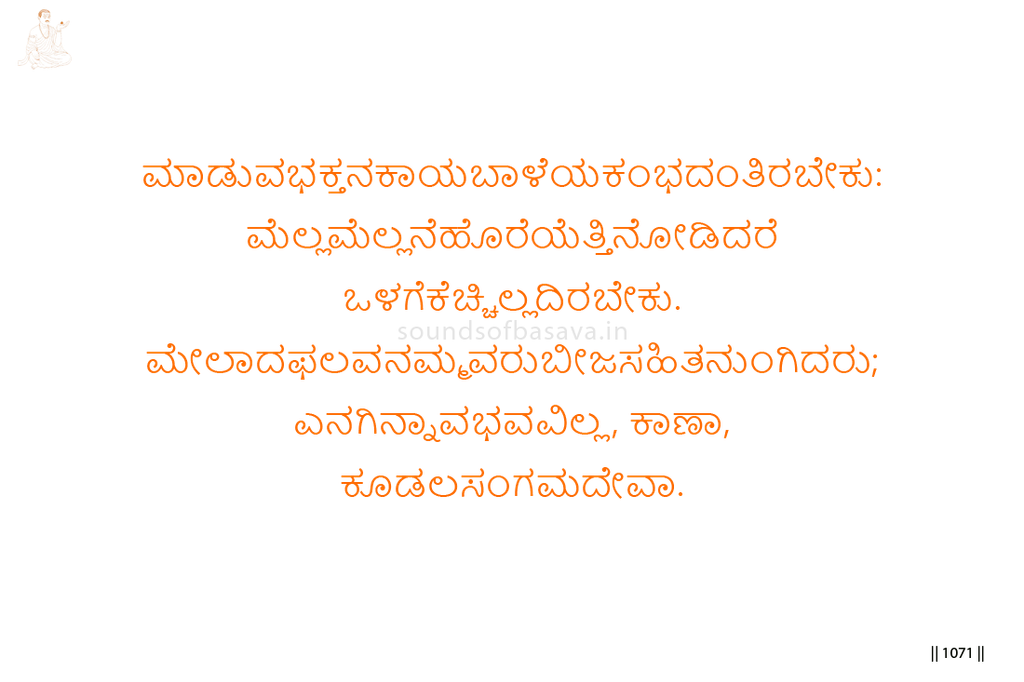
Basavanna says that the body of one who practises devotion must resemble a plantain stem. When its layers are gently removed and examined, no hard core should remain within.
He then says that his people have swallowed the ripened fruit together with its seed. Since nothing capable of producing another growth remains, he declares that no further bhava remains for him before Kudalasangama Deva.
Imagery & Symbolic Relevance
The body of the practising Bhakta is the first concern. Basavanna is not describing devotion as an inward claim alone; its truth must be present throughout embodied life.
The plantain stem gives the governing comparison. Unlike a woody trunk, it consists of yielding layers and has no rigid core at its centre. The devotee must therefore not preserve hidden hardness within.
The layers are to be removed gently, one after another, and examined. This suggests careful inward testing. Outer softness is not enough if resistance remains concealed beneath it.
The condition that there should be no hard core inside gives the measure of genuine transformation. Devotional appearance must not cover an inward centre that still refuses to yield.
The ripened fruit marks fulfilment. What was growing has reached its fruit and is no longer unfinished.
The fruit is swallowed with the seed itself. Normally, a seed remains capable of producing further growth. Here, even that remaining possibility is consumed.
The final declaration—“there is no further bhava for me”—completes the imagery. Because neither hard core nor seed remains, no further arising is left to continue.
The vachana moves from inward softness, through complete examination, to the removal of the very seed of recurrence.
Lingayoga
In Lingayoga, devotion must penetrate the whole embodied being. The seeker cannot retain an untouched inner core while displaying surrender outwardly.
The plantain image calls for inward openness: layer after layer must agree with the movement toward Linga. Nothing resistant should remain hidden at the centre.
The seed-image takes this further. Practice is complete only when the cause capable of renewing bondage no longer remains.
The practice-point is direct: allow devotion to soften the whole being and remove not only visible resistance but also the subtle remainder from which further becoming may arise.
Editorial Commentary
The plantain stem is important because it has layers but no woody central core. Basavanna’s concern is therefore not physical softness, but the absence of concealed inward hardness.
The seed should be understood through the final line of the vachana. Since Basavanna immediately says that no further bhava remains, the swallowed seed represents the ending of what could produce another arising.
Here, bhava means further becoming or renewed formation; it should not be read merely as emotion or ordinary worldly existence.
Related Vachana
Supporting Vachana
Sharana Sthala Vachana 665 — The Pulse of Purpose
Sharana Vachana 665 uses the plantain bearing fruit as an image of decisive fulfilment and warns the practising Bhakta not to lose inward resolve before the work is complete. Vachana 522 shows that fulfilment attained: the plantain has become the image of a devotee without inner hardness, and the fruit has been consumed with its seed, leaving no unfinished remainder.
Advancing Vachana
Aikya Sthala Vachana 1093 — The Garland of Devotion
Vachana 522 states through the plantain and seed that no further bhava remains.
Vachana 1093 makes this freedom explicit: the arising forms of bhava are removed, the garland of becoming is cut, and bondage no longer remains. Thus, the seed of recurrence consumed in Vachana 522 advances into the declared removal of becoming and bondage in Vachana 1093.
