

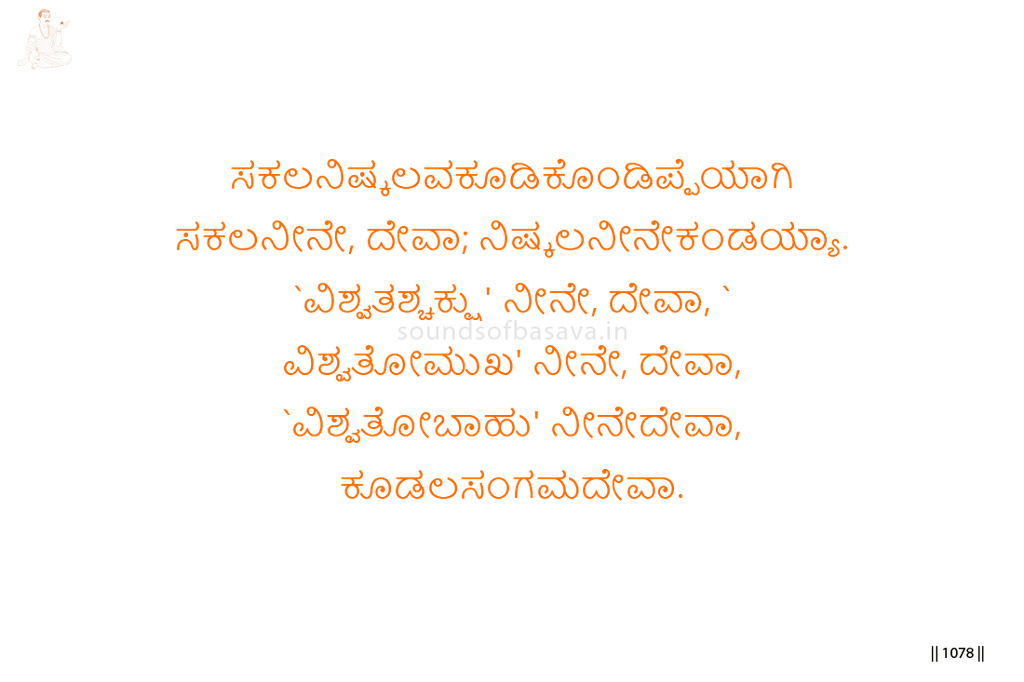
In this vachana, Basavanna reveals that spiritual failure does not begin in action but in the collapse of inner faith. External practices penance, rituals, vows are compared to striking the ground around a snake’s hole, never touching the serpent within. The “serpent” is the impurity, doubt, or duplicity resting in one’s own heart.
Basavanna teaches that when shraddhe (faithful sincerity) is lost, the seeker becomes disconnected from their inner source, and even the most intense spiritual practices become futile. Faith here does not mean blind belief but an unbroken inner alignment with truth, integrity, and the Divine Presence. Without this inner purity of faith, nothing reaches Kudalasangamadeva;
with it, even simple acts are transformed into true devotion.
Spiritual Context
Core Spiritual Principle: Spiritual efficacy is determined by the condition of the heart (hridaya shuddhi), not the vigor of external practice. Shraddhe faith as unwavering inner clarity, trust, and sincerity is the essential conduit. When this conduit is broken by impurity, doubt, or duplicity, all action becomes “beating the ground,” generating noise but no transformation.
Cosmic Reality Perspective: In the non-dual Shivayoga, the Linga is all-pervading consciousness. The individual heart is the localized site of recognition. Impurity (mala) is a contraction within that heart that blocks recognition. Austerities performed from this contracted state merely reinforce the contraction; they are the ego’s attempt to achieve what can only be received through an open vessel. The “serpent” is the egoic knot itself.
Historical Reality (Anubhava Mantapa Context): This vachana challenged the ascetic extremism and ritualistic piety prevalent in 12th-century Kalyana. It protected the Shivayoga path from being misconstrued as another system of severe external penance. It affirmed the Anubhava Mantapa’s core principle: that true transformation is an inner revolution of consciousness (antaranga kriya), with Kayaka and Dasoha being its natural outer expressions, not its substitutes.
Interpretation
1.”Can a serpent be killed by beating the ground around its hole?” The serpent is the core impurity often fear, greed, hatred, or duplicity lying coiled in the cave of the heart (hridaya guha). “Beating the ground” represents misplaced effort: fasting, prostrations, elaborate rituals, or scriptural study undertaken before or instead of confronting the inner poison. The action is loud, effortful, but entirely peripheral.
2.”What use are fierce austerities when the mind still wanders impure?” This names the disconnect between action and state. Austerities (tapas) are meant to concentrate and purify the mind. If the mind remains “impure” (scattered, attached, dishonest), the austerities are not serving their purpose; they have become performances of willpower, not instruments of transformation.
3.”When inner faith breaks, every effort falls to dust.” Shraddhe is the connective tissue between the human and the Divine. It is not blind belief but the steady, lived confidence in the reality of the Linga and the path. Its “breaking” signifies a reversion to transactional spirituality (“I do this to get that”) or cynical ritualism. Without this living connection, all effort lacks divine gravitation and turns to “dust” dry, lifeless, and fruitless.
Practical Implications: Before engaging in any spiritual practice, one must perform a “Heart-Check.” Ask: “What is the state of my shraddhe right now? Is there a ‘serpent’ of resentment, pride, or deceit I am avoiding? Is this practice an expression of inner alignment, or a distraction from it?” Prioritize restoring sincerity over increasing rigor.
The Cosmic Reality
Anga (Human Dimension): The realm of effort and technique. Here, one can choose: to beat the ground (apply technique to the periphery) or to enter the hole (apply awareness to the core). The Anga’s maturity is measured by its discernment in targeting the true problem.
Linga (Divine Principle): Koodalasangamadeva as the goal and the witness. The Linga is unaffected by the beating of the ground. It responds only to the death of the serpent the dissolution of the impurity that blocks its recognition. It is the light that appears when the inner obstruction is removed.
Jangama (Dynamic Interaction): The lethal strike of self-awareness. Jangama is the precise, penetrating force of truthful self-confrontation that enters the hole and kills the serpent. It is also the guidance of the true teacher who points not at the ground, but at the hole.
Shata Sthala
Primary Sthala: MAHESHWARA. The entire Maheshwara stage is the process of “killing the serpent.” The vachana defines the stage’s central error: expending energy on external purification while the internal enemy remains untouched. It calls for a reorientation of tapas inward.
Supporting Sthala: BHAKTA. For the Bhakta, shraddhe is the foundation. This vachana warns that devotion must protect this faith from erosion by hypocrisy or disappointment. A Bhakta with broken shraddhe is like a singer with a broken instrument no melody can emerge.
Practical Integration
Arivu (Awareness Practices): Practice “Entering the Hole” meditation. Sit quietly and identify a persistent negative pattern (the “serpent”). Instead of analyzing its effects (beating the ground), bring bare, gentle attention to the core feeling of it in the body. Simply be present with it. This awareness is the beginning of its dissolution.
Achara (Personal Discipline): Make the cultivation of shraddhe your primary discipline. This means nurturing honesty with oneself, keeping small promises, and spending time in environments and with people that reinforce genuine faith, not doubt or cynicism.
Kayaka (Sacred Action): Ensure your work is an expression of an integrated heart. If your labor forces you to nurture inner “serpents” of deceit or exploitation (e.g., unethical business), it is beating the ground, no matter how pious your after-work rituals. Align livelihood with inner truth.
Dasoha (Communal Offering): Offer help that addresses the core. In community, don’t just provide superficial solutions. Offer presence, listening, and support that helps others face their own “serpents.” Create a culture where honesty about inner struggles is valued over displays of external piety.
Modern Application
Spiritual bypassing and performative wellness. The modern seeker often “beats the ground” through intense yoga marathons, strict diets, or mindfulness apps, while avoiding therapy for deep-seated trauma, ethical compromises at work, or toxic relationships. Social media amplifies this, showcasing the “beating” (the practice) while the “serpent” (anxiety, loneliness, envy) grows unseen in the hole.
Prioritize depth over display. Choose one inner work practice (therapy, journaling, silent retreat) for every outer practice. Audit your life: where are you pounding the ground energetically (e.g., overworking, over-exercising) to avoid a core issue? Have the courage to stop beating, and instead, sit quietly at the entrance of the hole and look in.
Essence
Why beat the earth with futile sound,
While in the dark, the serpent’s wound
Lies coiled, untouched, within the heart?
All effort, till you do your part
To face the poison where it breeds,
Is just the dust of hollow deeds.
First mend the faith, then let the hand
Move true, by Truth’s divine command.
This vachana describes the first law of spiritual thermodynamics: energy applied to a system must be directed at the site of entropy (disorder) to create change. The heart with a “serpent” is a system with a localized entropy source (the impurity). “Beating the ground” is energy applied to a low-entropy area of the system, which achieves nothing. The shraddhe is the directed potential that allows energy to be targeted at the entropy source itself. Without this directing intelligence (faith/alignment), energy dissipates uselessly, increasing overall frustration (system heat) but not order.
Imagine your car has a flat tire (the serpent in the heart). You can polish the hood, fill the gas tank, and rev the engine (beating the ground)it makes noise and uses energy, but the car won’t move. Shraddhe is the understanding that says, “The problem is the tire.” Changing the tire (facing the impurity) is the only action that translates effort into motion. Basavanna says: stop revving the engine of your rituals. Look at the flat tire of your heart.
We prefer “beating the ground” because it feels productive and keeps us at a safe distance from the scary, vulnerable “hole.” We’d rather be exhausted from effort than terrified by introspection. This vachana names that avoidance and calls our bluff. The liberation it offers is freedom from the exhausting, futile cycle of misplaced effort. It grants permission to stop the performance and tend to the real wound. In that tending, we find not a monstrous serpent, but a frightened part of ourselves that, when met with the light of awareness, dissolves into the peace we sought all along.

Views: 0