Poetic Rendering

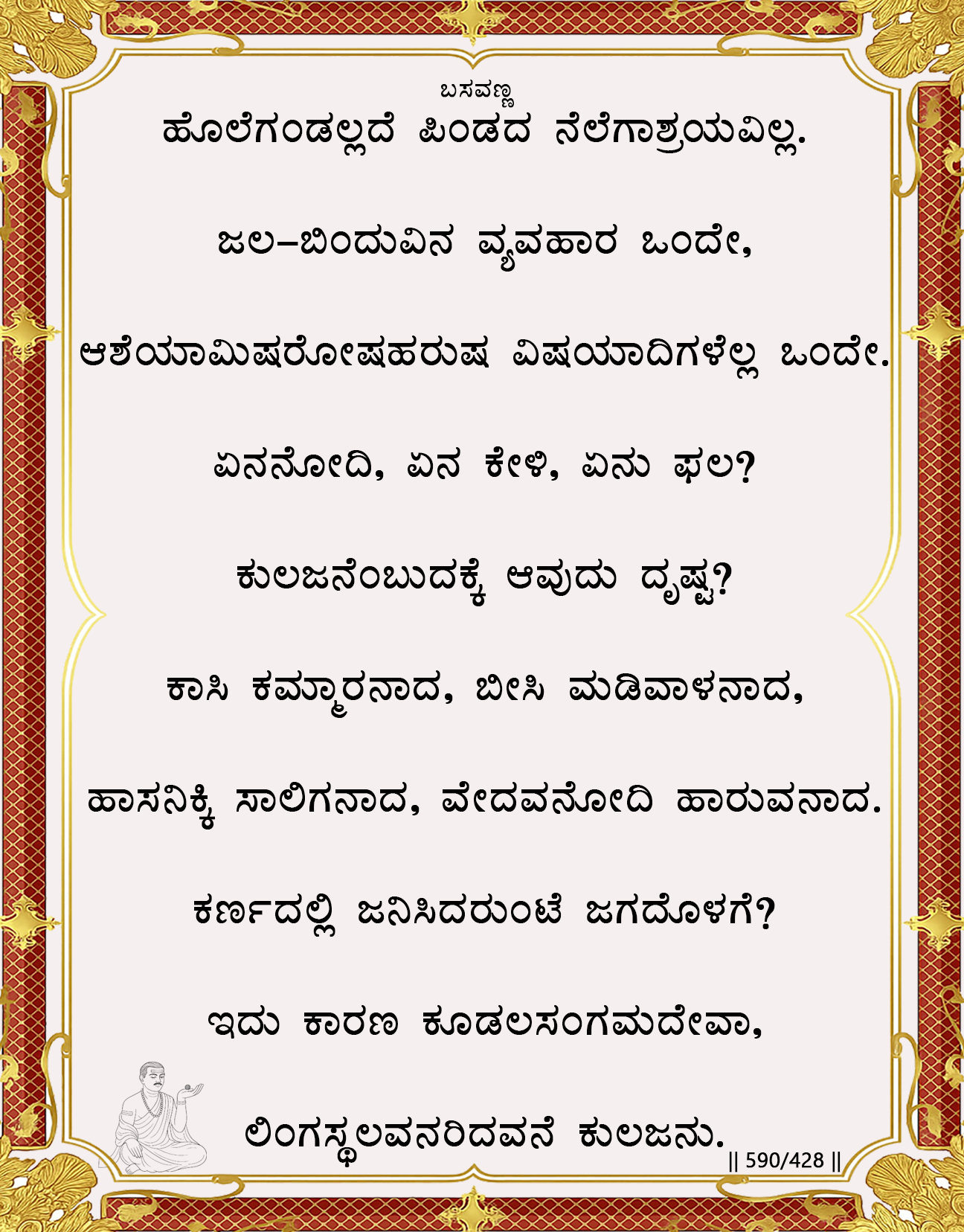
Without the seed, no womb conceives;
the life-force moves the same in all.
Desire, anger, greed these currents
flow alike in every being.
Then what is learned? What is heard?
What makes one high or low?
A smith by iron, a washer man by stone,
a goldsmith by fire, a Brahmin by books
each made by his work, not by birth.
Can a child be born from a queen’s ear?
Why cling to such tales?
O Kudalasangama,
only the one who knows where the Linga truly dwells
stands above all worldly ranks.
Basavanna dismantles the illusion of caste, lineage, and social superiority by showing that all beings arise from the same life-force and share the same inner impulses. If the basic human nature is universal, he asks, how can external markers birth, occupation, or inherited prestige determine true worth? He exposes the absurdity of caste-based pride through sharp examples: A person becomes iron-worker, washer man, goldsmith, or Brahmin not by birth but by the work they perform. Mythical stories used to justify caste hierarchies (like Karna’s birth from an ear) collapse when measured against reality. The vachana culminates in a profound declaration: True nobility comes only from recognizing the inner Linga the Divine presence within oneself and all beings.
Spiritual Context
Core Spiritual Principle: Kārya-Svarūpa – The Principle of Essence through Function. A being’s essence is defined and revealed by its function (kārya), not by its alleged origin. A blacksmith is defined by working iron, not by birth. Similarly, a human’s spiritual essence (Linga) is revealed by the function of conscious worship and righteous action, not by hereditary social status.
Cosmic Reality Perspective: From the non-dual view, Shiva-Shakti is the one seed and womb of all existence. The manifestation of various forms (human bodies, occupations) is the play of Shakti. To impose a hierarchy of purity on these forms is to deny the fundamental unity of their source. Realizing the Linga is seeing the one Shiva in the multiplicity of Shakti’s expressions.
Historical Reality (Anubhava Mantapa Context): This is the philosophical cornerstone of Basavanna’s social revolution. It provided an irrefutable, experience-based argument against caste. By citing specific occupations (smith, washer man, goldsmith, Brahmin), it directly empowered the working classes and demystified priestly authority. The Anubhava Mantapa was the lived embodiment of this principle a community where spiritual merit, defined by inner realization and ethical kayaka, was the sole determinant of status.
Interpretation
The “seed” and “womb” analogy establishes a common cosmic origin, negating any claim to special creation. Listing universal human failings (“desire, anger, greed”) negates any claim to innate moral or spiritual superiority based on birth. The rhetorical questions (“What is learned? What is heard?”) attack the pillars of Brahminical authority scriptural learning and oral tradition as insufficient without inner realization.
The occupational examples demonstrate that identity is performative and skill-based, not ontological. The final, question (“Can a child be born from a queen’s ear?”) uses absurdist logic to demolish mythological justifications for caste, demanding that spirituality be grounded in observable reality (anubhava).
Practical Implications: One must actively deconstruct internalized caste consciousness (both superiority and inferiority) and see oneself and others through the twin lenses of universal humanity and unique functional contribution. Spiritual practice involves rejecting the vanity of lineage and taking pride only in the quality of one’s work and devotion.
The Cosmic Reality
Anga (Human Dimension): The social persona, a mask constructed from the accident of birth and the role one performs. It is a contingent, fluid identity (“a smith by iron…”), mistaken for a fixed, essential self.
Linga (Divine Principle): Koodalasangamadeva as the singular, undifferentiated source and substance within all. It is the “life-force” (prana) itself, the true “seed” of being. It dwells not in a particular body type or lineage, but in consciousness.
Jangama (Dynamic Interaction): The Jangama is the liberating insight that dynamically connects the Anga to the Linga, bypassing the social fiction. It is the act of knowing “where the Linga truly dwells.” This knowledge is not intellectual but transformative; it immediately reconfigures one’s entire sense of self and relationship to society.
Shata Sthala
Primary Sthala: Aikya. The concluding declaration describes the state of Aikya (Union). The one who knows the indwelling Linga has realized the fundamental unity of all existence. From this vantage point, worldly ranks are seen as illusory projections upon a unified field of consciousness.
Supporting Sthala: Sharana. To arrive at this knowing, one must become a Sharana one who has taken refuge in the Linga alone, surrendering all other attachments, including the most deeply ingrained attachment to caste identity and social standing.
Practical Integration
Arivu (Awareness Practices): Meditate on the “life-force that moves the same in all.” Feel your breath as part of this universal current. When encountering others, practice seeing past social roles to this shared aliveness. Consciously question any thought that assigns higher or lower inherent value to a person based on their job, background, or education.
Achara (Personal Discipline): Let your discipline be the constant effort to attribute your skills and knowledge to practice and grace, not to innate superiority. Reject honorifics or treatment based on birth or status. Engage sincerely with people from all walks of life as equal manifestations of the Divine.
Kayaka (Sacred Action): Take profound dignity in your work as your kayaka, your path of self-definition and offering. Judge others by the integrity and skill of their work, not by its social prestige. See all honest labor as an equal refining fire for the soul.
Dasoha (Communal Offering): Build and protect communities that actively ignore caste and class distinctions. Ensure leadership and respect are based on wisdom, character, and service, not on lineage. Offer the gift of this radically equalizing vision to society.
Modern Application
Caste has morphed into other forms of inherited or systemic privilege: racism, classism, elitism based on university pedigree, and the unexamined hierarchy of certain professions over others. We still often confuse the value of a person with their social identity, net worth, or job title, creating deep alienation and injustice.
This vachana liberates you from both the prison of inferiority and the hollow tower of superiority. It allows you to define yourself by your actions, your values, and your direct connection to the sacred, not by society’s labels. It provides a timeless tool for social justice: an appeal to our shared biology and consciousness that invalidates all constructed hierarchies. It empowers you to find nobility not in who your ancestors were, but in how you choose to act now.
Essence
One blood, one breath, one beating core,
One set of wounds, and nothing more
To separate the skin you’re in.
The role you play is where you begin,
Not where you end. The truth within
The forge, the wash, the fire, the page,
Is just the same, at every stage.
The rank is yours to make or break:
The choice is what you choose to make.
This vachana applies metaphysical unit analysis to the human condition. It identifies the universal constants (the “seed”/life-force, the “currents” of base psychology) and the universal variable (the work performed, kayaka). Caste is exposed as a spurious, non-essential variable mistakenly squared with identity. The equation of true nobility has only one valid solution: the variable of conscious work multiplied by the constant of realized divinity (Linga). All other terms cancel out.
Imagine humanity as a vast forest. Caste claims that trees grown from certain seeds are inherently better. Basavanna says: all seeds contain the same potential for wood, leaf, and sap. An oak is not better than a pine; each is defined by its actual form and function. The true value is the shared sunlight (the Linga) they all convert into life. Don’t worship the blueprint; honor the living tree and the light it holds.
We crave a sense of specialness and belonging, often finding it in exclusive groups or inherited status. This vachana redirects that craving to the most inclusive belonging possible to the whole of life itself and to a specialness earned through your own conscious labor and integrity. Your true lineage is not behind you; it is within you and ahead of you, in every action that acknowledges the divine in all.

Views: 10