Poetic Rendering

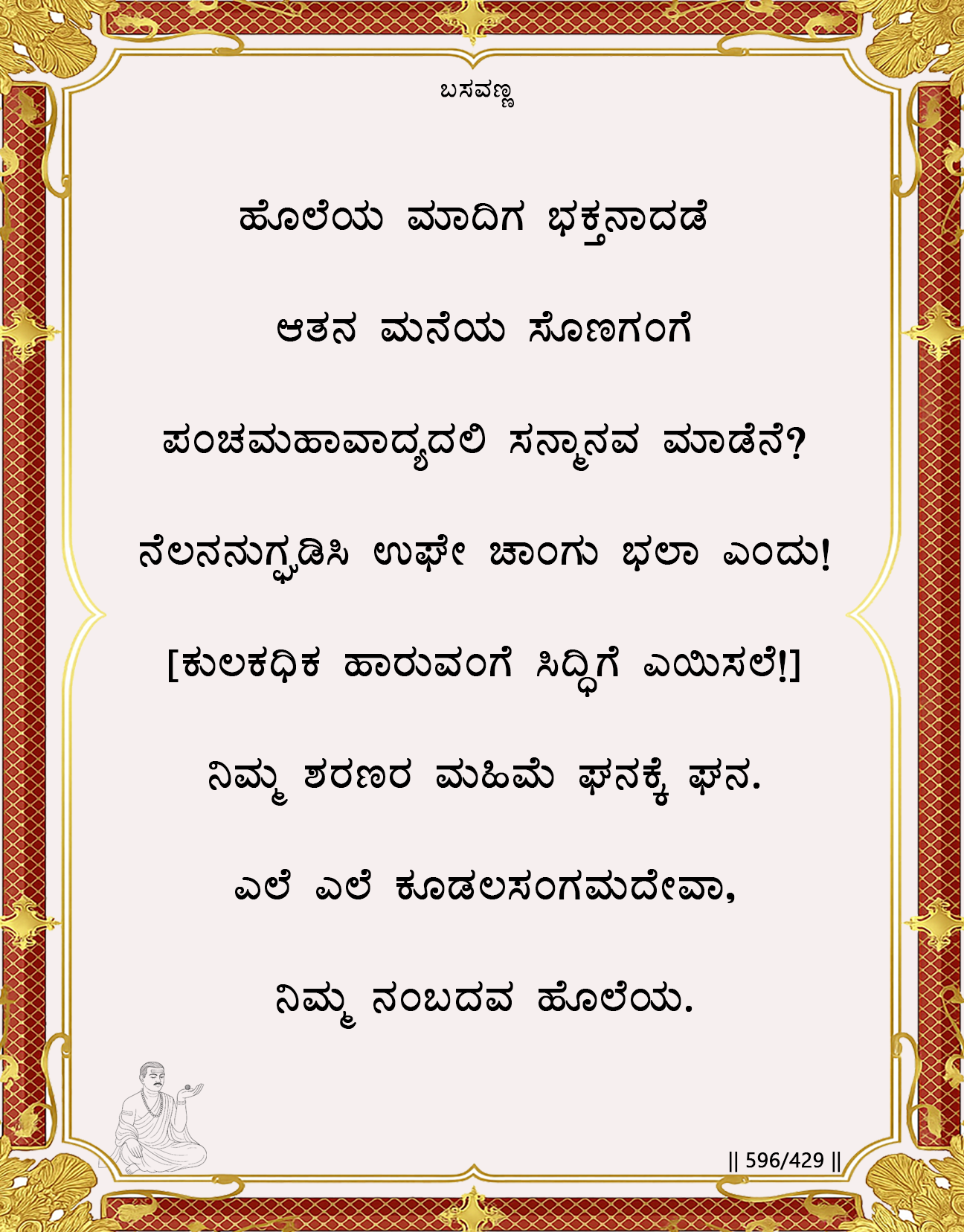
If one born low becomes Your true devotee,
does not the dog-nature fall away?
Washed clean of the five-sensed dirt,
why should he not become music
worthy of honor?
Let the drums resound,
let the earth itself tremble with praise!
But a high-born Brahmin
a leather pouch swollen with ghee and butter
what worth is that without devotion?
O Kudalasangama,
Your sharanas shine like sunlight;
those without faith,
whatever their birth, are truly low.
Basavanna overturns the traditional idea that holiness comes from birth or caste.
He declares: A person of “low birth” who becomes a genuine bhakta sheds all previous faults just as a dog loses its nature when purified by devotion. True devotion refines a person so deeply that they become like music a vibration worthy of celebration and reverence. By contrast, a high-born Brahmin without devotion is like a leather bag filled with ghee externally honored but inwardly empty. The only true measure of spiritual worth is faith and devotion to the Divine, not lineage. Thus, Basavanna concludes: God’s devotees radiate like sunlight; those without devotion, regardless of their birth, remain spiritually impoverished.
Spiritual Context
Core Spiritual Principle: Bhakti-Parampara – The Lineage of Devotion. True spiritual lineage is not of blood but of devotion. The transmission of grace and honor flows through channels of sincere bhakti, not through hereditary caste lines. The devotee, regardless of background, enters the divine family and becomes a bearer of its light.
Cosmic Reality Perspective: In the non-dual reality of Shiva-Shakti, all forms are equal expressions of the one consciousness. The hierarchy of caste is a projection of ignorance (avidya) onto this unity. The light of devotion (bhakti) burns away this ignorance, revealing the inherent divinity in all. The sharanas are those in whom this light shines unobstructed, making them beacons of truth.
Historical Reality (Anubhava Mantapa Context): This vachana was a radical liturgical and social proclamation. It provided the theological basis for honoring saints like Madara Channayya (from a marginalized community) with music and celebration in the assembly. It directly challenged the ritual purity laws that forbade such honor to “low castes,” instead instituting a new liturgy where devotion was the sole criterion for reverence.
Interpretation
The “dog-nature” is a metaphor for the impurities (mala) associated with low birth in the social mindset. True devotion acts as an alchemical fire that transmutes this base nature into divine “music.” The “five-sensed dirt” refers to the limitations of ordinary, sense-bound consciousness, which is washed away by devotion.
The “leather pouch swollen with ghee” is a powerful image: ghee (clarified butter) is a sacred substance, but contained in leather (considered impure), it symbolizes the paradox of a Brahmin who holds sacred knowledge but is encased in the impurity of pride and lack of devotion. The pouch is swollen, indicating empty inflation. The final contrast between sharanas shining like sunlight and the faithless being “truly low” establishes a new spiritual axis: the vertical dimension of faith/devotion replaces the horizontal dimension of birth.
Practical Implications: One must actively re-evaluate whom they honor and why. Spiritual communities should celebrate and elevate those who exhibit deep devotion and integrity, regardless of their social background. Conversely, one must guard against the empty pride of position or knowledge devoid of heartfelt practice.
The Cosmic Reality
Anga (Human Dimension): The socially constructed identity, burdened with the labels of “high” or “low.” This identity is a conditioning that obscures the true self. The Anga’s task is to allow this false identity to be dissolved in the fire of devotion.
Linga (Divine Principle): Koodalasangamadeva as the supreme source of light and value. It radiates equally on all, but only the devoted heart, like a clean mirror, can reflect that light fully. The Linga is the “sunlight” in which the sharanas shine.
Jangama (Dynamic Interaction): The Jangama is the process of purification and elevation through devotion. It is the dynamic that turns the “dog-nature” into “music,” and the force that exposes the “leather pouch” as hollow. It is also the celebratory response the drums and trembling earth that rightly honors this transformation, creating a new social-spiritual reality.
Shata Sthala
Primary Sthala: Aikya. The state described where sharanas “shine like sunlight” is the state of Aikya, union with the divine light. In this union, all small identities are lost in the brilliance of the one consciousness.
Supporting Sthala: Bhakta. The journey to that union is the stage of Bhakta. This vachana defines the true Bhakta: one whose devotion is so sincere that it utterly transforms their perceived nature, making them worthy of the highest honor. It is devotion that leads to union.
Practical Integration
Arivu (Awareness Practices): Cultivate the awareness that sees the divine presence in every sincere seeker. Practice looking past external labels to perceive the quality of devotion and integrity in others. Reflect on your own biases regarding social status and consciously invert them based on this principle.
Achara (Personal Discipline): Let your discipline include honoring those who are truly devoted, regardless of their social standing. In your personal practice, focus on cultivating sincere devotion rather than accumulating knowledge or status. Reject any inner sense of superiority based on birth, education, or spiritual accomplishments.
Kayaka (Sacred Action): In your work, strive to be a “sharana” in your field one whose labor is infused with devotion and integrity. Support and celebrate colleagues who demonstrate these qualities, irrespective of their position. Let your work be an offering that purifies your own nature.
Dasoha (Communal Offering): Create communities and rituals that explicitly honor spiritual merit over social status. Organize celebrations for those who embody devotion and service. Offer the gift of this equalizing vision to the wider society, challenging caste-based and class-based discrimination.
Modern Application
Modern societies still operate on hidden hierarchies based on wealth, race, education, and social connections. Even in spiritual circles, teachers with large followings or impressive lineages are often revered more than humble, unknown devotees of profound sincerity. We are quick to judge by externals.
This vachana liberates by providing a clear, uncompromising standard for evaluation: the depth of one’s devotion and integrity. It empowers you to disregard societal rankings and trust your own discernment of spiritual substance. It encourages you to seek out and learn from the “saints” hidden in plain sight the ordinary people whose lives radiate kindness, wisdom, and faith. It also frees you from the need to prove your own worth through social climbing; your worth is secured by your inner connection to the Divine.
Essence
The world assigns its high and low,
A measured worth it can bestow.
But in the eyes that see the flame,
The only rank is love’s pure claim.
The heart that beats for God alone
Becomes a temple, not a stone.
So let the drums for devotion sound,
And cast the empty pouch to ground.
This vachana illustrates the metaphysics of spiritual valence. In chemistry, an element’s valence determines its combining power. Here, birth-based caste is a false valence. True spiritual valence is determined by the element of devotion (bhakti). A person with high devotional valence can combine with the divine (achieve Aikya) and radiate its qualities. A person with low devotional valence (like the pride-filled Brahmin) is inert or reactive in negative ways, despite having the appearance of sacred elements (ghee/butter). The alchemy of Linga yoga changes one’s spiritual valence through the catalyst of grace.
Imagine two cups: one is a simple clay cup filled with pure water; the other is a golden cup filled with poison. Society praises the golden cup, but the wise seek the water. Devotion is the pure water; birth is the material of the cup. Only the content matters. Drink from the cup that holds the water of life.
We all want to be valued and respected. This vachana tells us that seeking respect through external status is a dead end; the only respect that truly satisfies is that which comes from being recognized for the authenticity of our love and faith. It reassures us that no matter how society labels us, we can attain the highest honor by cultivating a sincere heart. The path to true dignity is open to all.

Views: 6