

Summary
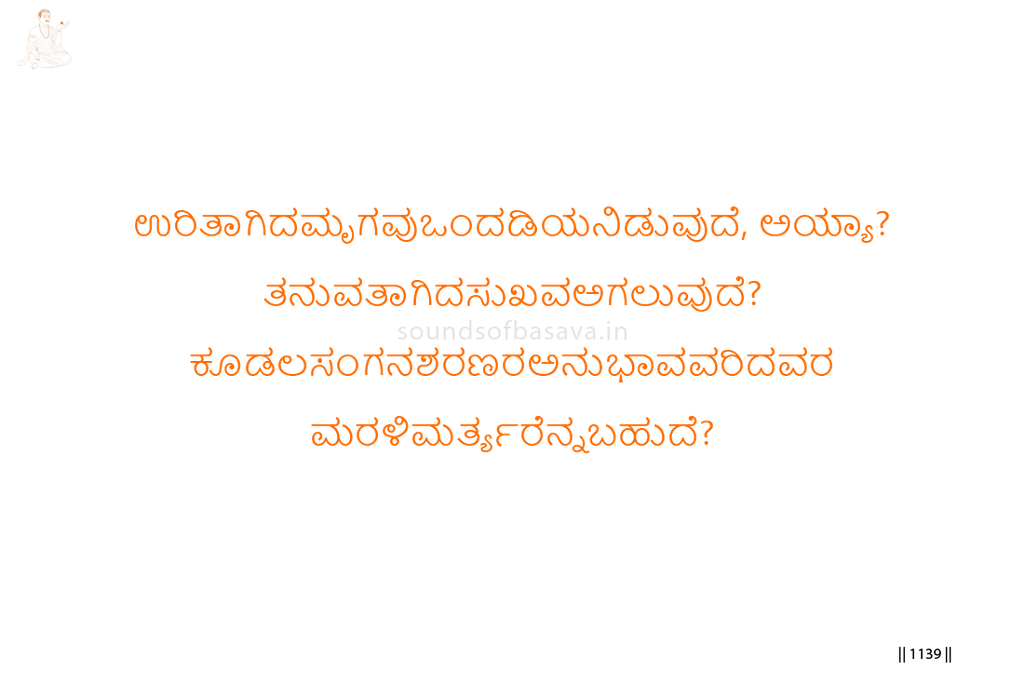
Basavanna begins with two irreversible conditions. Can an animal that has been struck down take even one more step? Can the joy that has entered and touched the body simply depart?
He then applies this finality to Sharana-Anubhava. Those who have truly known the lived experience of Kudalasangama’s Sharanas cannot again be described merely as mortals.
The body remains embodied and subject to its natural condition. What has changed is the person’s defining identity. Sharana-Anubhava has entered so deeply that the former mortal measure can no longer contain the one who has known it.
Imagery & Symbolic Relevance
The struck animal forms the first image. Once the decisive blow has fallen, its former movement cannot continue. Basavanna asks whether it can take even one further step.
The image emphasizes finality. A condition has been reached from which the earlier movement cannot simply resume.
The joy touching the body gives the second image. Unlike the first image of arrested movement, this one concerns an experience that enters and remains.
The phrase does not describe a passing idea observed from a distance. Joy has touched the body and become directly felt. Basavanna asks whether such deeply entered experience can simply separate itself and disappear.
The two questions work in opposite but complementary ways. The first shows something decisively ended; the second shows something deeply entered and not easily removed.
Basavanna then brings these images to Sharana-Anubhava. The experience of Kudalasangama’s Sharanas is not information heard and later forgotten. It is lived contact that changes the one who knows it.
The phrase “those who have known” is essential. The vachana does not speak merely of those who admire, describe, or worship the Sharanas outwardly. It concerns those who have inwardly understood their Anubhava.
The word “again” gives the final question its force. Before this knowledge, the person might be measured by ordinary mortal identity. After Sharana-Anubhava has become known, that former description can no longer be applied without remainder.
“Can they again be called mortals?” expects the answer no. Basavanna does not say that the physical body will never die. He declares that one transformed through Sharana-Anubhava cannot be reduced to bodily mortality alone.
The movement is therefore from a decisive ending, to an experience that remains embodied, to the irreversible transformation produced by knowing Kudalasangama’s Sharanas.
Lingayoga
In Lingayoga, sacred experience must become more than memory, borrowed teaching, or temporary feeling.
When Sharana-Anubhava enters the practitioner, it changes the basis from which body, life, and death are understood. The body continues in its natural condition, but bodily mortality no longer gives the complete definition of the person.
The practical measure is irreversibility: has the experience entered deeply enough that the former way of identifying oneself cannot simply return?
Editorial Commentary
The first comparison concerns an animal that has received a decisive strike and cannot continue its former movement. The precise force is finality; no additional violent imagery is required.
The second comparison concerns joy that has touched the body and remains as lived experience. It should not be reduced to ordinary sensory pleasure alone; within the sequence, it prepares the lasting force of Sharana-Anubhava.
The conclusion does not claim physical immortality. Basavanna asks whether those who have known the Sharanas’ experience can again be called merely mortal. The correction concerns reduction of the realized person to bodily identity.
Anubhava should retain its depth as lived and inwardly known experience. It is more than learning about the Sharanas or repeating their words.
Related Vachana
Supporting Vachana
Sharana Sthala Vachana 1207 — Do Not Call Them Mere Men
Sharana Vachana 1207 repeatedly warns against calling the Sharanas ordinary men. Basavanna names them his fathers, kinsmen, gods, and lords and rejects the judgment that sees them only as embodied human beings.
This prepares Vachana 793 directly. Vachana 1207 corrects the observer’s vision: the Sharana must not be reduced to the body that appears before the eye.
Vachana 793 brings that correction into the one who receives Sharana-Anubhava. Not only are the Sharanas themselves more than mere embodied persons; those who truly know their experience can no longer be described entirely through mortal identity.
What Sharana Vachana 1207 establishes as purified vision before the realized being matures in Aikya Vachana 793 into irreversible participation in the Sharanas’ experience.
Advancing Vachana
Aikya Sthala Vachana 941 — See the Sahaja Sharana
Vachana 793 asks whether one who has known Kudalasangama’s Sharanas can again be called mortal. It removes mortality as the final definition of the transformed person.
Vachana 941 reveals the mature Sharana beyond the paired classifications of birth and death, form and formlessness, bodily attachment and bodily rejection. The Sharana remains established in uninterrupted Sahaja and is declared incomparable.
The continuation is precise: Vachana 793 states that Sharana-Anubhava prevents return to the former mortal measure; Vachana 941 shows the fulfilled condition in which birth and death no longer define the Sharana.
Irreversible experience thus matures into uninterrupted Sahaja before Kudalasangama Deva.
