

Summary
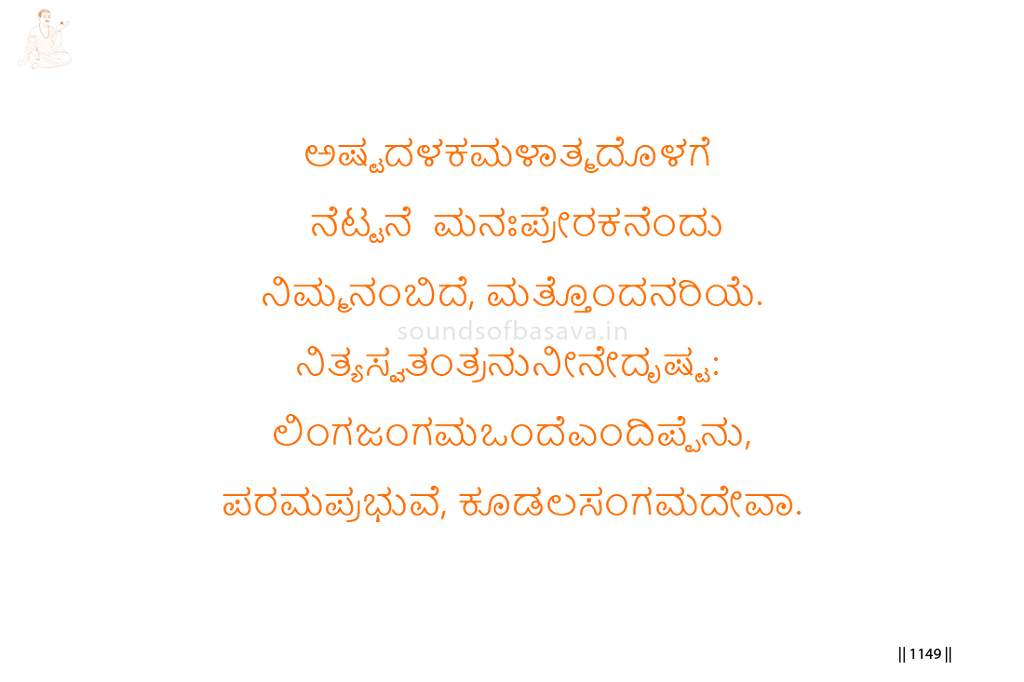
Within the eight-petalled lotus of the self, Basavanna places unwavering trust in Kudalasangama Deva as the inward mover of the mind.
He knows no other. Kudalasangama Deva alone is eternally free and self-governing.
From this inward certainty, Basavanna remains established in the recognition that the visible Linga and the living Jangama are one.
Imagery & Symbolic Relevance
Within the eight-petalled lotus of the self, Basavanna places unwavering trust in Kudalasangama Deva as the inward mover of the mind.
He knows no other. Kudalasangama Deva alone is eternally free and self-governing.
From this inward certainty, Basavanna remains established in the recognition that the visible Linga and the living Jangama are one.
Lingayoga
In Lingayoga, the mind must cease claiming itself as the independent guide of practice. Its movement is entrusted to Kudalasangama Deva.
The visible Linga and the living Jangama must not be honoured through divided attitudes. Worship before Linga must continue as reverence, service, and right relation before Jangama.
The practical measure is inward and outward agreement: one Lord moves the mind, and one Divine presence is recognized through both Linga and Jangama.
Editorial Commentary
The eight-petalled lotus should remain an inward sacred image. The Kannada does not require a detailed system of bodily centres or esoteric anatomy.
Manah-preraka means the inward mover or prompter of the mind. Basavanna places the mind under Kudalasangama Deva’s direction rather than declaring the mind itself Divine.
Nitya-svatantra belongs to Kudalasangama Deva. It indicates the Lord’s eternal freedom and self-sufficiency.
The statement that visible Linga and Jangama are one should not erase their functional distinction. It affirms that the fixed sacred presence and the living sacred presence belong to one Kudalasangama Deva.
Related Vachana
Supporting Vachana
Sharana Sthala Vachana 1340 — Other Than Linga, What Else Shall I Seek?
Sharana Vachana 1340 declares that Basavanna will seek none other than Linga, contemplate none other than Shiva-Linga, bow to none other than Jangama, receive nothing except Prasada, and keep no company apart from Shiva’s devotees.
This prepares Vachana 822 through disciplined undividedness. Sharana Vachana 1340 gathers seeking, contemplation, bowing, receiving, and fellowship into one sacred direction.
Vachana 822 reveals the inward maturity of that direction. Kudalasangama Deva becomes the mover of the mind; no other is known; and Linga and Jangama are recognized as one Divine presence.
What is maintained in Sharana as exclusive fidelity becomes in Aikya settled inward recognition.
Advancing Vachana
Aikya Sthala Vachana 1192 — Jangama Seva Is the Eternal Path
Vachana 822 establishes that the visible Linga and the living Jangama are one.
Vachana 1192 carries this recognition into conduct. Jangama Seva is known there as Guru-puja, Linga-puja, sustenance, true nature, the Self, and the Eternal State.
The continuation is direct: Vachana 822 gives the inward recognition of unity; Vachana 1192 reveals its lived consequence. Service to Jangama is no longer separate from worship of Linga.
Undivided seeing thus matures into undivided worship and service before Kudalasangama Deva.
