

Summary
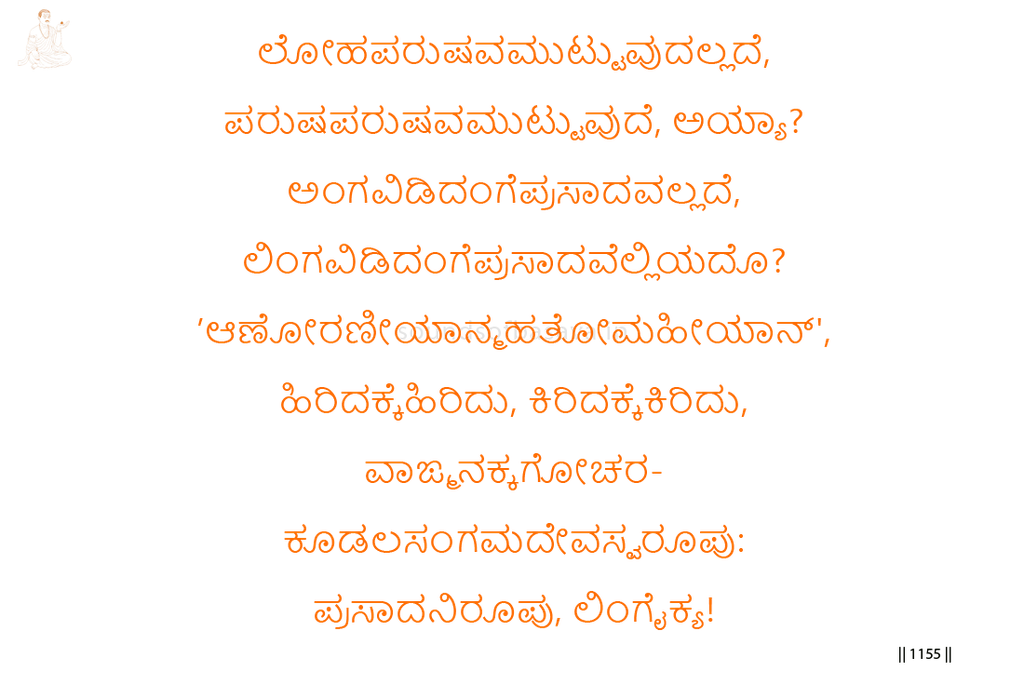
Basavanna asks whether the philosopher’s stone must touch another philosopher’s stone, as iron touches it for transformation. The transforming principle does not itself require a second transformation.
Likewise, Anga bears Linga while the relation between devotee and Divine remains distinct. When Anga has been received into Linga, no second Linga remains to be sought.
Kudalasangama Deva is greater than the great, smaller than the small, and beyond speech and mind. The vachana names Svarupa as Prasada and Nirupa as Lingaikya.
Imagery & Symbolic Relevance
Iron and the philosopher’s stone form the opening comparison. Iron approaches the philosopher’s stone because it is still subject to transformation. The philosopher’s stone does not seek another philosopher’s stone to become what it already is.
The image distinguishes the one requiring transformation from the transforming presence. Once the former condition has ended, the same relation cannot continue indefinitely as though transformation had never occurred.
The Anga–Linga question applies this principle inwardly. Anga bears Linga in worship, remembrance, and disciplined relation. Here, Anga and Linga remain distinguishable as devotee and the Divine received.
The second question reverses the relation. When Linga has taken hold of Anga, what other Linga could remain? The question removes the idea of one Linga being reached through another in an endless sequence.
“Aṇor aṇīyān, mahato mahīyān” removes measurement. Kudalasangama Deva is not merely extremely small or extremely great. He cannot be confined by either scale.
“Greater than the great” and “smaller than the small” place the Lord beyond comparison. Size cannot define His presence.
The Lord is also beyond speech and mind. Words cannot contain Him, and mental conception cannot provide His measure.
The closing distinction is concise. Svarupa—manifest presence—is Prasada. Nirupa—that which is beyond form—is Lingaikya. Form is received as grace; beyond form, the separate Anga–Linga relation no longer stands.
Lingayoga
In Lingayoga, the Anga begins by bearing and worshipping the Linga. This relation must be lived fully rather than dismissed prematurely.
Yet the practitioner must not preserve separation as the final condition. When the Anga is wholly received into the Linga-relation, no second sacred centre remains to be pursued.
Svarupa is honoured as Prasada, while Nirupa is known as Lingaikya. The embodied form is therefore neither rejected nor treated as the final limit of Kudalasangama Deva.
Editorial Commentary
The philosopher’s-stone comparison concerns transformation. Iron requires the philosopher’s stone; the philosopher’s stone does not require another of its kind for further transformation.
The Anga–Linga questions should not be reduced to physical containment. They test whether the Divine can remain one object among others after Anga has been taken into the Linga-relation.
“Aṇor aṇīyān, mahato mahīyān” removes all dimensional measure. “Beyond speech and mind” indicates that Kudalasangama Deva cannot be contained by description or conception.
The final expressions should retain their distinction: Svarupa Prasada and Nirupa Lingaikya.
Related Vachana
Supporting Vachana
Sharana Sthala Vachana 829 — The Algebra of Surrender
Sharana Vachana 829 declares that when the body, mind, and wealth are known as belonging to Kudalasangama Deva, no separate body, mind, wealth, or possessive concern remains.
This prepares Vachana 839 by removing the Anga’s independent claim. Vachana 839 carries that surrender further: once Anga has been taken into the Linga-relation, another separate Linga cannot remain as a further object of attainment.
What begins in Sharana as the ending of ownership matures in Aikya into freedom from the distinction that repeatedly separates the transformed Anga from Linga.
Advancing Vachana
Aikya Sthala Vachana 875 — The Sharana Who Is Not Two
Vachana 839 presents Svarupa as Prasada and Nirupa as Lingaikya, beyond all measure and conception.
Vachana 875 advances this by revealing the Sharana who is confined by neither form nor formlessness. Embodied life continues, yet no duality remains.
Thus the distinction between Svarupa and Nirupa reaches fulfilment in the Sharana who is not two before Kudalasangama Deva.
