

Summary
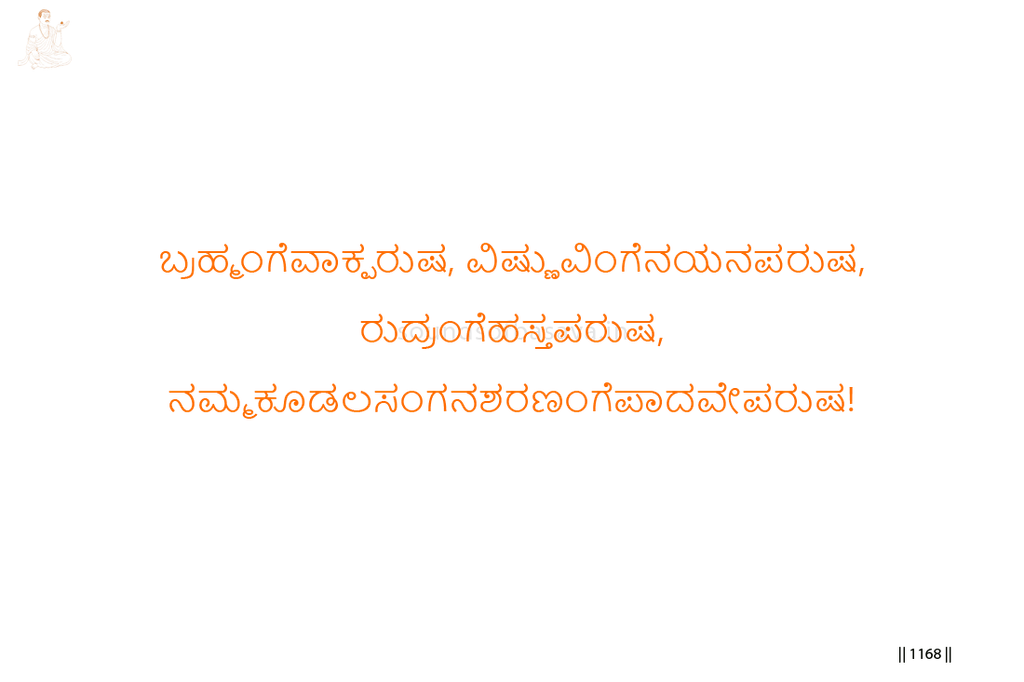
Basavanna identifies a distinct transforming power in each sacred figure. For Brahma, speech is paruṣa; for Vishnu, the eye is paruṣa; and for Rudra, the hand is paruṣa.
For Kudalasangama’s Sharana, however, the feet themselves are paruṣa—the touchstone whose contact transforms what comes near.
The vachana therefore culminates in the living feet of the Sharana. Divine transformation is not confined to word, gaze, or hand; it becomes embodied in the path walked by Kudalasangama Deva’s Sharana.
Imagery & Symbolic Relevance
Brahma and vāk-paruṣa form the first relation. Vāk means speech or word. Brahma’s transforming power operates through utterance.
The image gives speech an active force. Word does not merely describe; it can instruct, name, awaken, and alter the one who receives it.
Vishnu and nayana-paruṣa form the second relation. Nayana means the eye or sight. Here transformation operates through seeing.
The gaze is not presented as ordinary visual perception. It is sight carrying the power to affect and transform what comes within it.
Rudra and hasta-paruṣa form the third relation. Hasta means the hand. The hand touches, acts, directs, and performs.
The transforming power therefore moves from speech, to sight, to direct contact through the hand.
The final movement concerns Kudalasangama’s Sharana. For him, the feet themselves are paruṣa.
The feet are the point of contact with the earth and the means by which the Sharana walks his lived path. They carry the conduct, journey, and embodied presence of one established in Kudalasangama Deva.
To approach the Sharana’s feet is therefore not merely to honour a physical part of the body. It is to come into contact with the path he has lived and the realized condition in which he stands.
The sequence also reverses ordinary ideas of hierarchy. Speech, eye, and hand may appear more elevated or active, while the feet appear lowest. Basavanna places the greatest transforming contact precisely there.
The Sharana’s feet become the touchstone because contact with the living Sharana changes the seeker. What comes near does not remain under its former measure.
Lingayoga
In Lingayoga, transformation cannot remain limited to hearing sacred words or seeing sacred forms. Word must enter understanding, vision must become recognition, and bodily nearness must mature into surrender.
The feet of the Sharana represent contact with lived realization. The practitioner bows not before status or personality, but before the path made visible through the Sharana’s conduct.
Such contact must produce inward change. As iron touched by the alchemical stone does not remain iron, nearness to Kudalasangama Deva’s Sharana should loosen former identity, pride, and separation.
Editorial Commentary
Paruṣa in this vachana carries the alchemical sense of a touchstone or transforming power. The compounds vāk-paruṣa, nayana-paruṣa, hasta-paruṣa, and pāda-paruṣa identify speech, sight, hand, and feet as distinct means through which transformation operates.
The Kannada does not say that Brahma, Vishnu, or Rudra are bound by these faculties. It assigns a particular transforming faculty to each and culminates in the Sharana’s feet.
The final declaration concerns specifically the feet of Kudalasangama’s Sharana. Its force arises from the Sharana’s realized and lived relation with the Lord.
Related Vachana
Supporting Vachana
Sharana Sthala Vachana 140 — The Alchemy of a Glance
Sharana Vachana 140 says that seeing the Shiva-bhakta becomes refuge and that touching and bowing at the feet is like contact with the transforming touchstone.
It prepares Vachana 876 by establishing that the Sharana’s feet are not merely honoured; their contact transforms and prevents return to the former garland of becoming.
Advancing Vachana
Aikya Sthala Vachana 1100 — When Head and Feet Become One
Vachana 1100 carries the transforming power of the feet into direct fulfilment. Basavanna’s head merges with Kudalasangama Deva’s feet, bodily deceit and mental distortion melt away, and inner darkness disappears in their radiance.
Thus the feet identified as paruṣa in Vachana 876 become the actual field of transformation in Vachana 1100.
