

Summary
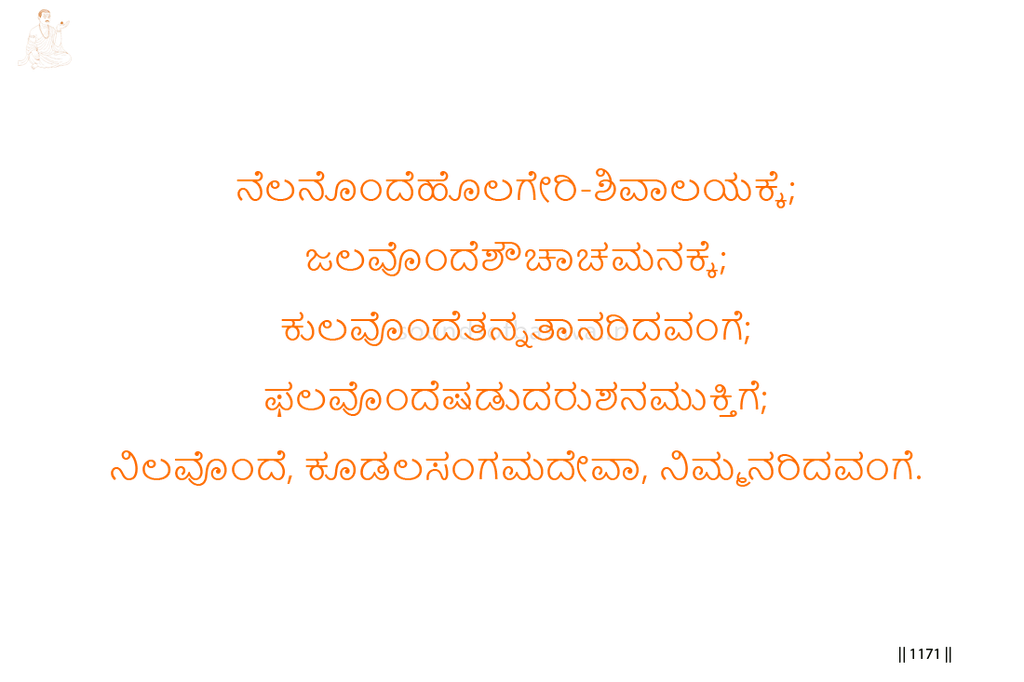
Basavanna declares one earth for both the Holageri and the Shiva temple, and one water for both bodily cleansing and ritual achamana. The divisions of sacred and unsacred, socially separated and ritually privileged, cannot alter the earth and water shared by all.
For the one who knows oneself, lineage is one. For the six darshanas, the fruit of liberation is one. For the one who knows Kudalasangama Deva, the abiding state is one.
The repeated “one” removes divisions of place, purity, lineage, philosophical position, spiritual fruit, and final standing.
Imagery & Symbolic Relevance
“One earth” gives the first declaration. Basavanna places the Holageri and the Shivalaya upon the same ground.
The Holageri is the settlement associated with those whom society placed outside its accepted caste boundaries. The Shivalaya is the temple regarded as sacred. Basavanna brings these sharply separated locations onto one earth.
The earth does not reproduce the distinction imposed by society. It bears the socially excluded settlement and the Shiva temple without division.
“One water” gives the second declaration. The same water serves shaucha, bodily cleansing, and achamana, ritual purification through the ceremonial sipping of water.
Basavanna does not deny their different functions. He shows that the water used in both remains one. Functional distinction does not create separate substances or separate sacred worth.
“One lineage” gives the third declaration. This lineage belongs to the one who has known oneself.
Lineage is therefore no longer finally determined by birth, ancestry, inherited caste, or social recognition. Self-knowledge removes the authority of competing birth-based classifications.
“One fruit” gives the fourth declaration. For the six darshanas, the fruit of liberation is one.
The line acknowledges distinct philosophical visions while identifying liberation as the single fruit. It does not require every doctrine or method to be declared identical; it places their final fruit under one measure.
“One abiding state” completes the vachana. For the one who knows Kudalasangama Deva, no divided spiritual standing remains.
The final unity is therefore not an abstract numerical statement. It is the settled condition of one whose knowing rests in Kudalasangama Deva.
The sequence moves from shared earth and water, through the removal of lineage-division, to one liberating fruit and one abiding state.
Lingayoga
In Lingayoga, Linga-awareness must transform the way the practitioner sees place, purity, birth, and spiritual standing.
The practitioner cannot honour the Linga while continuing to treat human beings as divided by sacred and unsacred ground. Nor can ritual purification be allowed to support social impurity or exclusion.
Self-knowledge must loosen inherited identity, while knowledge of Kudalasangama Deva must gather the practitioner into one steady abiding. Practice matures when external distinctions no longer divide inward recognition or conduct.
Editorial Commentary
Holageri and Shivalaya are intentionally contrasted. The force of the line lies in placing the socially excluded settlement and the sacred temple upon the same earth.
Shaucha and achamana are distinct uses of water—bodily cleansing and ritual purification—but the water remains one.
The reference to the six darshanas should remain as given in the Kannada. It does not refer to the six Sthalas.
Nila indicates standing, state, or abiding ground. The final line concerns the single abiding condition of one who knows Kudalasangama Deva.
Related Vachana
Supporting Vachana
Sharana Sthala Vachana 453 — The Protocol of the Divine Guest
Sharana Vachana 453 forbids asking the occupation or caste of a Bhakta who comes bearing Divine presence.
It prepares Vachana 879 by rejecting caste-measure in sacred fellowship. In Aikya, this matures into one earth, one lineage, and one abiding state.
Advancing Vachana
Aikya Sthala Vachana 894 — The Silence Where Only Linga Remains
Vachana 894 carries this non-division into lived vision: others are beheld as Sharanas, moving Jangamas, and living Lingas, while Kudalasangama Deva alone remains the eternal Linga.
The fivefold declaration of oneness in Vachana 879 thus deepens into perception in which spiritual hierarchy and separation no longer govern.
