

Summary
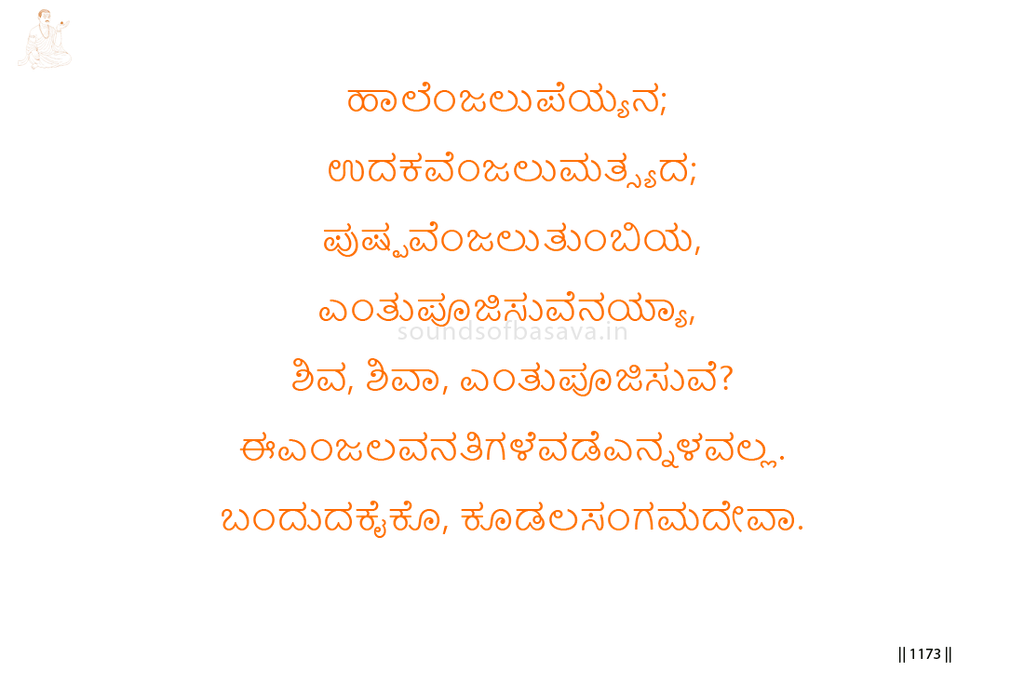
Basavanna examines the materials ordinarily used in worship. Milk has already been touched by the calf, water by the fish, and the flower by the bee. None can be presented as wholly untouched.
He repeatedly asks how worship is possible under such a demand for ritual purity. Unable to remove this condition of enjalu, he turns directly to Kudalasangama Deva and asks Him to receive whatever has come.
The movement is from anxiety over untouched offerings to surrendered worship. The Lord is not approached through the worshipper’s claim of perfect purity, but through the honest offering of what is available.
Imagery & Symbolic Relevance
Milk is the first offering. Basavanna calls it the calf’s enjalu. Before milk reaches the worshipper, the calf has already approached and received it.
The image does not condemn the calf or the milk. It exposes the impossibility of claiming that the offering has remained wholly untouched by another living being.
Water gives the second image. It is called the fish’s enjalu. Fish live, move, and feed within it; water cannot be separated from the life already present in it.
The flower gives the third image. It is the bee’s enjalu. The bee has already approached, touched, and drawn from the flower before it is taken for worship.
The sequence moves through three familiar offerings—milk, water, and flowers. Each appears pure according to ritual expectation, yet each has already participated in living contact.
The repeated cry, “How shall I worship, Shiva, Shiva; how shall I worship?” gives the vachana its urgency. Basavanna is not refusing worship. He is questioning a standard under which no natural offering could ever become acceptable.
The statement that he cannot remove this enjalu acknowledges the limit of personal purification. He cannot separate milk from the calf, water from the fish, or flowers from the bee.
The final plea, “Receive what has come,” resolves the difficulty. Basavanna does not manufacture another offering or claim that he has made these materials pure. He places what has come directly before Kudalasangama Deva.
The sequence is therefore precise: the offerings are examined, their prior living contact is recognized, ritual certainty fails, and worship becomes surrendered reception by the Lord.
Lingayoga
In Lingayoga, worship must become free from pride in the purity of the offering and the person who offers it.
The practitioner should maintain cleanliness and reverence, but cannot claim independent possession of perfectly untouched materials. Milk, water, flowers, body, hand, and action already belong to a larger field of life.
The practical movement is to offer faithfully without self-claim. What comes into the hand is placed before Linga with humility, and its reception is entrusted to Kudalasangama Deva.
Editorial Commentary
Enjalu carries the force of leftover or contact-based impurity. Here it is applied to milk after the calf, water inhabited by fish, and flowers touched by the bee.
The animals are not presented as morally impure. Their contact reveals the impossibility of maintaining an absolute ritual distinction between untouched and touched offerings.
The final line governs the interpretation. Basavanna does not say that he has purified the materials; he asks Kudalasangama Deva to receive what has come.
Related Vachana
Supporting Vachana
Sharana Sthala Vachana 1315 — Is There Any Separation Between the Two?
Sharana Vachana 1315 surrenders separate agency in doing and giving, recognizing both as movements made possible by Kudalasangama Deva.
It prepares Vachana 886, where even the offering cannot be claimed as independently possessed or purified. What comes is simply placed before the Lord.
Advancing Vachana
Aikya Sthala Vachana 887 — Beyond Claim, Beyond Attainment
Vachana 887 removes the remaining claim, “purity is mine” or “attainment is mine.”
Thus the surrendered offering of Vachana 886 deepens into receiving without ownership, where neither purity, attainment, giver, nor gift is personally claimed.
