

Summary
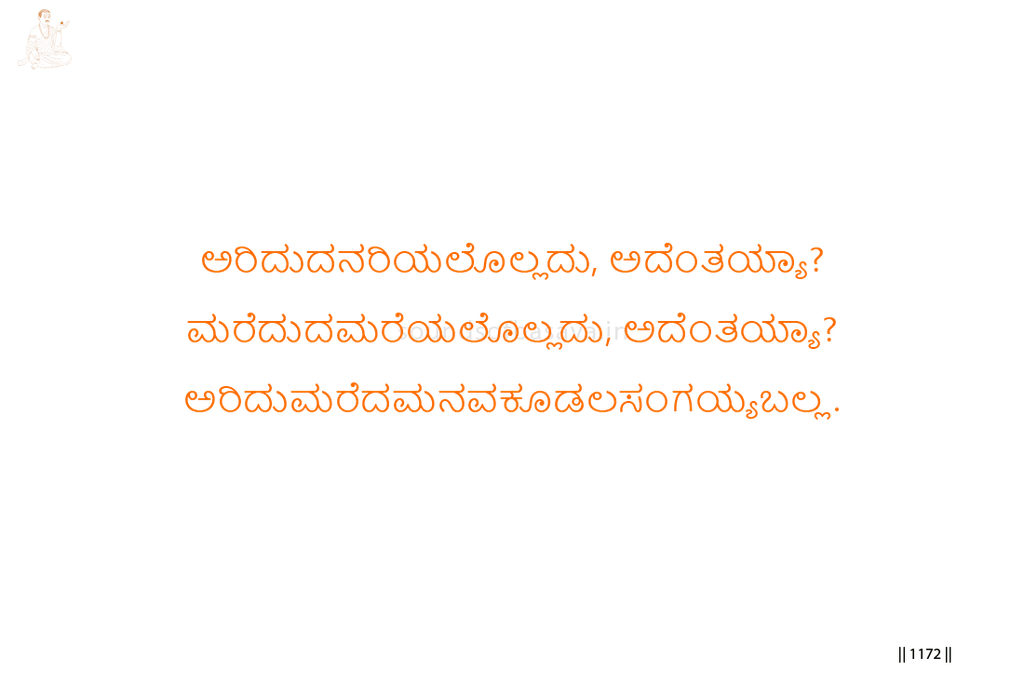
Basavanna presents a paradox of knowing. What has been known does not allow itself to be known again as an object that the mind can grasp. What has been forgotten does not allow itself to be completely forgotten.
The mind moves through knowing and forgetting, but neither movement contains the truth fully. Kudalasangayya alone knows the mind that has passed through both.
The vachana therefore removes personal mastery over realization. True knowing cannot be possessed, while its presence cannot be erased like an ordinary memory.
Imagery & Symbolic Relevance
This vachana contains no material image. Its movement is formed through the opposed actions of knowing and forgetting.
“What has been known does not allow itself to be known” gives the first paradox. Ordinary knowledge can be examined, recalled, explained, and possessed as information.
The knowing indicated here does not submit to that form of grasping. Once directly known, it cannot be placed at a distance and known again as a separate object.
Basavanna’s exclamation—“What is this, Ayya?”—expresses wonder before this condition. He does not claim control over it or offer a conceptual definition.
“What has been forgotten does not allow itself to be forgotten” gives the second paradox. Ordinary memory may weaken, disappear, or be deliberately dismissed.
This recognition cannot be erased in that manner. Even when the mind appears to forget, what has been directly known does not return to complete absence.
The two lines therefore do not describe intellectual confusion. They reveal the inadequacy of the mind’s ordinary categories.
Knowing cannot possess the realization, and forgetting cannot destroy it.
The final line brings the mind before Kudalasangayya. The mind has known and forgotten; Kudalasangayya alone knows that mind.
Basavanna does not say that the mind has become an infallible knower. He places both its knowing and its forgetting under the Lord’s complete knowledge.
The sequence is precise: knowing cannot grasp what has been known; forgetting cannot erase what has been forgotten; and Kudalasangayya alone knows the mind moving through both.
Lingayoga
In Lingayoga, realization must not be treated as information that the practitioner can possess and repeatedly display.
The practitioner may experience clarity and later feel that the clarity has receded. This vachana prevents both pride during knowing and despair during apparent forgetting.
Practice should remain surrendered to Linga through both conditions. The mind’s changing sense of knowing or forgetting is not the final measure; Kudalasangama Deva remains the knower of the mind.
The practical discipline is therefore non-claiming steadiness. Neither “I know” nor “I have lost what I knew” should become a new spiritual identity.
Editorial Commentary
The repeated construction carries the force of “does not consent to” or “does not allow itself to.” The truth is neither available for mental possession nor available for complete erasure.
The vachana distinguishes direct recognition from ordinary memory. It does not claim that factual knowledge can never be recalled or forgotten.
The final line preserves the distinction between the fluctuating mind and Kudalasangayya, who alone knows the mind’s complete movement.
Related Vachana
Supporting Vachana
Sharana Sthala Vachana 843 — That Which Cannot Be Attained by Words
Sharana Vachana 843 distinguishes verbal knowledge from Anubhava and teaches that words cannot substitute for lived realization.
It prepares Vachana 884, where direct knowing can neither be mentally possessed nor erased through forgetting.
Advancing Vachana
Aikya Sthala Vachana 899 — The Measure of the True Sharana
Vachana 899 distinguishes ritual, conceptual knowledge, and outward claims from directly seeing Linga within.
Thus the ungraspable knowing of Vachana 884 becomes the authentic inward recognition by which the true Sharana is known.
