

Summary
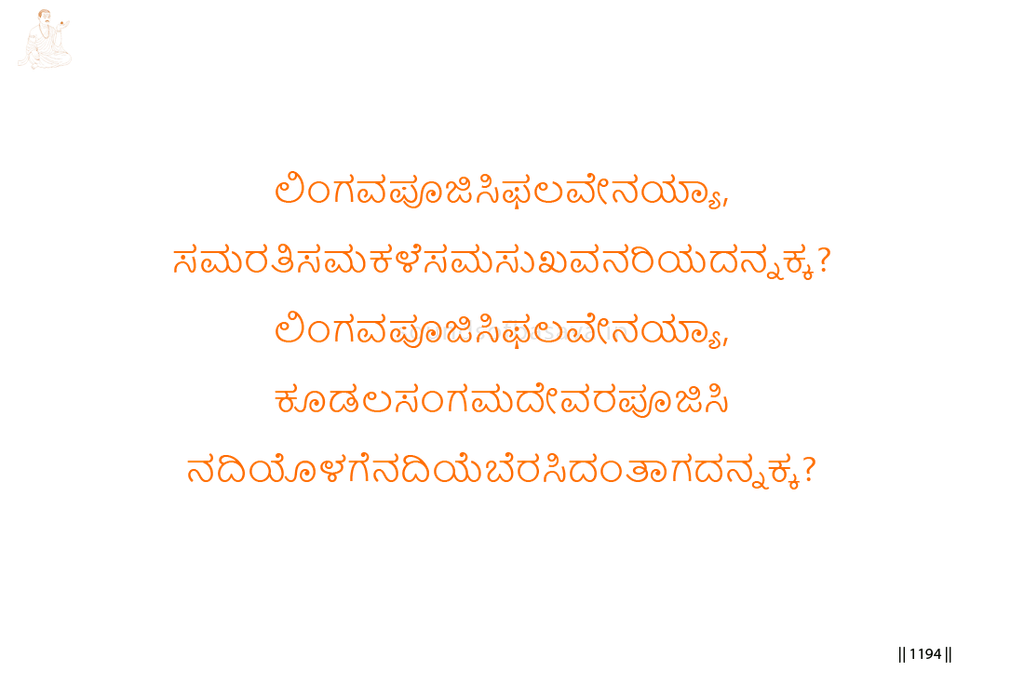
Basavanna asks what fruit comes from worshipping Linga if Samarati, Samakale, and Samasukha have not been known.
He repeats the question and gives the measure of fulfilled worship: one must become like a river blending into another river.
Worship bears fruit when the worshipper no longer preserves superiority, opposition, or separate spiritual ownership before Kudalasangama Deva.
Imagery & Symbolic Relevance
The repeated question—“What is the fruit of worshipping Linga?”—examines the effect of worship rather than its outward completion.
Basavanna does not reject Linga-puja. He asks whether it has produced the condition toward which worship is directed.
Three terms name that fruit:
Samarati — equal delight, love, or inward harmony;
Samakale — a state in which separating distinctions no longer dominate;
Samasukha — joy shared without preference or divided possession.
These terms should remain together. They move from inward disposition, through undivided condition, into its joy.
The final image is not a river entering the sea. It is a river blending into a river.
Before meeting, the rivers may have different names, banks, routes, and places of origin. Once their waters join, neither current can maintain an isolated boundary or claim superiority over the other.
Because both are rivers, the image especially conveys equality. One does not become the ruler, container, or owner of the other. They become one flowing current.
The name Kudalasangama Deva strengthens the image. Sangama is confluence. To worship the Lord of confluence while inwardly preserving separation would leave the worship incomplete.
The sequence is direct: Linga is worshipped, its fruit is questioned, the three states of harmony are named, and their fulfilment is shown through river joining river.
Lingayoga
In Lingayoga, the value of worship is tested by transformation.
Puja that leaves pride, hierarchy, possessiveness, and opposition untouched has not yet yielded its full fruit. The practitioner may correctly perform worship while still maintaining a separate centre that says, “I worship,” “I have attained,” or “I am greater.”
The river image gives the correction. Linga-centred practice must soften the boundary through which the practitioner remains inwardly opposed to the Lord, the Sharana, and other beings.
This does not erase responsible conduct or visible difference. It removes the self-claim that converts difference into division.
Editorial Commentary
The vachana should not be reduced to social equality alone, though social hierarchy is clearly challenged by its movement. Its primary test is whether Linga-worship has become lived non-separation.
Samarati, Samakale, and Samasukha should not be collapsed into one general word. Each contributes to the progression toward fulfilled worship.
Here two rivers meet as rivers, emphasizing equal union.
The repeated question is not contempt for ritual. It demands that ritual bear its intended fruit.
Related Vachana
Supporting Vachana
Sharana Sthala Vachana 1385 — The Bliss of Linga-Aikya
Vachana 1385 says that Samarati, inward joining, and sacred joy became possible through Kudalasangama Deva and the guidance of Prabhudeva.
It prepares Vachana 930, where that grace-given path becomes the tested fruit of Linga-worship.
Advancing Vachana
Aikya Sthala Vachana 942 — Beyond Division in the Ocean of Linga
Vachana 942 carries the water image further: like a drop entering the ocean, separate taste and bhinnabhava disappear.
Thus the river-union of Vachana 930 matures into complete freedom from divided feeling.
