

Summary
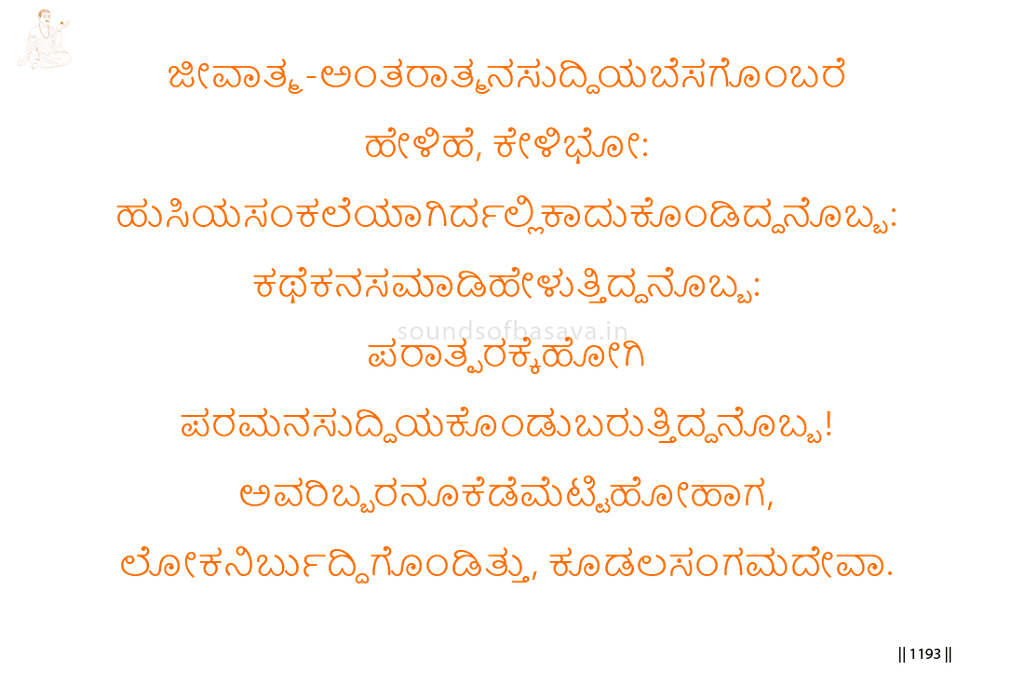
Basavanna announces that he will tell the news concerning Jivatma and Antaratma. He then presents three unnamed figures.
One remains waiting within a false chain. Another fashions stories and dreams and continues speaking. The third actually travels to parāpara and returns bearing news of Parama, the Supreme.
When this true messenger overcomes the other two and departs, the world becomes bereft of discernment. It retains confinement and fabricated narration but loses the one who has directly brought the Supreme message.
Imagery & Symbolic Relevance
The vachana begins with an urgent invitation: “Listen!” What follows is not a systematic definition of Jivatma and Antaratma, but a dramatic account of three figures.
The first waits within a false chain. The chain signifies confinement, while “false” shows that the bondage is sustained by something lacking ultimate truth. Waiting within it does not produce release.
The second makes story and dream and keeps speaking. His words arise from fabrication rather than direct arrival from the Supreme. The dream should therefore not be automatically interpreted as genuine intuition or Divine revelation; within this sequence it is contrasted with the authentic news brought by the third figure.
The third figure travels to the realm beyond all dualities and brings back the news of the Supreme Reality, the ultimate, unconditioned Divine. Unlike the first, he does not remain bound. Unlike the second, he does not construct a report from imagination. He goes, encounters, and returns bearing news.
The word suddi means news or report. Its repetition emphasizes transmission: the decisive message comes from one who has made the journey, not from one who merely waits or speaks.
The third then keḍemeṭṭi—overcomes, puts down, or strides beyond—the other two. Their confinement and imagined narration cannot stand before the message directly brought from Parama.
When this messenger goes, the world becomes nibuddhi—deprived of intelligence or discernment. The world may continue speaking, dreaming, and waiting, yet without the bearer of true news it cannot distinguish direct realization from fabricated account.
Lingayoga
In Lingayoga, spiritual language must be tested by its source. A thought, dream, inherited account, or impressive narration should not be treated as realization merely because it concerns the Divine.
The practitioner must move beyond second-hand assertion toward lived contact with Linga. The true message is verified through transformation: it overcomes bondage and imaginative self-deception rather than strengthening them.
The vachana also gives importance to the realised bearer of truth. When the authentic messenger is ignored or driven away, information may remain abundant while discernment disappears.
Editorial Commentary
The three figures are not individually named in the Kannada. They should not be rigidly assigned to Jivatma, Antaratma, and Paramatma without qualification.
The third is not identified as Parama Himself; he is the one who goes to parāpara and brings the news of Parama.
The closing action must be translated accurately. The third figure overcomes the other two and goes away. The source does not say that all three depart together or merge simultaneously.
The world’s final condition is not enlightened astonishment. It becomes nibuddhi—without sound understanding—after losing the authentic messenger.
Related Vachana
Supporting Vachana
Sharana Sthala Vachana 924 — Beyond the Two Worlds
Vachana 924 rejects confinement within the boundary of Devaloka and Martyaloka and warns against claiming union from a partial taste.
It prepares Vachana 927, where the true messenger crosses to parāpara rather than remaining within bounded or imagined knowledge.
Advancing Vachana
Aikya Sthala Vachana 930 — The River of Equality
Vachana 930 tests worship by whether Samarati, Samakale, and Samasukha have arisen and whether one has become like a river merging into a river.
Thus the news brought from Parama in Vachana 927 becomes lived non-division rather than another story about realization.
