

Summary
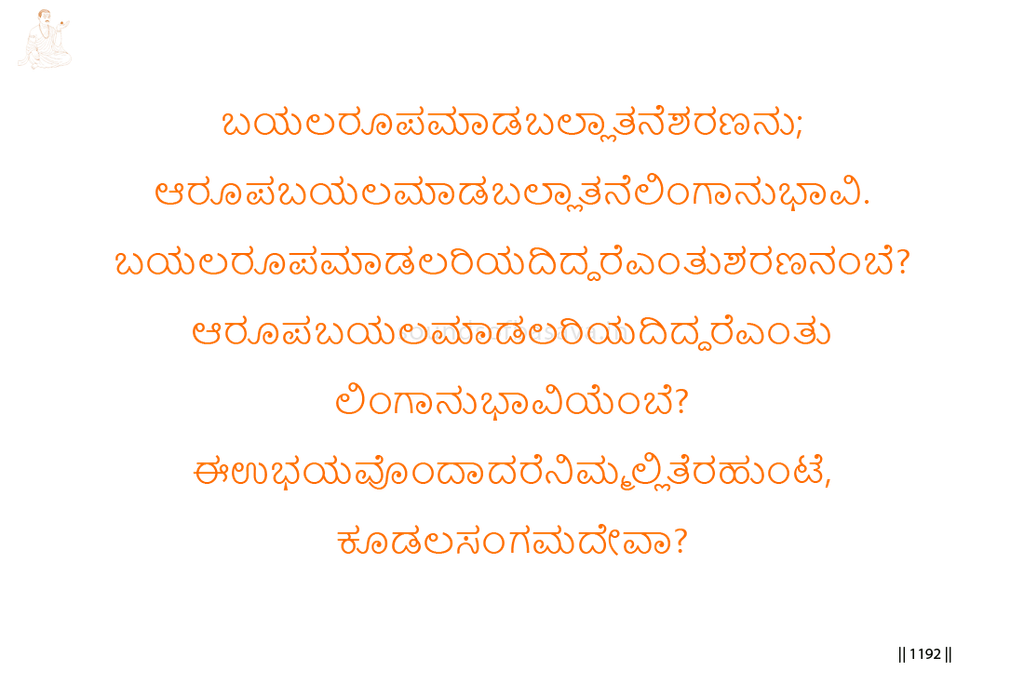
The Sharana is capable of making Bayalu—the open, unbounded Formless—take form. The Linganubhavi is capable of returning that manifested form to Bayalu.
Basavanna tests both designations through direct questions. One who cannot reveal Bayalu through form cannot rightly be called a Sharana; one who cannot make that form Bayalu cannot rightly be called a Linganubhavi.
When these two movements become one, no division remains in Kudalasangama Deva. Form and Formless are not competing realities, but reciprocal expressions of one Divine truth.
Imagery & Symbolic Relevance
The vachana is built upon two opposite but complementary movements.
The first is:
Bayalu becomes form.
Bayalu means the open, unobstructed expanse. In this vachana, it carries the force of the Formless—not a visible object limited by boundary or shape.
The Sharana makes this Bayalu take form. This does not mean that the Sharana manufactures the Divine. The Formless becomes recognizable through the Sharana’s embodied presence, conduct, speech, and relationship.
The Sharana therefore gives visible expression to what cannot otherwise be confined to a visible form.
The second movement reverses the first:
That form becomes Bayalu.
The phrase “that form” is important. It refers to the very form through which Bayalu has become manifest.
The Linganubhavi does not cling to the manifested form as though it were complete in itself. He knows its open, unbounded ground and returns it to Bayalu without denying its appearance.
Basavanna then turns both statements into tests.
If one cannot make Bayalu form, how can that person be called a Sharana? The name Sharana requires more than speaking about an invisible or abstract Divine. The Formless must become evident in lived existence.
If one cannot make that form Bayalu, how can that person be called a Linganubhavi? Experience of Linga requires the ability to see beyond the boundary of manifested form without rejecting the form itself.
The final question joins the two capacities. Sharana and Linganubhavi are not presented as permanently opposed identities. When their two movements become one, Basavanna asks whether any separating gap remains in Kudalasangama Deva.
The vachana therefore presents a complete circulation:
Bayalu becomes form through the Sharana.
Form becomes Bayalu through the Linganubhavi.
Both become one in Kudalasangama Deva.
Lingayoga
In Lingayoga, the practitioner must avoid one-sidedness.
Seeking only the Formless may lead to rejection of the body, the Ishtalinga, Jangama, conduct, and embodied service. Clinging only to form may obscure the unbounded reality that form reveals.
Practice must therefore move in both directions. Linga becomes visible through worship, conduct, and living relationship; yet every visible form must remain transparent to Bayalu.
The mature practitioner neither abandons form nor confines the Divine within it. Form is honoured as manifestation and released from possessive limitation.
Editorial Commentary
Bayalu should not be reduced to blank emptiness or non-existence. It signifies open, unobstructed vastness beyond limiting form.
The verb “make” expresses realized capacity, not personal creation. The Sharana does not create Bayalu, and the Linganubhavi does not physically destroy form.
The two designations carry distinct functions:
the Sharana manifests the Formless through form;
the Linganubhavi recognizes and returns form to its Formless ground.
The concluding question does not erase these functions prematurely. It first preserves both movements and then reveals their unity in Kudalasangama Deva.
Related Vachana
Supporting Vachana
Sharana Sthala Vachana 399 — Formless Meets Form
Vachana 399 says that, as a painting needs a surface and seed needs earth, the subtle Kudalasangama Deva becomes knowable through the living face of Jangama.
It prepares Vachana 923 by showing the Formless becoming recognizable through embodied presence.
Advancing Vachana
Aikya Sthala Vachana 1153 — Beyond Distinctions, Into Grace
Vachana 1153 declares that Kudalasangama Deva bears both Formless and Form, and that grasping one while abandoning the other is a deficiency.
Thus the reciprocal realization of Vachana 923 matures into equal acceptance without division between the two.
