

Summary
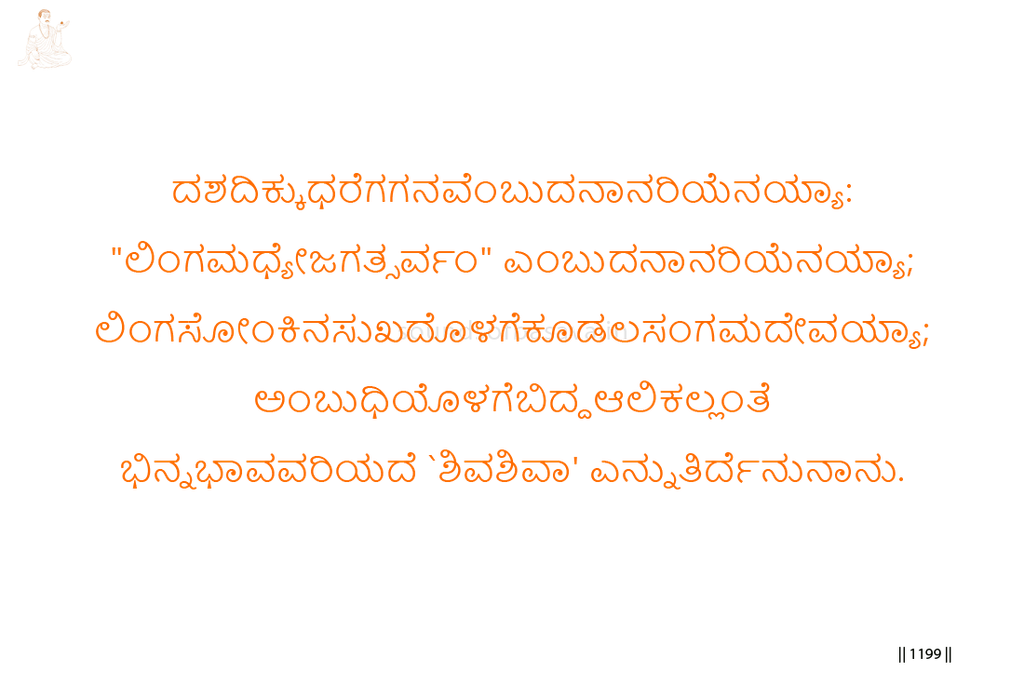
Within the joy of Linga-contact, Basavanna no longer knows the ten directions, earth, or sky. Even the sacred formulation, “All the world is within the Linga,” no longer remains as a separate thought.
He compares his condition to a hailstone fallen into the ocean. Divided feeling is no longer known, and he remains uttering, “Shiva, Shiva,” before Kudalasangama Deva.
Imagery & Symbolic Relevance
The ten directions form the first image. They represent the complete field of spatial orientation: every direction through which the world is located, divided, and measured.
Earth and sky extend this spatial field vertically. Earth is below and sky above; together they provide the broadest visible division within which embodied life ordinarily understands its place.
Basavanna says that he does not know these distinctions within the joy of Linga-contact. The statement is experiential: directions, earth, and sky no longer govern his awareness as separate fields.
The quoted expression “Linga-madhye jagat sarvam” — “All the world is within the Linga” introduces a sacred conceptual formulation. It gathers the entire universe within Linga and is therefore already a vision of Divine totality.
Yet Basavanna says that he does not know even this formulation within the joy of Linga-contact. The conceptual statement about the world being within Linga gives way to direct contact with Linga itself. What had been expressed as knowledge is no longer held separately from what is experienced.
The phrase Linga-sōnku gives the centre of the vachana. Sōnku means touch or contact. The joy described here arises from contact with Linga, not from cosmological analysis or doctrinal statement.
The ocean forms the final and governing natural image. It is vast, continuous water without the enclosed boundary of a small separate form.
The object falling into it is an ālikallu—a hailstone. A hailstone is water that has become hardened, bounded, and visibly distinct. Although it appears separate, its substance is not different from the water into which it falls.
When the hailstone enters the ocean, its fixed and isolated form cannot remain as before. The image shows the ending of hardened separateness within that which shares its own nature.
Basavanna compares himself directly to this hailstone. The image does not concern an external object entering an unrelated substance; it concerns what appears separately formed returning into the same element.
The phrase bhinnabhāva names what is absent: divided feeling, the inward disposition through which one experiences oneself, the world, and Linga as separately standing centres.
The final utterance, “Shiva, Shiva,” completes the movement. Basavanna does not conclude with a philosophical declaration. The name of Shiva arises repeatedly from the condition in which divided feeling is no longer known.
The complete sequence moves from cosmic space, to sacred formulation, to Linga-contact, and finally to the hailstone in the ocean. Directions and concepts recede; divided feeling disappears; the utterance “Shiva, Shiva” remains.
Lingayoga
This vachana distinguishes knowledge about Linga from direct contact with Linga. The practitioner may understand that the world exists within Linga, yet still hold that understanding as a thought standing apart from experience.
Linga-sōnku changes the governing bhāva. The decisive movement is not the accumulation of a greater cosmology, but the ending of the inward hardness through which Anga continues to experience itself as separate.
The hailstone gives the practice-measure. Linga-centred awareness must reach the boundary that sustains divided feeling. When that boundary no longer governs, remembrance arises without a second inward centre claiming the act.
“Shiva, Shiva” therefore becomes the living expression of undivided Linga-contact rather than a statement about unity.
Editorial Commentary
Daśa-dikku means the ten directions and gives the full spatial field.
“Linga-madhye jagat sarvam” means “All the world is within the Linga.” It appears in the vachana as a quoted sacred formulation.
Linga-sōnku means the touch or contact of Linga. Its joy governs the speaker’s condition.
Ālikallu means hailstone. The source-image is a hailstone falling into the ocean, not a drop of water.
Bhinnabhāva is divided feeling or the inward disposition of separateness.
The final words are spoken by Basavanna: “I was saying ‘Shiva, Shiva.’” The vachana culminates in repeated invocation.
Related Vachana
Supporting Vachana
Sharana Sthala Vachana 1385 — The Bliss of Linga-Aikya
Sharana Vachana 1385 says that Samarati, Samasandhana, Sangasukha, and the path of Linga-Aikya became possible through Kudalasangama Deva and through being placed in the refuge of Prabhudeva.
It prepares Vachana 942 by establishing Linga-Aikya as grace-given and revealed through the living Sharana. In Vachana 942, that revealed path becomes direct Linga-contact, where the hailstone-like boundary of divided feeling no longer remains.
Advancing Vachana
Aikya Sthala Vachana 1344 — When Linga Is Anga and Anga Is Linga
Vachana 1344 declares Linga to be Anga and Anga to be Linga; Linga to be Prana and Prana to be Linga. Nothing is displayed as present or searched for as absent; uninterrupted Linga alone abides.
Vachana 942 gives the experiential image of the hailstone entering the ocean and losing divided feeling. Vachana 1344 advances this into explicit recognition: Anga, Prana, and Linga no longer stand as separate terms requiring union.
