

Summary
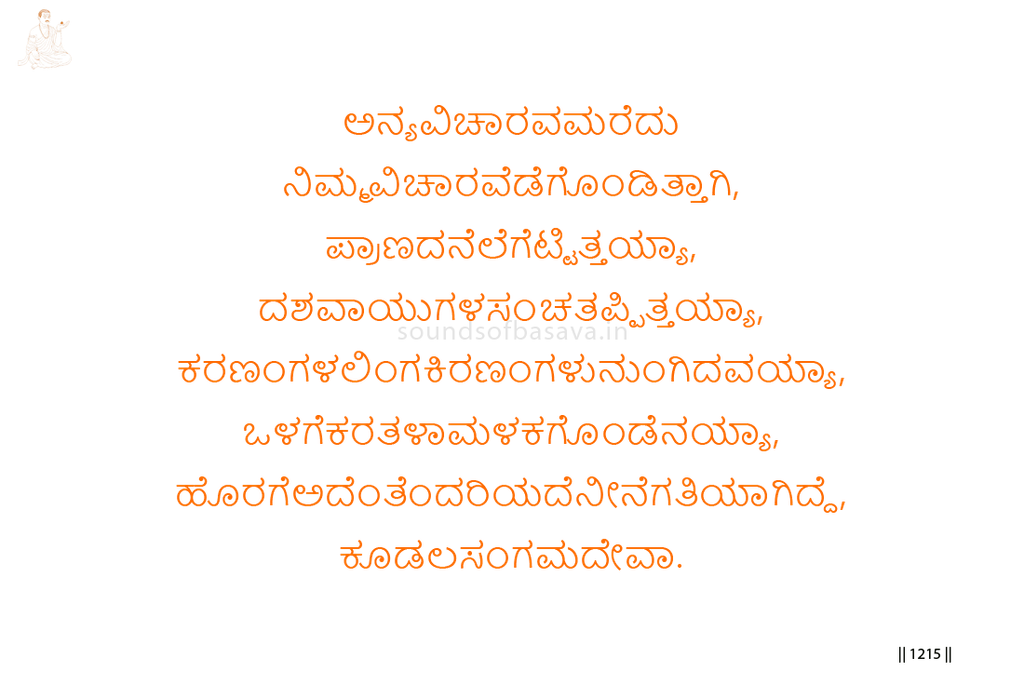
When other thought is forgotten and Kudalasangama Deva’s thought takes its place, Prāṇa becomes firmly established in its ground. The movement of the ten vital airs ceases, and the Linga-rays swallow the karaṇas.
Inwardly, the condition becomes evident like an āmalaka fruit resting in the palm. Outwardly, Basavanna cannot determine or express what it is. Kudalasangama Deva alone becomes his gati—his way, refuge, and destination.
Imagery & Symbolic Relevance
The first movement is the forgetting of anya-vichāra, other thought or concern.
Basavanna does not begin with an external act. He begins where attention had been divided among other concerns. Those concerns are forgotten, and Your thought takes their place.
The Kannada does not merely say that thought stops. One orientation yields to another: other thought recedes, while the thought of Kudalasangama Deva becomes established.
The next image is Prāṇa finding its ground.
Nelegattittu conveys being firmly grounded, settled, or established. Prāṇa is not described as extinguished. Its movement is brought into a stable ground.
The ten vital airs form the next field. Their sancha—movement, circulation, or roaming—ceases. What had moved through different directions no longer continues its independent wandering.
The vachana then names the karaṇas, the faculties or instruments through which perception and activity function.
These karaṇas are swallowed by the Linga-rays.
The ray-image is important. A ray proceeds from light and reaches what lies within its field. Here the rays do not merely illuminate the faculties from outside; they swallow them. The faculties no longer stand as independent instruments apart from Linga.
The most concrete image is karatalāmalaka.
An āmalaka fruit placed in the open palm is immediately present and plainly visible. It is neither hidden nor reached through inference.
Basavanna says that inwardly he became like this. The condition is directly evident within, with the clarity of an object resting openly in one’s own hand.
The following movement creates a deliberate contrast: outwardly, he does not know how or what it is.
Inward certainty does not become outward description. What is evident within cannot be given an equally definite external formulation.
The final expression is “You alone became my gati.”
Gati may mean way, refuge, course, or destination. Kudalasangama Deva is not merely one support among others. After other thought, scattered vital movement, and independent faculty-action have ceased, He alone remains as the way and refuge.
The sequence is exact:
other thought is forgotten;
Kudalasangama Deva’s thought becomes established;
Prāṇa finds its ground;
the movement of the ten vital airs ceases;
the Linga-rays swallow the karaṇas;
inwardly the condition becomes clear as the fruit in the palm;
outwardly it cannot be determined;
and Kudalasangama Deva alone becomes the gati.
Lingayoga
In Lingayoga, attention must cease to be divided among unrelated inward concerns. Remembrance becomes steady when the thought of Kudalasangama Deva occupies the place previously held by scattered thought.
Prāṇa, the vital movements, and the faculties are not left as independent centres of activity. They become grounded and gathered within Linga-relation.
The karatalāmalaka image gives the experiential measure. Linga-awareness becomes inwardly immediate rather than remaining an idea accepted from outside.
The culmination is refuge. Practice, inward movement, perception, and understanding are gathered into Kudalasangama Deva as the sole gati.
Editorial Commentary
Anya-vichāra means other thought, concern, or consideration.
Nimma vichāra edegondittu indicates that the thought or concern of Kudalasangama Deva took its place and became established.
Prāṇada nele gattittu means that Prāṇa became firmly grounded or established. It does not state that Prāṇa was destroyed.
Daśavāyugaḷa sancha tappittu means that the movement, circulation, or roaming of the ten vital airs ceased.
Karaṇa means faculty or instrument. The individual karaṇas are not enumerated in this vachana.
The Linga-kiraṇas, the rays of Linga, are the active agents that swallow the karaṇas.
Karatalāmalaka refers to an āmalaka fruit resting visibly in the palm. It signifies direct and unmistakable inward evidentness.
Gati includes way, refuge, course, and destination. The conclusion directly names Kudalasangama Deva as the speaker’s sole gati.
Related Vachana
Supporting Vachana
Sharana Sthala Vachana 1337 — Show Me the Difference Between Prana and Prana-Linga
In Sharana Vachana 1337, Basavanna confesses that outward worship has not revealed the living relation between his Prāṇa and Prāṇa-Linga. He asks Chennabasavanna to show that relation directly.
It prepares Vachana 981 closely. What remains an unresolved inquiry in Sharana Sthala becomes inwardly evident here: Prāṇa stands established, the vital movements cease their wandering, and the faculties are swallowed by the rays of Linga.
Advancing Vachana
Aikya Sthala Vachana 1154 — The Revelation of Linga-Aikya
Vachana 981 presents the inward condition in which Prāṇa is grounded, the karaṇas are swallowed by Linga-radiance, and Kudalasangama Deva alone becomes the way.
Vachana 1154 advances this through Chennabasavanna’s explicit revelation of the relation between Prāṇa-Linga and Linga-Prāṇa, culminating in the showing of Linga-Aikya. What is inwardly evident like the fruit in the palm in Vachana 981 is later made fully manifest through Guru-revelation.
