

Summary
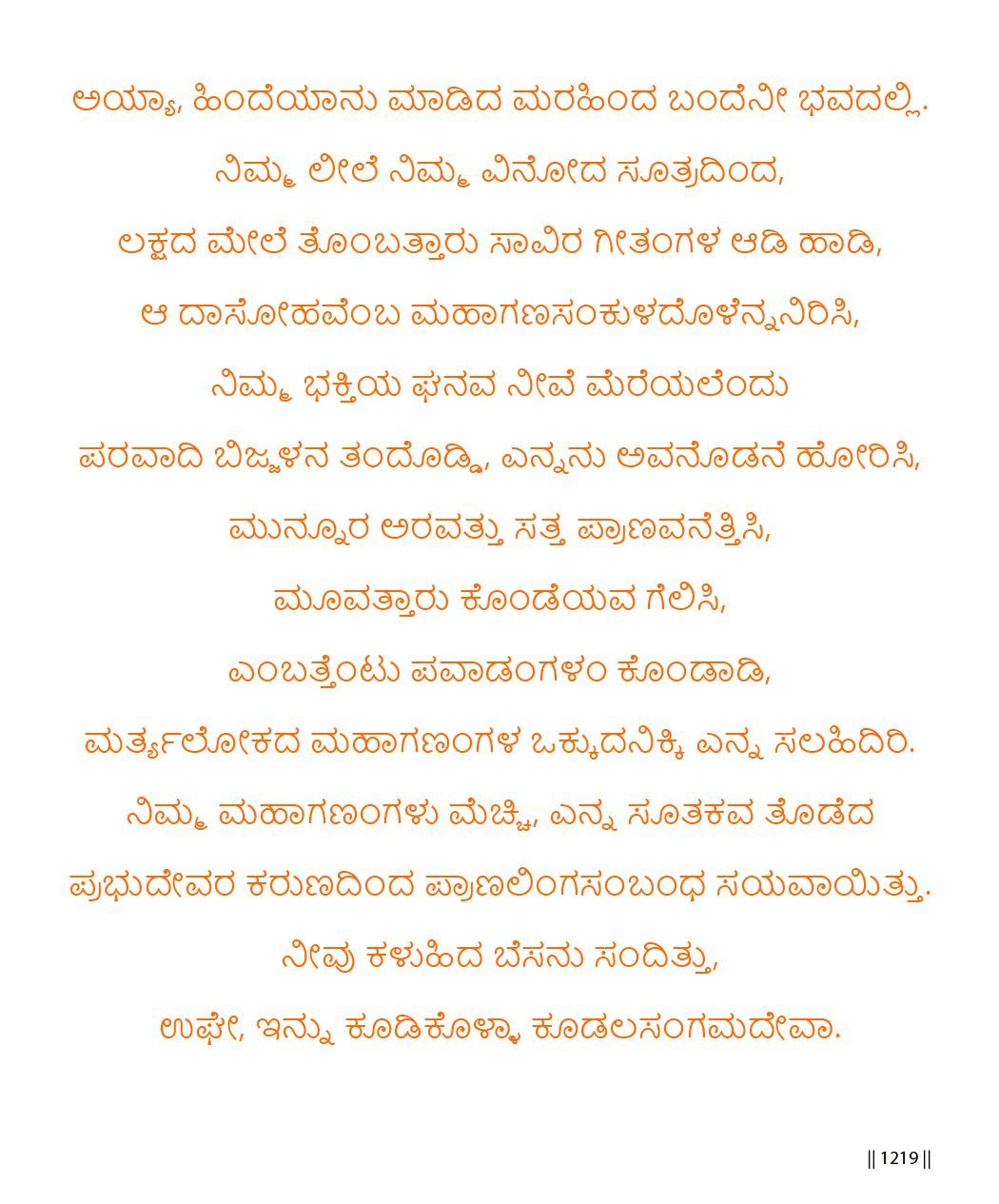
Basavanna says that through the forgetfulness of what had gone before, he came into this bhava, this embodied becoming.
Through Kudalasangama Deva’s līlā and the ordering thread of His vinoda, Basavanna danced and sang one lakh and ninety-six thousand songs. The Lord placed him within the great congregation called Dasoha and sustained him for the gathering of the Mahaganas in the mortal world, so that the fullness of the Lord’s own bhakti might be manifested.
The Mahaganas were pleased, and Basavanna’s sūtaka was removed. Through Prabhudeva’s compassion, the relation with Pranalinga became established. The commission for which Kudalasangama Deva had sent him reached completion.
With that work fulfilled, Basavanna makes his final request: call me now and take me into union, O Kudalasangama Deva.
Imagery & Symbolic Relevance
The vachana begins with forgetfulness.
Basavanna does not begin by claiming an exalted spiritual history. He looks back upon marahu—the condition of forgetting—and says that through it he came into this bhava.
Bhava here carries the sense of becoming or embodied existence. The opening therefore places his arrival in the mortal field within a movement from forgetfulness into Divine purpose.
The next image is the līlā and vinoda of Kudalasangama Deva.
Līlā is Divine play. Vinoda carries delight, wondrous movement, or Divine unfolding. The word sūtra gives the image of a thread that holds a long sequence together.
Basavanna’s life and expression are therefore not presented as disconnected personal acts. They are held upon the thread of Kudalasangama Deva’s play.
The vachana then gives an immense numerical image: one lakh and ninety-six thousand songs.
The total is 196,000. Basavanna says that he danced and sang them. Speech, song, and bodily movement appear together.
The number conveys a vast outpouring, but Basavanna does not claim authorship as private achievement. The songs arise within the Lord’s līlā-vinoda-sūtra.
The next image is the great congregation called Dasoha.
Dasoha is not presented as an isolated act of giving. It is a Mahagana-sankula—a dense gathering or great multitude of Ganas.
Basavanna says that Kudalasangama Deva placed him within this congregation. He does not appoint himself to it or stand above it. He is situated within a shared life of offering and sacred fellowship.
The vachana then turns to the Mahaganas of the mortal world.
The mortal world is the field in which the Divine work must become visible. Basavanna says that Kudalasangama Deva sustained him for the gathering of these Mahaganas.
His life is therefore held for a collective purpose. The songs, Dasoha, and the gathering of the Sharanas belong to one Divine movement.
The purpose is expressed through the phrase “that You Yourself might manifest the fullness of Your bhakti.”
The bhakti is named as Kudalasangama Deva’s own. Basavanna does not say that he wished to display the greatness of his devotion.
The Lord manifests His bhakti through the life, speech, song, fellowship, and Dasoha in which Basavanna has been placed.
The word ghana gives weight and fullness to this bhakti. It is not a passing feeling but a profound and concentrated devotional presence made visible through the Divine work.
The next movement concerns the approval of the Mahaganas.
Their pleasure or acceptance confirms that the work has occurred within Sharana-fellowship rather than through individual self-certification.
Following this, Basavanna’s sūtaka is removed.
Sūtaka denotes impurity or a defiling condition. The vachana does not enumerate its form. Its removal marks release from what had obstructed full belonging within the sacred congregation.
The decisive spiritual movement then appears: through Prabhudeva’s compassion, Pranalinga-sambandha became established.
Prabhudeva’s compassion is the enabling agency. Basavanna does not say that the Pranalinga relation arose merely because he had sung an immense number of songs or gathered a great community.
Expression and service do not substitute for realization. The living relation between Prāṇa and Linga becomes fulfilled through the grace of Prabhudeva.
The phrase concerning the commission sent by Kudalasangama Deva brings the life-work to completion.
The besana is the message, command, errand, or commission for which Basavanna was sent. It has now reached fulfilment.
The movement of the vachana is therefore not an escape from unfinished responsibility. Basavanna first accounts for the Divine play, the songs, Dasoha, the Mahaganas, the removal of impurity, the Pranalinga relation, and the completed commission.
Only then does he say: “Now call me.”
The final request remains dependent upon Kudalasangama Deva. Just as the Lord sent him, placed him, sustained him, and completed the work through him, the Lord must now call and receive him.
The full movement is from forgetfulness into becoming, from becoming into Divine service, from service into Mahagana fellowship, from fellowship into purification, from purification into Pranalinga relation, and from the fulfilled commission into the final request for union.
Lingayoga
In Lingayoga, the spiritual path cannot be separated from Divine purpose, Sharana-fellowship, and Dasoha.
Basavanna’s vast body of songs is meaningful because it stands within Kudalasangama Deva’s līlā and within the congregation of the Mahaganas. Expression becomes sacred when it serves the Lord’s bhakti rather than the speaker’s reputation.
The vachana also distinguishes extensive sacred work from Pranalinga realization. The Pranalinga relation is established through Prabhudeva’s compassion, showing that living realization is received through grace and direct revelation.
The final prayer preserves complete surrender. Basavanna does not determine his own departure or declare merger by personal authority. Having fulfilled the commission, he asks the same Lord who sent him to call and receive him.
Editorial Commentary
Marahu means forgetfulness. The opening line attributes Basavanna’s entrance into this becoming to earlier forgetfulness.
Bhava means becoming or embodied existence in this context.
Līlā-vinoda-sūtra joins Divine play and delight with the image of a connecting or ordering thread.
The number is explicit: one lakh plus ninety-six thousand, giving a total of 196,000 songs. The Kannada uses vachanas, and speaks of both dancing and singing.
Mahagana-sankula means a great congregation, multitude, or dense gathering of Ganas. This congregation is directly identified with Dasoha.
Bhaktiya ghana means the fullness, weight, or profound density of the Lord’s bhakti. Kudalasangama Deva is the One who manifests it.
Sūtaka denotes impurity or defiling condition. The source does not specify a separate ritual or doctrinal list.
Prāṇaliṅga-sambandha means the living relation between Prāṇa and Linga. It becomes established through Prabhudeva’s compassion.
Besana carries the sense of message, errand, command, or commission. The phrase indicates that the purpose for which Kudalasangama Deva sent Basavanna had reached fulfilment.
The closing wording preserves an editorial variant between joining and being called and taken. Both forms retain the same final movement: Basavanna asks Kudalasangama Deva Himself to complete the union. The approved title follows the reading “Call Me Now.”
Related Vachana
Supporting Vachana
Sharana Sthala Vachana 1337 — Show Me the Difference Between Prana and Prana-Linga
In Sharana Vachana 1337, Basavanna confesses that he does not yet understand the intimate relation between Linga and Prāṇa. Because this relation has remained unknown, worship has stayed outward and his days have passed without reaching the essential truth. He therefore asks Chennabasavanna to reveal the distinction between his Prāṇa and Pranalinga.
It prepares Vachana 1007 directly. What remains an unresolved request in Sharana Sthala is recorded here as fulfilled: through Prabhudeva’s compassion, Pranalinga-sambandha becomes established.
Advancing Vachana
Aikya Sthala Vachana 1008 — Lost in the Linga
Vachana 1007 ends with the prayer to be called after the Divine commission and Pranalinga relation have reached fulfilment.
Vachana 1008 advances this readiness into experiential absorption. The approved Aikya source describes bodily traits and even the separate taste of being a devotee as receding while Linga envelops Anga completely.
Thus the request “Call me now” in Vachana 1007 deepens into the condition of being overtaken by Linga in Vachana 1008.
