

Summary
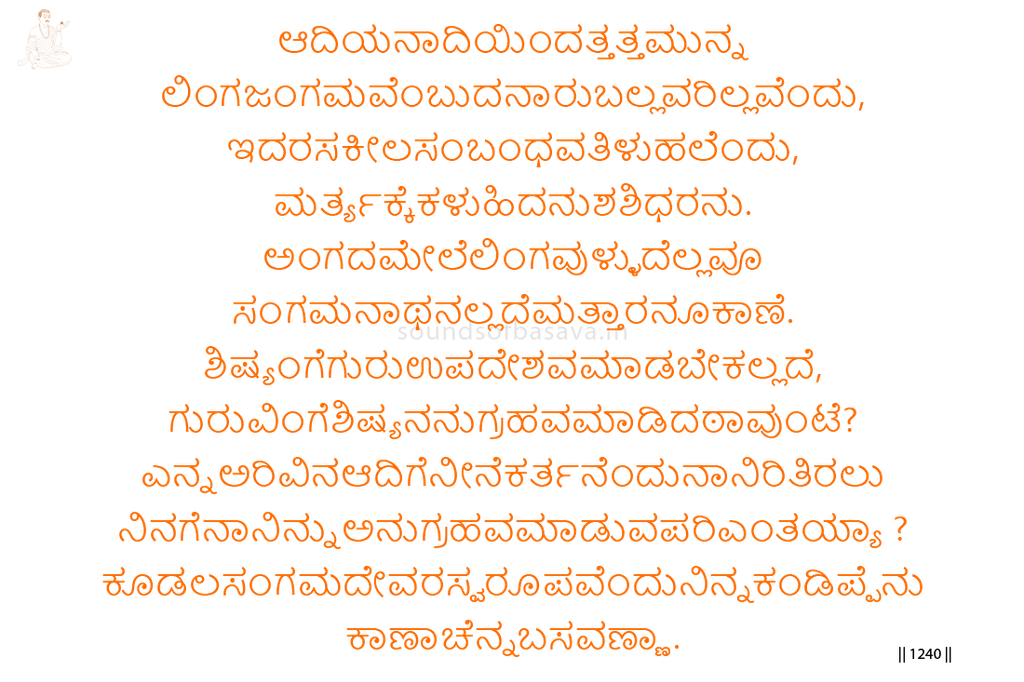
Basavanna says that the relation between Linga and Jangama was unknown even before the ideas of beginning and beginninglessness arose. To reveal this hidden relation, the Moon-crested Lord sent the Guru into the mortal world.
Basavanna then states what has been revealed to him: whenever Linga rests upon the Anga, he sees no one there except Sangamanatha. Linga is not an object separate from Kudalasangama Deva.
The final movement concerns Chennabasavanna. A Guru instructs and blesses the disciple; the disciple cannot reverse this relation and claim to bless the Guru. Because Kudalasangama Deva is the source of Basavanna’s awareness, Basavanna sees Chennabasavanna as the very form through which Kudalasangama Deva has revealed Himself.
Imagery & Symbolic Relevance
The vachana begins before Adi and Anadi—before beginning and beginninglessness.
Basavanna is not simply describing a remote time. He is showing that the relation between Linga and Jangama cannot be explained as something invented later by human beings. It belongs to the sacred order before the mind begins making distinctions.
At that level, no one knew the secret of Linga and Jangama. The word “secret” does not imply information deliberately concealed. It points to a relation that cannot be understood merely by looking at Linga as an object and Jangama as a person.
The Moon-crested Lord therefore sends the Guru into the mortal world. The Guru comes to make this relation known through instruction and living presence.
The sending is important. The Guru does not appoint himself, and the disciple does not create the Guru through admiration. The Guru comes as the Lord’s means of revelation.
Basavanna next says that wherever Linga is present upon the Anga, he sees none other than Sangamanatha.
The Anga is the embodied devotee who bears and worships the Linga. The Linga rests upon the Anga, yet Basavanna does not see two separate realities—an individual body on one side and a sacred object on the other.
He sees Sangamanatha alone. The Linga borne upon the body is Kudalasangama Deva’s own presence.
This recognition prepares the second half of the vachana. Just as Linga must not be reduced to an object, Chennabasavanna must not be reduced to an ordinary individual.
Basavanna then speaks of the proper relation between Guru and disciple. The Guru gives instruction to the disciple. Knowledge moves from the one who reveals to the one who receives.
Grace follows the same direction. The Guru blesses the disciple; the disciple cannot claim to confer grace upon the Guru.
Basavanna asks whether there has ever been a place where the disciple bestowed grace upon the Guru. The question exposes a spiritual reversal: the receiver begins imagining himself to be the giver.
He then applies this correction to himself. Kudalasangama Deva is the source and author of his awareness. Even the understanding through which Basavanna recognizes the Guru has come from the Divine.
How, then, could Basavanna claim to bless the very source from which his awareness arose?
The final address to Chennabasavanna completes the revelation. Basavanna says that he sees him as the svarupa, the very form, of Kudalasangama Deva.
Chennabasavanna is therefore not honoured merely as an intelligent teacher or spiritual companion. In him, Basavanna beholds the living form through which Kudalasangama Deva instructs, reveals, and gives grace.
The complete movement is from the hidden relation of Linga and Jangama, to the Guru’s coming into the mortal world, to Linga recognized as Sangamanatha upon the Anga, and finally to Chennabasavanna recognized as the living form of Kudalasangama Deva.
Lingayoga
In Lingayoga, the seeker receives Linga upon the Anga and instruction through the Guru and Jangama. These should not remain unrelated parts of practice.
The Linga borne upon the body is Divine presence, while the realized Jangama makes that presence understandable through living instruction. Reverence must therefore be joined with humility and receptiveness.
The seeker should not convert spiritual learning into superiority. Whatever clarity arises has been received through Guru, Linga, Jangama, and Divine grace.
Editorial Commentary
“Before Adi and Anadi” removes conceptual beginnings; it need not be expanded into a chronological account of creation.
The statement that the disciple cannot bless the Guru corrects reversed spiritual self-importance. It does not diminish the disciple but places receiving, instruction, and grace in their proper relation.
Calling Chennabasavanna the svarupa of Kudalasangama Deva does not glorify his separate personality. Basavanna recognizes the Divine source acting and becoming visible through him.
Related Vachana
Supporting Vachana
Sharana Sthala Vachana 804 — The Subtle Ego at the Threshold
Sharana Vachana 804 warns that even Dasoha and sacred service can become a hidden form of self-claim. The mind may build an identity around being a Bhakta, servant, Guru, disciple, or Jangama. The vachana therefore asks that these relations be understood in their proper sacred order so that the seeker becomes truly related to Linga.
This prepares Vachana 1043 closely. Vachana 804 removes the ego that tries to possess sacred roles. Vachana 1043 then shows their right direction: the Guru instructs and gives grace, while the disciple receives without claiming authority over the source.
The Sharana teaching purifies the relationship from self-ownership. The Aikya teaching reveals Chennabasavanna, the Guru-Jangama, as the form of Kudalasangama Deva Himself.
Advancing Vachana
Aikya Sthala Vachana 1325 — When All Three Become One
Vachana 1043 reveals the secret relation of Linga and Jangama. Linga upon the Anga is Sangamanatha, and Chennabasavanna is beheld as Kudalasangama Deva’s living form.
Vachana 1325 carries this recognition into fuller integration. Guru, Linga, and Jangama are no longer experienced as separate. The seer, seeing, and what is seen become one; the individual body and the cosmic field are recognized in one reality; bondage is cut, and the seeker enters the open expanse of Linga-Aikya.
The progression is clear. Vachana 1043 establishes the correct relation through which revelation and grace are received. Vachana 1325 shows the fulfilled condition in which Guru, Linga, Jangama, Anga, and awareness no longer stand apart.
