

Summary
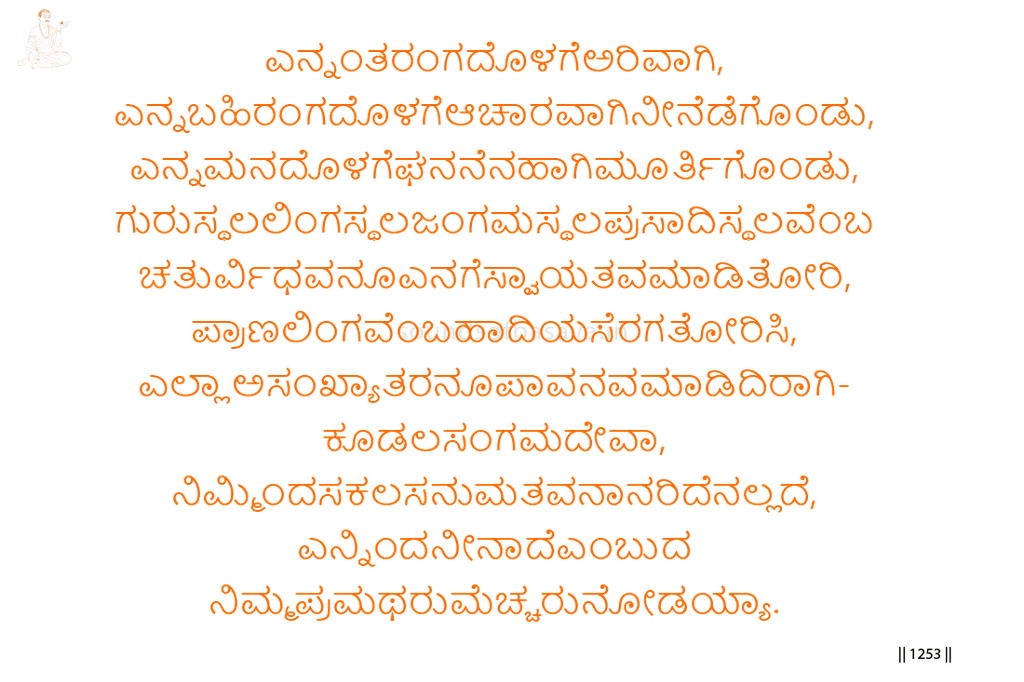
Basavanna attributes his entire spiritual transformation to Kudalasangama Deva.
The Lord becomes awareness within his inner being, right conduct in his outward life, and steady remembrance in his mind. Guru-sthala, Linga-sthala, Jangama-sthala, and Prasadi-sthala are no longer teachings known from outside; they have become his own lived experience.
Kudalasangama Deva also reveals the way of Pranalinga and sanctifies countless beings through it.
Basavanna therefore claims no personal greatness. Whatever understanding, virtue, or goodness appears in him comes from the Lord. The Pramathas rejoice because Divine grace has become visible through his life.
Imagery & Symbolic Relevance
The vachana begins by joining the inner and outer life.
Within Basavanna’s antaranga, Kudalasangama Deva becomes Arivu—awareness or clear understanding. The Lord is not merely someone Basavanna thinks about; Divine awareness becomes the light by which he understands.
Within the bahiranga, the Lord becomes Achara—right conduct. What is known inwardly is expressed through action, speech, relationship, service, and daily life.
Arivu and Achara must remain together. Awareness without conduct would remain incomplete, while conduct without inward understanding could become mechanical.
The next movement concerns the mind. Kudalasangama Deva takes form there as ghana nenahu—dense, steady, and deeply established remembrance.
This is not remembrance that appears only during worship and disappears afterward. It has gathered strength and become the mind’s continuing orientation.
Basavanna then names four sthalas: Guru, Linga, Jangama, and Prasadi.
Guru reveals and directs. Linga becomes the centre of worship and awareness. Jangama makes the Divine relation living and moving. Prasadi receives and shares what comes through grace.
Basavanna says that these four were made svayata to him. They ceased to be external subjects that he merely understood. They became directly known and lived within his own experience.
Kudalasangama Deva next shows him the way of Pranalinga. Linga is now known not only in the palm or in ritual worship, but within life and breath.
The reference to countless beings broadens the vachana beyond Basavanna’s personal transformation. The way revealed through grace becomes a sanctifying path through which many are made pure.
The final movement removes personal ownership. Basavanna recognizes that whatever sound understanding, goodness, or spiritual worth appears in him has arisen through Kudalasangama Deva.
The Pramathas therefore do not praise an independent spiritual achiever. They rejoice because the Lord’s grace has become visible through a devotee who no longer claims it as his own.
The complete movement is from inward awareness, to outward conduct, to constant remembrance, to the four sthalas becoming lived experience, to the revelation of Pranalinga, and finally to the surrender of all spiritual credit to Kudalasangama Deva.
Lingayoga
In Lingayoga, inner understanding and outward conduct must agree. The seeker should not remember Linga inwardly while living from a different centre in daily action.
Guru, Linga, Jangama, and Prasada must also become more than religious terms. They must be experienced through guidance, worship, living sacred relationship, receiving, and sharing.
The practical measure is whether remembrance has entered life and whether spiritual progress still produces pride. Whatever clarity appears should deepen gratitude rather than strengthen the claim, “I achieved this.”
Editorial Commentary
Ghana nenahu indicates remembrance that has become firm and continuous, not merely intense emotion.
Svayata means made one’s own through direct experience. It should not be understood as possession or control over the four sthalas.
The concluding praise of the Pramathas must not be turned into praise of Basavanna’s ego. They rejoice because Kudalasangama Deva’s grace and presence have become manifest through him.
Related Vachana
Supporting Vachana
Sharana Sthala Vachana 413 — The Orphan Before the Eternal
In Sharana Vachana 413, Basavanna refuses every claim to greatness. He does not present himself as spiritually accomplished and trembles before Kudalasangama Deva’s Pramathas. He finally calls himself an orphan, without personal title or support apart from the Lord.
This prepares Vachana 1078 directly.
Vachana 413 removes false greatness and spiritual self-display. Basavanna will not claim a ripeness that has not been given.
Vachana 1078 shows the fulfilled form of that humility. Awareness, conduct, remembrance, the four sthalas, and the way of Pranalinga have become real, but Basavanna still claims none of them as his achievement.
The one who earlier stood without greatness before the Pramathas now becomes the occasion for their joy, because Kudalasangama Deva’s grace has become visible without being appropriated by the devotee.
Advancing Vachana
Aikya Sthala Vachana 1079 — Nothing Is Apart From You
Vachana 1078 says that awareness, conduct, remembrance, spiritual understanding, and goodness arise through Kudalasangama Deva.
Vachana 1079 carries this recognition into every part of experience. Inner and outer being, knowing and forgetting, devotion and understanding, weakness and ecstasy are all declared to be the Lord’s presence.
It then gives the image of a wave entering the ocean. Once the wave has entered, it cannot maintain a boundary of its own. Whatever goodness appears belongs to the ocean alone.
The continuation is immediate. Vachana 1078 returns all spiritual attainment to Kudalasangama Deva. Vachana 1079 removes even the remaining distinction between the devotee’s different conditions and the Divine ground within which they arise.
Grace made inwardly one’s own thus advances into the recognition that nothing is apart from Kudalasangama Deva.
