

Summary
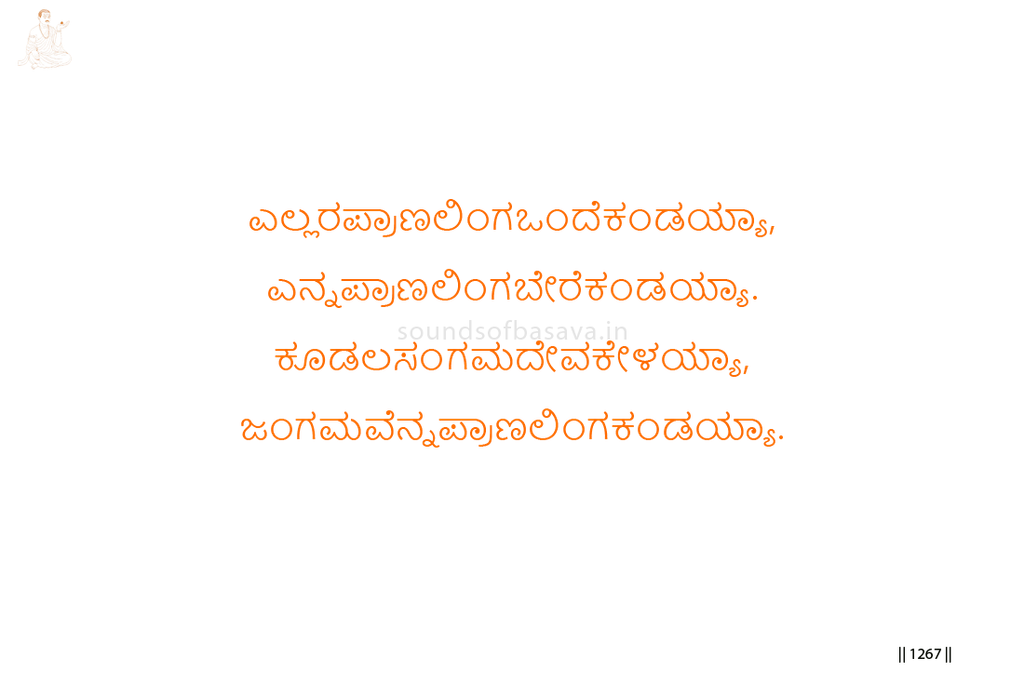
Basavanna begins with a deliberate contrast. The Prāṇa-Linga recognized by everyone is one, but his Prāṇa-Linga is different: for him, the Jangama itself is Prāṇa-Linga.
The difference does not imply that Basavanna has another independent Divine reality. It lies in the manner of recognition. Prāṇa-Linga is not confined to an inward principle or private experience; it stands before him as the living Jangama.
Basavanna therefore asks Kudalasangama Deva to hear his direct realization. The Divine life known as Prāṇa-Linga and the living presence encountered as Jangama are not separate in his experience.
Imagery & Symbolic Relevance
The opening statement, “everyone’s Prāṇa-Linga is one,” establishes a commonly recognized understanding. Prāṇa-Linga is spoken of as the Linga joined with life and inwardly known through prāṇa.
The expression “my Prāṇa-Linga is different” introduces the central contrast. Basavanna does not deny Prāṇa-Linga or create another Linga. He distinguishes his direct experience from a general or inwardly confined understanding.
The word “my” makes the declaration experiential. Basavanna is not defining Prāṇa-Linga for others. He states how it has become known within his own relation to Kudalasangama Deva.
The word “different” receives its explanation only in the final line. It must not be expanded into a claim that Basavanna possesses a separate God or superior Linga. His Prāṇa-Linga is different because he encounters it in the living form of Jangama.
The appeal “Kudalasangama Deva, listen” places the declaration before the Lord. Basavanna does not make an independent theological assertion. He speaks directly to Kudalasangama Deva as witness to what he has realized.
The Jangama gives the vachana its decisive movement. Prāṇa-Linga is no longer known only as inward life, breath, or awareness. It is recognized in the living presence that moves, teaches, receives, and stands before the devotee.
The statement “the Jangama itself is my Prāṇa-Linga” does not merely compare Jangama with Prāṇa-Linga. The word “itself” removes the distance between them in Basavanna’s experience.
Jangama is therefore not treated as an external representative standing apart from Linga. The living Jangama is the form in which Basavanna directly encounters Prāṇa-Linga.
The complete movement is concise: the commonly understood Prāṇa-Linga is named; Basavanna distinguishes his own realization; he calls Kudalasangama Deva to hear; and he declares Jangama itself to be his Prāṇa-Linga.
Lingayoga
In Lingayoga, this vachana teaches that inward realization of Prāṇa-Linga must not become separated from recognition of Jangama.
The practitioner cannot honour the Divine life within and remain indifferent to its living presence. Prāṇa-Linga becomes complete in experience when the same sacred reality is recognized in Jangama.
The practical relevance is direct: let the relation between Linga, prāṇa, and Jangama remain undivided. The inwardly known Linga must be honoured in the living Jangama.
Editorial Commentary
The phrase “my Prāṇa-Linga is different” does not mean that Basavanna claims a second or separate Divine Linga. The final line defines the difference: his Prāṇa-Linga is directly recognized as Jangama.
Prāṇa-Linga here is the Linga known in living relation with prāṇa. Jangama is the living sacred presence. The vachana brings these two expressions together without erasing their distinct functions in practice.
The Kannada states a personal realization rather than a general philosophical argument. Its force lies in Basavanna’s direct declaration: “Jangama itself is my Prāṇa-Linga.”
Related Vachana
Supporting Vachana
Sharana Sthala Vachana 398 — The Living Altar
Sharana Vachana 398 says that Linga-archane performed without Jangama is like water poured into a broken pot. The water may be pure, but the vessel cannot retain it. In the same way, worship separated from Jangama cannot hold its proper fruit.
The vachana then states that Linga-archane in the presence of Jangama is the path of Bhakti, and that receiving and partaking of Jangama-Prasada is itself Linga-archane.
This prepares Aikya Vachana 1104 directly. Sharana Vachana 398 first establishes that Linga, Jangama, worship, and Prasada must not be divided. Aikya Vachana 1104 carries that integration into direct realization: Jangama is no longer merely required for the completion of Linga-worship; Jangama itself is recognized as Basavanna’s Prāṇa-Linga.
Advancing Vachana
Aikya Sthala Vachana 1109 — Where the Two Have Become One
Aikya Vachana 1109 asks the reader to behold the devotee who is no longer confined by bodily identity and the Jangama who is free from the governance of mind, prāṇa, and bhava. Their realized state cannot be seized or confined, just as a flash of lightning cannot be held in one place.
The vachana concludes that when the two are seen as one, only Kudalasangama Deva remains visible.
Vachana 1104 establishes the living recognition that Jangama is Prāṇa-Linga. Vachana 1109 advances this by showing the fulfilled state of that recognition: the apparent distinction between devotee and Jangama no longer governs vision.
The movement is precise. In Vachana 1104, Basavanna identifies Jangama as his living Prāṇa-Linga. In Vachana 1109, the two are beheld as one, and no separate presence remains before Kudalasangama Deva.
