

Summary
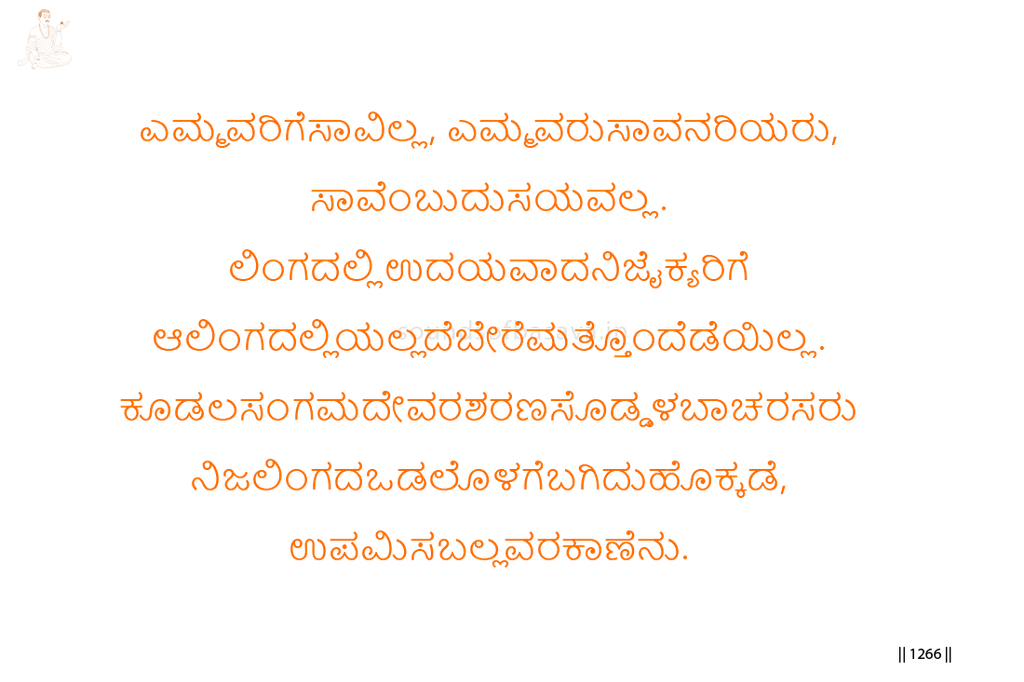
Basavanna declares that for those who belong to Kudalasangama Deva, death is not the final truth. They do not know death as separation, because those who have arisen into Nijaikya within the Linga have no other place or second abode apart from that Linga.
The teaching is then embodied in Soddala Bacharasa, a Sharana of Kudalasangama Deva. He enters deeply into the body of the Nija-Linga. Basavanna does not describe him merely as a person whose bodily life has ended; he presents his state as incomparable.
The vachana therefore does not deny the end of bodily visibility. It denies that such an ending can remove the realized Sharana from the Linga in which he is already established. What the world calls death does not become departure from Kudalasangama Deva.
Imagery & Symbolic Relevance
The opening expression, “for our people,” establishes spiritual belonging. Basavanna is speaking of the Sharanas who belong to Kudalasangama Deva and whose lives are established in the Linga.
The declaration “there is no death” gives the first movement. It does not claim that the physical body remains unchanged forever. It states that death cannot become separation from the Linga for the realized Sharana.
The next statement, “our people do not know death,” strengthens the declaration. The Sharanas do not relate to death as an event that removes them from their Divine ground. Their relation to Kudalasangama Deva is not cancelled when bodily visibility ends.
The statement that what is called death is not true death distinguishes ordinary naming from realized understanding. The world sees the disappearance of the body and calls it death. Basavanna measures the Sharana by relation to the Linga rather than by visible bodily presence alone.
The phrase “those who have arisen in the Linga” gives the source of this freedom. The realized ones have not merely approached or worshipped the Linga from outside. Their state has arisen within the Linga itself.
Nijaikya gives the precise condition. It is true union in which the Sharana’s abiding ground is no longer elsewhere. The word must remain connected to the vachana’s direct claim: the Nijaikya has no other place apart from the Linga.
The statement that there is “no other place” removes the idea of departure to a second spiritual location. The Sharana does not leave the Linga and travel toward another abode after death.
The expression “no other” also removes divided belonging. The realized Sharana is not partly established in the Linga and partly dependent upon another destination. The Linga alone is the abiding ground.
Soddala Bacharasa then appears as the concrete realization of the teaching. Basavanna does not leave Nijaikya as a general statement. He names a Sharana whose state demonstrates what has just been declared.
Soddala Bacharasa is identified specifically as the Sharana of Kudalasangama Deva. His identity rests in this belonging, not merely in his personal name, place, or bodily history.
The body of the Nija-Linga is the central concluding image. The Nija-Linga is presented as the reality within which the Sharana enters. The image reverses ordinary bodily measurement: instead of the Sharana being confined to his own body, he enters the body of the True Linga.
The action of bending or yielding and entering shows complete submission. Soddala Bacharasa does not stand outside the Nija-Linga as an observer or possessor of realization. He enters within it.
The final statement, “I see none comparable to him,” gives Basavanna’s response. It praises the incomparable state of Soddala Bacharasa after his complete entry into the Nija-Linga. The Kannada does not say, “I see none who can say that he is gone.”
The complete movement is therefore exact: the Sharanas do not know death as separation; the Nijaikya has no second abode outside the Linga; Soddala Bacharasa enters the body of the Nija-Linga; and his fulfilled state is declared incomparable.
Lingayoga
In Lingayoga, this vachana teaches that relation to the Linga must become the practitioner’s abiding ground while living. Nijaikya is not presented merely as a destination assigned after bodily death. It is the state in which no separate abode remains outside the Linga.
The practical relevance is direct: the Anga must not continue to preserve an independent place apart from the Linga. When belonging becomes complete, bodily death cannot create spiritual separation from Kudalasangama Deva.
Soddala Bacharasa provides the lived measure. The fulfilment of Lingayoga is not a claim about survival, but complete entry into the Nija-Linga through surrender.
Editorial Commentary
The repeated denial of death must be read within the qualifying line concerning Nijaikya in the Linga. Basavanna is not making a general claim that the physical bodies of devotees never die. He declares that death cannot remove the realized Sharana from the Linga or create a second destination.
Nijaikya means true union or true oneness. In this vachana, its defining mark is the absence of any other place apart from the Linga.
Soddala Bacharasa is the named Sharana of Kudalasangama Deva. The final grammar praises his incomparable state after entering the body of the Nija-Linga.
The concluding expression “upamisaballavara kanenu” means “I see none who can be compared with him” or “I see none comparable to him.” It does not mean that no one can say he has gone.
Related Vachana
Supporting Vachana
Sharana Sthala Vachana 1221 — The Integrity of Final Offering
Sharana Vachana 1221 defines Sadachara at the death of a Linga-bhakta. The devotee is to be joined at the Lord’s feet, the body is to be placed in samadhi, and Vibhuti and Prasada are to be shared among Linga-devotees. Basavanna rejects corpse-decoration, noisy procession, public display, ritual feasting, and inherited death ceremonies because they return attention to bodily identity rather than the devotee’s relation to the Linga.
This prepares Vachana 1103 directly. Sharana Vachana 1221 establishes the conduct appropriate when a devotee’s bodily life ends: the devotee is honoured through union at the Lord’s feet rather than through attachment to the corpse.
Aikya Vachana 1103 reveals the truth underlying that conduct. The realized Sharana has no other abode apart from the Linga. Therefore what is treated in Sharana Sthala through samadhi, simplicity, and sacred sharing is understood in Aikya as non-departure from the Linga. Sadachara before death deepens into the recognition that, for the Nijaikya, death creates no separation.
Advancing Vachana
Aikya Sthala Vachana 1104 — The One Prāṇa-Linga
Aikya Vachana 1104 acknowledges the teaching that the Prāṇa-Linga in everyone is one, but Basavanna then gives his direct realization: the Jangama itself is his Prāṇa-Linga. The Divine life known inwardly is recognized in the living presence of the realized Jangama.
Vachana 1103 shows Soddala Bacharasa entering and abiding within the Nija-Linga so completely that death cannot establish another place for him. Vachana 1104 advances this teaching from the fulfilled state of the named Sharana to the recognition of realized Sharana-presence while living.
The movement is precise: Vachana 1103 reveals that the realized Sharana does not depart from the Linga; Vachana 1104 reveals why the Jangama must be encountered as living Linga-presence. The Sharana who is inseparable from Nija-Linga beyond bodily death is recognized in life as Prāṇa-Linga itself.
