

Summary
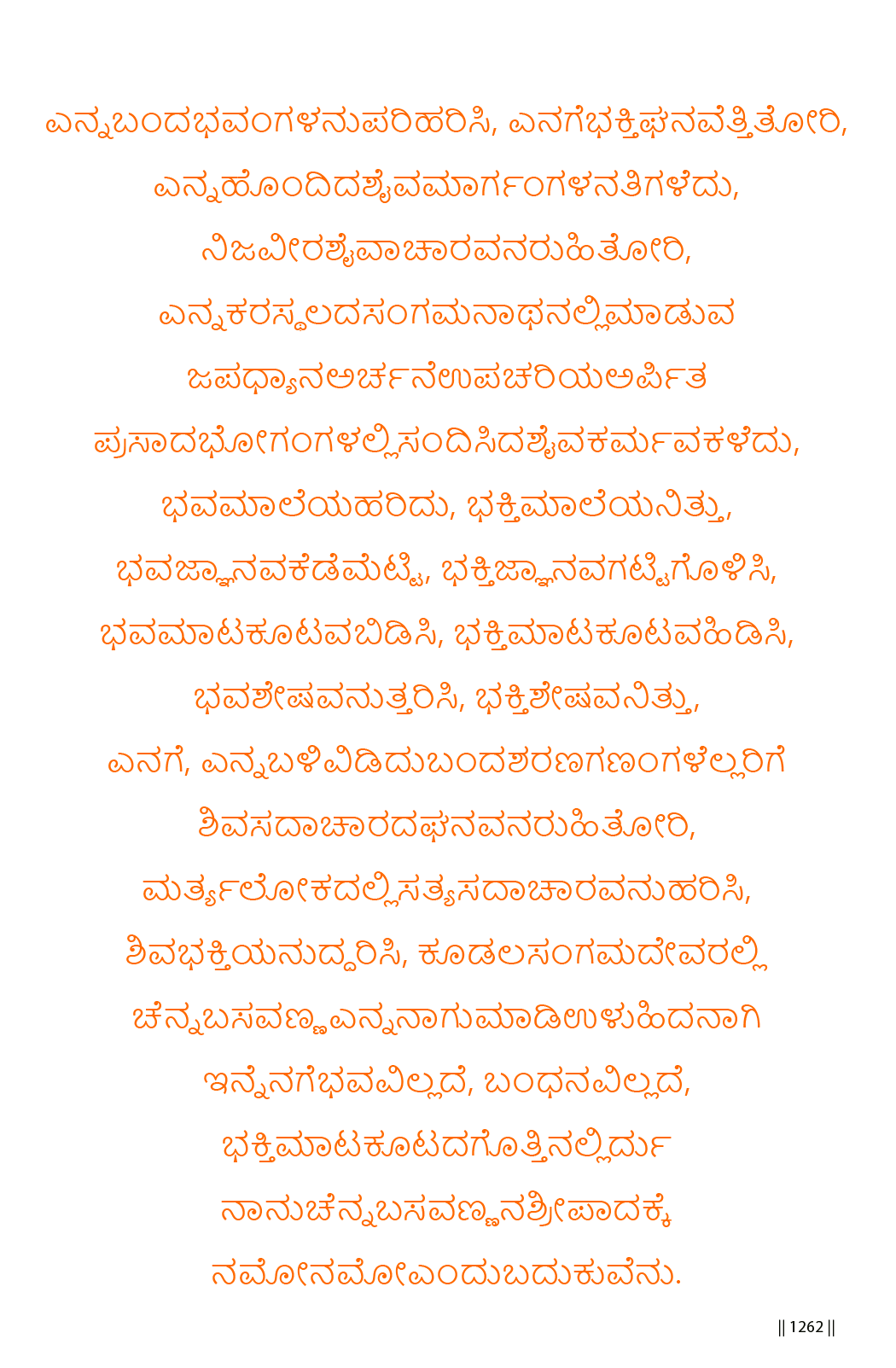
Basavanna presents Chennabasavanna as the active agent of a complete transformation. Chennabasavanna removes the forms of bhava that had gathered around him, reveals the fullness of devotion, leads him beyond the Shaiva paths he had previously held, and clears the merely karmic element that had become mixed with japa, meditation, worship, service, offering, and Prasada-bhoga performed before Sangamanatha in the Karasthala.
The transformation then unfolds through a deliberate series of replacements. The garland of bhava is cut away and the garland of devotion is given. Bhava-centred knowledge is struck down and Bhakti-knowledge is made firm. The assembly formed around bhava is left behind and the fellowship of devotion is embraced. The residue of bhava is brought to an end, and devotion alone remains.
Chennabasavanna extends this transformation beyond Basavanna personally. He reveals the greatness of Shiva-Sadachara to the gathered Sharanas, establishes true conduct in the mortal world, and upholds Shiva-bhakti. Basavanna therefore declares that Chennabasavanna has formed and preserved him in Kudalasangama Deva. With becoming and bondage removed, he will live within the fellowship of devotion, continually bowing at Chennabasavanna’s sacred feet.
Imagery & Symbolic Relevance
The vachana begins with “the bhavas that came upon me.” Bhava is presented as something that has gathered around and conditioned the speaker. Basavanna does not say that he removed these formations by his own effort. Chennabasavanna is the one who removes them.
The revelation of Bhakti-ghana, the fullness or substantial wealth of devotion, gives the positive movement that follows removal. Basavanna is not left empty after bhava is cleared. He is shown devotion as a complete and sustaining reality.
The reference to the Shaiva paths previously embraced indicates the many religious directions, disciplines, and distinctions through which Basavanna had moved. Chennabasavanna carries him beyond dependence upon these paths as separate supports. The vachana does not dismiss sacred practice; it brings practice under a more complete devotional realization.
The Karasthala of Sangamanatha is the living centre of the next movement. Japa, dhyana, archana, upachara, arpita, and Prasada-bhoga are all named. These are not treated as isolated acts of religious performance. Chennabasavanna removes the Shaiva-karma that had become mixed with them, so that practice is no longer governed by accumulated action, self-claim, or mere observance.
The two garlands form the clearest visible contrast. A garland rests upon and identifies the one who wears it. The bhava-mala, the garland of becoming, signifies the many formations and bonds carried by the speaker. Chennabasavanna cuts it away and gives the Bhakti-mala, the garland of devotion. One governing identity is removed and another is bestowed.
The contrast between bhava-jnana and Bhakti-jnana moves the transformation into knowledge. Bhava-jnana is knowing conditioned by worldly becoming and separation. Chennabasavanna strikes it down and makes Bhakti-jnana firm. Devotion is therefore not presented as feeling without understanding; it becomes a stable way of knowing.
The contrast between bhava-matha-koota and Bhakti-matha-koota moves from inward knowledge to fellowship. Basavanna is released from association organised around becoming and gathered into the fellowship of devotion. The change is communal as well as personal: the company in which one lives must accord with the knowledge that has been established.
The contrast between bhava-shesha and Bhakti-shesha reaches what remains after everything else has been removed. Chennabasavanna brings the residue of bhava to an end and leaves the residue of devotion. At the conclusion of the transformation, devotion is not one remaining quality among others; it is what alone endures.
The vachana then widens to include all the Sharana assemblies that gathered around Basavanna. Chennabasavanna reveals to them the greatness of Shiva-Sadachara. His work is therefore not confined to correcting one individual. He shows an entire community how devotion must become conduct.
The establishment of Satya-Sadachara in the mortal world gives the transformation a lived and public form. True conduct is not left as private understanding. It must flow through embodied life, relationship, fellowship, and action.
The uplifting of Shiva-bhakti completes this collective movement. Devotion is not merely protected within Basavanna; it is raised and sustained among the Sharanas through right conduct.
The statement that Chennabasavanna “made me what I am in Kudalasangama Deva” identifies both the agent and the ground of transformation. Chennabasavanna acts, but the new condition is established in Kudalasangama Deva. Basavanna does not claim that he formed himself.
The declaration “there is no bhava for me, no bondage for me” gives the fruit of the entire sequence. It follows the removal of bhava, the replacement of its garland, knowledge, fellowship, and residue, and the establishment of Bhakti and Sadachara. Freedom is therefore presented as the result of complete devotional reformation, not as an unsupported personal claim.
The final “Namo, Namo” gives Basavanna’s abiding posture. After all the transformations described, he does not claim authority, achievement, or equality with Chennabasavanna. He remains within the fellowship of devotion and lives in repeated reverence at Chennabasavanna’s sacred feet.
Lingayoga
In Lingayoga, this vachana places all practice before Sangamanatha in the Karasthala. Japa, meditation, worship, service, offering, and receiving Prasada cannot remain separate religious accomplishments. Their karmic and self-owned elements must fall away so that each act rests in the living presence of the Linga.
The direct practical movement is from bhava to Bhakti in every field: from conditioned knowledge to devotional knowledge, from binding association to the fellowship of devotion, and from the residue of becoming to devotion alone. Shiva-Sadachara ensures that this inward transformation becomes truthful conduct.
The final discipline is grateful abidance. Basavanna lives without claiming the transformation as his own, remaining among the devotees and continually bowing at Chennabasavanna’s feet.
Editorial Commentary
Chennabasavanna is the governing agent throughout the vachana. The sequence of removing, revealing, leading, cutting, giving, strengthening, gathering, establishing, and preserving belongs to him. Basavanna is the recipient who finally responds through “Namo, Namo.”
The paired expressions—bhava-mala and Bhakti-mala, bhava-jnana and Bhakti-jnana, bhava-matha-koota and Bhakti-matha-koota, bhava-shesha and Bhakti-shesha—must remain distinct. They show a systematic replacement of what binds by what sustains devotion.
“There is no bhava for me, no bondage for me” describes the fruit of Chennabasavanna’s transformative work in Kudalasangama Deva. It is not a claim of self-produced perfection or an assertion that Basavanna has independently become God.
Related Vachana
Supporting Vachana
Sharana Sthala Vachana 13 — Caught in the Net
In Sharana Vachana 13, Basavanna says that he is caught in the net of samsara. He calls repeatedly to Kudalasangama Deva for protection, declares that there is no true substance in the condition that binds him, and ends in direct invocation.
This prepares Aikya Vachana 1093 by establishing the condition from which release is required. In the Sharana vachana, Basavanna is still within the net and can only ask to be protected. In Vachana 1093, that cry receives its fulfilment through Chennabasavanna: the formations of bhava are removed, the garland of becoming is cut away, its knowledge and fellowship are displaced, and Basavanna declares that neither bhava nor bondage remains.
Advancing Vachana
Aikya Sthala Vachana 1095 — You Are the Power Within Every Power
Aikya Vachana 1095 declares that the power within devotion, the power within understanding, and the power within liberation are all Kudalasangama Deva. Through Madivala Machideva’s insight and the realized state of Mahadeviyakka, the radiance of the Great Reality becomes clear.
Vachana 1093 shows Chennabasavanna giving the garland, knowledge, fellowship, and enduring residue of devotion, thereby ending becoming and bondage. Vachana 1095 advances this teaching by revealing the source of those gifts: even Bhakti, discernment, and liberation do not belong to the individual. Their power is Kudalasangama Deva Himself. What is received through the transforming grace of the Sharana is thus traced to its Divine ground, leaving no basis for spiritual ownership.
