

Summary
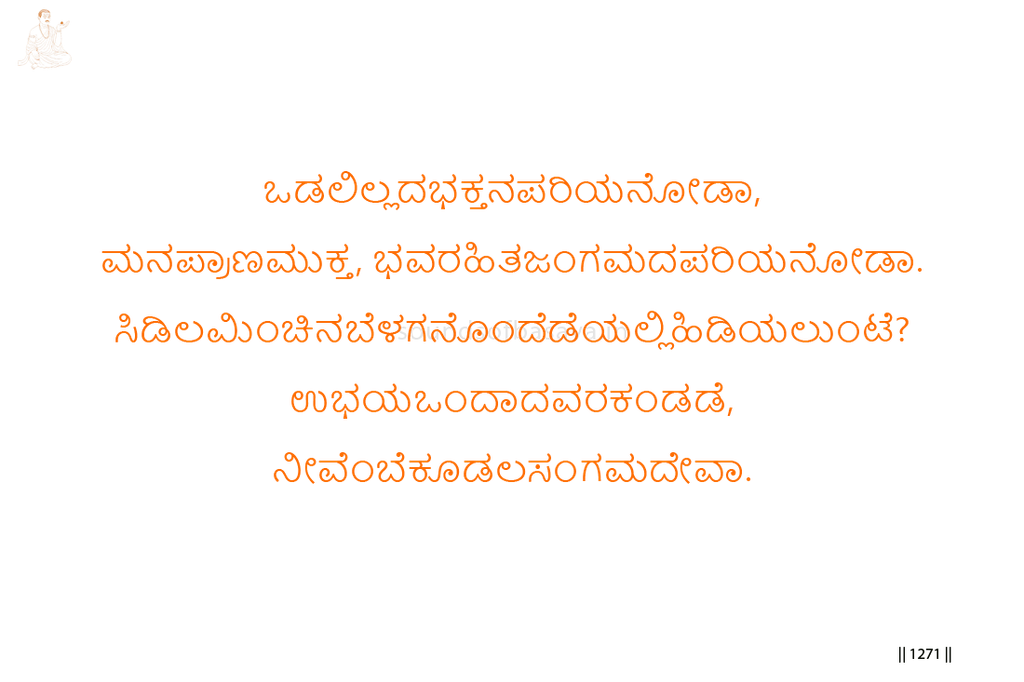
Basavanna asks us first to behold the Bhakta who is no longer defined or confined by the body. He then asks us to behold the Jangama who is free from the governance of mind and prāṇa and untouched by bhava.
Their state cannot be fixed, contained, or possessed. Basavanna compares it to the brilliance of lightning, which flashes forth but cannot be seized and held in one place.
The conclusion identifies the “two” precisely: the Bhakta and the Jangama. When Basavanna beholds them as one, he recognizes Kudalasangama Deva. Their outward distinction no longer governs his vision; in their oneness, the Lord alone is revealed.
Imagery & Symbolic Relevance
The command “behold” governs the opening movement. Basavanna does not ask the reader merely to define, discuss, or infer the realized state. He calls for direct seeing.
The Bhakta without body is the first figure. The Kannada does not require the conclusion that the physical body has disappeared. The Bhakta is no longer confined, measured, or identified by bodily existence.
The body may remain visible, but it no longer supplies the Bhakta’s final identity. The Bhakta cannot be fully understood through appearance, bodily condition, social position, or physical location.
The Jangama free from mind and prāṇa is the second figure. Mind and life-breath ordinarily appear to define living individuality. Here they no longer govern or contain the Jangama’s realized state.
Freedom from mind does not mean unconsciousness or the destruction of understanding. It means that mental movement no longer establishes an independent centre.
Freedom from prāṇa does not mean physical death. It means that the Jangama is not finally defined by the vital force that sustains bodily life.
The Jangama is also described as bhava-rahita, free from bhava. Bhava here is conditioned becoming—the movement through which attachment, possession, self-definition, and renewed separateness arise.
This does not mean that the Jangama lacks devotion, compassion, awareness, or living presence. It means that the Jangama is not governed by the formation of a separate self.
The Bhakta and the Jangama are initially presented separately. One is not confined by the body; the other is not governed by mind, prāṇa, or bhava. Basavanna first asks that each state be seen clearly.
The flash of lightning then gives the central image. Lightning is visible, brilliant, and unmistakable, yet it cannot be caught and preserved as an object.
The question “Can the light of lightning be held in one place?” expects the answer no. Its brilliance appears, but its movement cannot be confined.
The image prevents the realized Bhakta and Jangama from being turned into fixed objects of measurement. Their state cannot be possessed through description, limited to bodily location, or held within a conceptual definition.
The lightning image also preserves living immediacy. The state is not vague or absent; like lightning, it is directly revealed. What cannot be grasped may nevertheless be clearly seen.
The phrase “when the two have become one” gives the culmination. The two are the Bhakta and the Jangama named in the preceding lines.
Basavanna does not say merely that they cooperate, stand near each other, or share a similar teaching. Their apparent two-ness no longer remains the final truth.
The closing expression “I say: You” turns the vision toward Kudalasangama Deva. When Basavanna sees the Bhakta and Jangama as one, he does not establish a new identity belonging to either person. He recognizes the Lord.
Kudalasangama Deva is therefore not introduced as a third presence added to the Bhakta and Jangama. The Lord is what becomes visible when their apparent division no longer governs seeing.
The complete sequence is exact: behold the Bhakta beyond bodily confinement; behold the Jangama beyond mind, prāṇa, and bhava; recognize that their state cannot be fixed like lightning in one place; behold the two as one; and recognize Kudalasangama Deva.
Lingayoga
In Lingayoga, this vachana teaches that the relation between Bhakta and Jangama must move beyond external distinction.
The Bhakta must not remain defined by Anga as an independent bodily identity. The Jangama must not be approached merely as another embodied individual governed by mind, breath, and becoming.
The practical relevance is direct: the practitioner must not attempt to possess, confine, or judge realized presence through bodily and mental measures. The lightning image calls for alert seeing without appropriation.
When Bhakta and Jangama are no longer held as spiritually separate, their oneness reveals Kudalasangama Deva. The fulfilment is not the Bhakta’s self-elevation, but vision purified of division.
Editorial Commentary
The expression “without body” describes freedom from bodily confinement and identification. It does not require a claim that the Bhakta has physically ceased to possess a body.
Mana-prāṇa-mukta means free from the governance of mind and prāṇa. It does not describe unconsciousness, lifelessness, or bodily death.
Bhava-rahita means free from conditioned becoming and separate self-formation. It should not be reduced to emotionlessness.
The lightning must remain a concrete comparison for what cannot be fixed or held in one place. It need not be expanded into an independent doctrine of energy, subtle anatomy, or momentary mystical experience.
The word ubhaya, “the two,” refers most directly to the Bhakta and the Jangama named in the preceding clauses. It should not first be replaced by other pairs such as body and soul, inner and outer, or devotee and God.
The closing recognition means that, when the Bhakta and Jangama are beheld as one, Basavanna recognizes Kudalasangama Deva. It does not glorify either individual as a separate God.
Related Vachana
Supporting Vachana
Sharana Sthala Vachana 892 — Where the Mind and Body Find Their True Abode
In Sharana Vachana 892, Basavanna says that the body does not remain settled in the mind and the mind does not remain settled in the body. The body becomes absorbed in Allama, while the mind becomes absorbed in Chennabasavanna. Basavanna then asks where he himself can remain before Kudalasangama Deva.
This prepares Vachana 1109 closely. In Sharana Vachana 892, the ordinary body–mind arrangement is broken by the realized presence of the Sharanas. Body and mind no longer provide a secure ground for an independent “I.”
Aikya Vachana 1109 reveals the fulfilled state of that movement. The Bhakta is no longer confined by the body, and the Jangama is no longer governed by mind, prāṇa, or bhava. What appears in Sharana as the loss of a separate resting place matures in Aikya into the vision of Bhakta and Jangama as one, revealing Kudalasangama Deva.
Advancing Vachana
Aikya Sthala Vachana 1119 — The Stainless Vision Beyond the Mind
Aikya Vachana 1119 turns the gaze inward through the Karasthala. Bodily distortion no longer governs the vision, and Anubhava rises beyond the furthest reach of the mind. The distinction between bhava and nirbhava also loses its hold.
Basavanna then declares that he lives in Kudalasangama Deva through Prabhudeva and calls Chennabasavanna to witness this realization.
Vachana 1109 establishes the vision of the body-transcending Bhakta and the mind-, prāṇa-, and bhava-free Jangama becoming one. Kudalasangama Deva is recognized in that oneness.
Vachana 1119 advances this from beholding realized unity in the Bhakta and Jangama to Basavanna’s own direct inward experience. Bodily limitation and the mind’s furthest movement are passed beyond, and life is established through Prabhudeva in Kudalasangama Deva.
The movement is therefore precise: Vachana 1109 beholds the two as one; Vachana 1119 shows that vision becoming stainless, inward, and directly lived beyond body and mind.
