

Summary
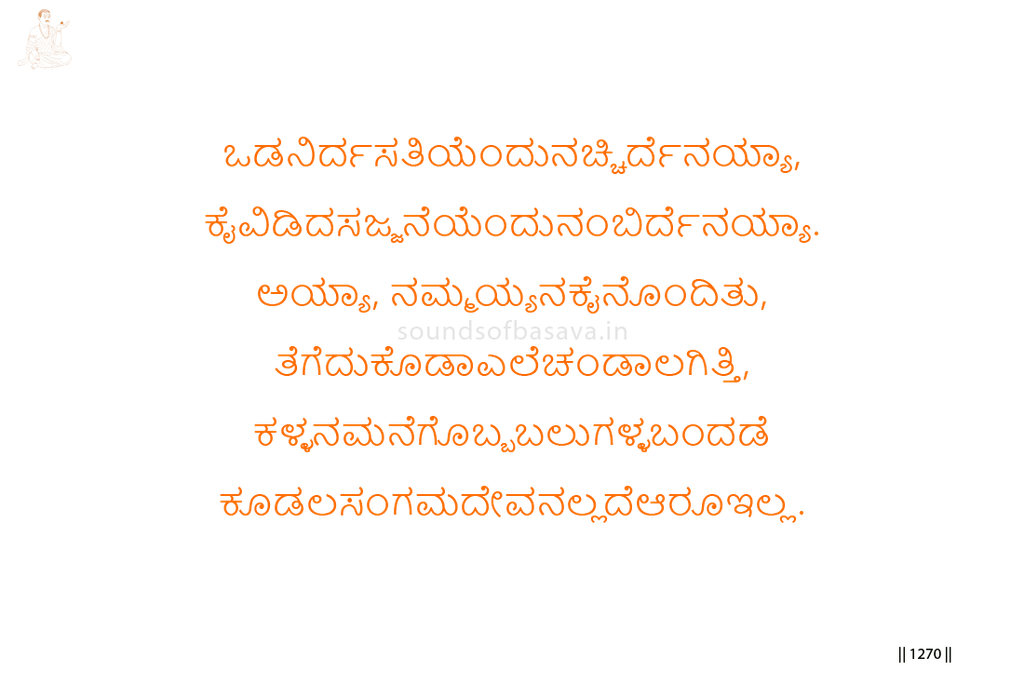
Basavanna begins with intimate trust. He trusted the companion who remained beside him and believed in the virtuous hand that held his own. Yet pain arises in that very joined hand. The place of closeness reveals that something is still being held and guarded.
The command is immediate: “Take it and give it away, O Chandalgitti.” What is being preserved cannot finally remain. The image then turns sharply—a mighty thief has entered the thief’s own house.
Basavanna identifies that greater thief as Kudalasangama Deva. The Lord enters not to seize something that truly belongs to another, but to remove the final claim of ownership. What the smaller thief had appropriated as “mine” is taken by the Lord, before whom no guarded possession or separate possessor can remain.
Imagery & Symbolic Relevance
The companion who remains beside Basavanna forms the opening image. The language begins within the closeness of human relationship. Basavanna speaks of one whom he trusted because she remained with him.
The statement that he believed in the hand that held his own strengthens that intimacy. A held hand signifies established trust, companionship, and mutual reliance. Basavanna does not begin from suspicion or distance.
Pain arising in the joined hand gives the vachana its turning point. The bond has not simply disappeared, but something troubling is felt within the very place of contact. The source understands this pain as the exposure of a remaining tendency to hold, preserve, or possess.
The image is spiritually precise. Even where nearness has been established, the impulse to guard something as one’s own may continue. The pain makes that hidden holding visible.
The command “take it and give it” is direct. Basavanna does not recommend gradual negotiation with possession. What is being held must be released.
The repetition implied in the command gives urgency to the relinquishment. Once the guarded thing has been recognized as impermanent, continued preservation has no true purpose.
Chandalgitti is the one directly addressed in the Kannada. The approved source reads this address inwardly, as a summons to the part of the mind that continues to guard and preserve what cannot remain.
The name should not be detached from the concrete scene. Basavanna speaks through the form of direct address, but the concern reaches beyond an ordinary household exchange. The command exposes the inward keeper of possessions.
The house forms the next major image. A house is the place in which things are stored, protected, and claimed. It establishes an inside from which others may be excluded.
The source relates this house to embodied and inward life. Within this house, memories, attainments, experiences, identities, and possessions may all be guarded as belonging to the self.
Basavanna then calls it the thief’s house. This reverses ordinary ownership. The one who claims the contents of the house is already a thief, because what is guarded as “mine” was never independently possessed.
A greater thief enters that house. The image is deliberately forceful. The smaller thief preserves and appropriates; the greater thief removes the very ground of appropriation.
Kudalasangama Deva is identified as this mighty thief. The Lord does not enter as a criminal enemy. He enters as the one before whom false ownership cannot continue.
What Kudalasangama Deva takes is precisely what the seeker had attempted to preserve as personal property. The Lord’s taking therefore becomes release from possession.
The contrast between the two thieves gives the vachana its deepest force. The lesser thief is the self that says, “This is mine; I must guard it.” The greater thief is Kudalasangama Deva, who removes both what is guarded and the claim of the one who guards.
The Lord’s entrance into the house also shows that surrender cannot remain merely external. Kudalasangama Deva enters the place where ownership has been established and empties it from within.
The approved title speaks of gold, but the Kannada movement is broader than a single material object. The concern is whatever is being guarded because it is considered valuable and personally owned.
The complete sequence is therefore clear: intimate trust, the joined hand, pain within that contact, the command to give, the house of possession, the entrance of the greater thief, and the recognition that the thief is Kudalasangama Deva Himself.
Lingayoga
In Lingayoga, this vachana tests whether the Anga still guards something as its own even after taking the hand of the Linga.
Spiritual experience, knowledge, merit, memory, status, and the sense of attainment can themselves become possessions. Contact with Linga is incomplete when the practitioner turns that contact into something to be preserved as “mine.”
The practical movement is direct: when Kudalasangama Deva enters the inner house, the practitioner must allow the guarded claim to be taken. The Lord’s taking is not deprivation; it removes the ownership that preserves separation.
The fulfilment of surrender is not that the seeker owns the Divine, but that nothing remains from which the seeker can say, “This belongs independently to me.”
Editorial Commentary
The domestic imagery should first be allowed to remain concrete: a companion, a held hand, pain, direct address, a house, and a thief. Its inward relevance arises from this sequence and should not replace it.
The approved source understands Chandalgitti as an inward address to the guarding mind. The expression is not used here to condemn a woman or to establish a separate historical character.
The title’s word “gold” identifies what is being guarded as precious, but the Kannada does not require the explanation to construct an additional gold-symbol. The central action is preserving, withholding, and then giving away.
Calling Kudalasangama Deva a thief does not accuse the Lord of wrongdoing. The metaphor shows His irresistible removal of false ownership. The one who imagined himself to be the owner is revealed as the lesser thief when the true Lord of the house enters.
Related Vachana
Supporting Vachana
Sharana Sthala Vachana 150 — Alchemy of Offering
Sharana Vachana 150 distinguishes lived devotion from speech, argument, victory, and defeat. What has been received as wealth, knowledge, experience, or insight must pass into action rather than remain accumulated.
The vachana honours the Bhakta who repeatedly gives to Kudalasangama Deva’s Sharanas until the gathered wealth is spent. Having emptied what was accumulated through service, the Bhakta becomes worthy before the Linga.
This prepares Aikya Vachana 1108 directly. The Sharana vachana establishes the discipline of giving away actual accumulation rather than guarding it through words or self-importance.
Aikya Vachana 1108 carries that discipline further inward. The issue is no longer only whether wealth has been distributed, but whether the impulse to preserve anything as “mine” remains. Kudalasangama Deva enters as the greater thief and removes the final possessive claim from its own house.
Advancing Vachana
Aikya Sthala Vachana 1109 — Where the Two Have Become One
Aikya Vachana 1109 asks us to behold the devotee who is no longer confined by the body and the Jangama who is free from the governance of mind, prāṇa, and bhava. Their state cannot be captured in one place, just as the flash of lightning cannot be grasped and held.
The vachana concludes that when the apparent two have become one, only Kudalasangama Deva is seen.
Vachana 1108 removes the guarded possessions and the owner who seeks to preserve them. The Lord enters the house and overturns the distinction between the one who possesses and what is possessed.
Vachana 1109 advances this emptying into fulfilled non-division. The devotee is no longer confined by bodily identity, the Jangama is not confined by inward faculties, and the apparent two cannot be held apart. When the final structure of possession and separation has fallen, Kudalasangama Deva alone is beheld.
