

Summary
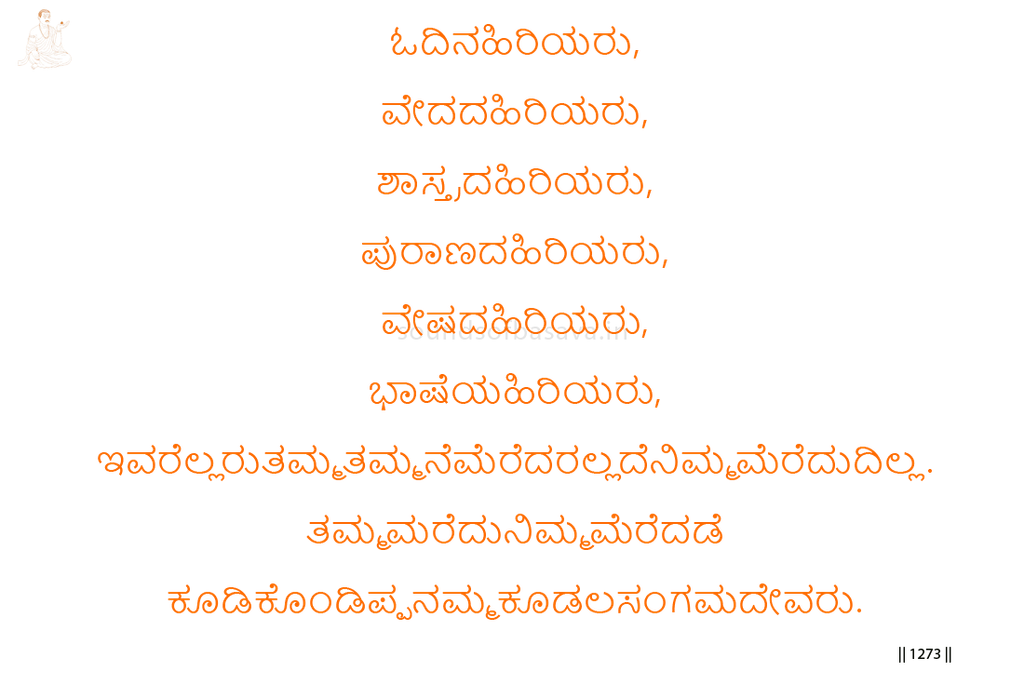
Basavanna names those considered eminent in study, the Veda, the Shastra, the Purana, religious appearance, and language. Although their attainments differ, they share one failure: they use them to glorify themselves rather than Kudalasangama Deva.
The vachana does not reject sacred knowledge or religious expression. It exposes their corruption by self-importance. When learning, appearance, or eloquence makes the individual prominent, the Lord whom they should reveal is obscured.
Basavanna gives the corrective in the final line: those who forget their own importance and glorify Kudalasangama Deva become joined with Him.
Imagery & Symbolic Relevance
This vachana proceeds through a catalogue of recognised forms of greatness rather than through material imagery.
Those eminent in study possess learning and the honour associated with it. Basavanna tests whether that learning reveals the Lord or merely establishes the learner’s reputation.
Those eminent in the Veda, Shastra, and Purana represent sacred authority, interpretation, and inherited teaching. These sources may guide understanding, but mastery of them can become a means of intellectual superiority.
Those eminent in vesha, religious appearance, rely upon visible marks, attire, or bearing. Outward signs may identify a religious role, but they cannot prove freedom from self-display.
Those eminent in language possess eloquence and persuasive speech. Even praise directed toward the Divine may become a performance centred upon the speaker.
The repeated description of these people as “eminent” is deliberate. Society recognises their greatness, but Basavanna judges it by its direction. Their learning, appearance, and speech return honour to themselves rather than to Kudalasangama Deva.
The final line reverses this condition. To “forget oneself” is to relinquish the need to become prominent through knowledge or religious identity. When the same learning and speech glorify Kudalasangama Deva rather than their possessor, separation ends and the Lord abides joined with the devotee.
Lingayoga
In Lingayoga, sacred knowledge must not strengthen the Anga as an independent possessor. Veda, Shastra, Purana, religious signs, and speech fulfil their purpose only when they direct awareness toward Linga.
The practitioner must therefore examine whether learning produces clarity or spiritual prestige. Self-forgetting does not require abandoning knowledge; it requires surrendering ownership and personal glory. When the Anga no longer seeks distinction through what it knows, knowledge becomes transparent to Kudalasangama Deva.
Editorial Commentary
Vesha means religious appearance, attire, or visible bearing. Bhashe refers to language and accomplished speech.
The Veda, Shastra, and Purana are not condemned. Basavanna criticises their use as instruments of self-glorification.
The Kannada repeats the same action on both sides of the contrast: they glorified themselves but not the Lord; those who forget themselves glorify Kudalasangama Deva. “Glorify” therefore preserves the source movement more precisely than “remember.”
Related Vachana
Supporting Vachana
Sharana Sthala Vachana 209 — The Living Truth Beyond Scripture
Sharana Vachana 209 distinguishes sacred words from truth embodied in the Sharana. Veda, Shastra, and religious speech may be read and repeated, but truth becomes firm only when it is lived.
This prepares Vachana 1116 by showing that scriptural mastery is not sufficient. Vachana 1116 identifies the remaining obstruction: even sacred learning may serve self-importance. What passes from word into life in the Sharana vachana must, in Aikya, also become free from the learner’s desire for recognition.
Advancing Vachana
Aikya Sthala Vachana 1142 — Only the Humble Reach the Mahalinga
Aikya Vachana 1142 names those who study the Vedas, Shastras, Agamas, and Puranas yet remain distant from the Mahalinga because pride still governs their understanding. Doctrinal certainty, sectarian identity, and declarations of realization cannot bring one near the Linga while self-assertion remains. Kudalasangama Deva’s pride-free Sharanas alone become worthy of reverence.
Vachana 1116 exposes self-glorification within learning, appearance, and speech. Vachana 1142 advances this teaching by showing its consequence: sacred knowledge without humility leaves the seeker far from the Mahalinga.
The positive continuity is equally direct. In Vachana 1116, those who forget themselves and glorify Kudalasangama Deva become joined with Him. In Vachana 1142, freedom from pride marks those who truly stand near the Mahalinga.
