

Summary
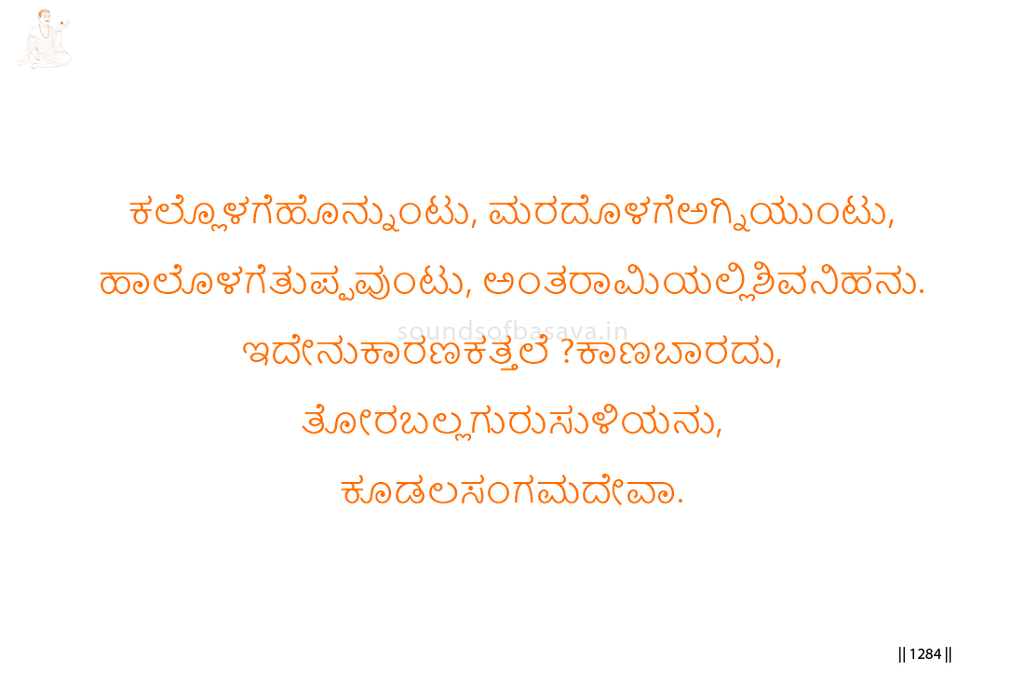
Gold is present within stone, fire within wood, and ghee within milk, though none is immediately visible. In the same way, Shiva abides within the inner being.
Basavanna asks why darkness remains when the Divine is already present. The difficulty is not Shiva’s absence but the inability to see the concealed presence. The Guru reveals what ordinary sight cannot recognize and makes the hidden Shiva known before Kudalasangama Deva.
Imagery & Symbolic Relevance
Gold within stone is the first image. The precious substance is already present, but the stone’s outward appearance does not disclose it. Concealment does not mean absence.
Fire within wood gives the second image. The fire belongs within the wood, yet it is not visible merely by looking at the surface. What is latent must be brought into manifestation.
Ghee within milk forms the third comparison. The essence is contained within what is seen, though it does not appear separately in its finished form.
These three images prepare the statement that Shiva abides within the inner being. Basavanna does not describe Shiva as arriving from elsewhere. The Divine presence is already inward, just as gold, fire, and ghee are already contained within their respective sources.
The question concerning darkness introduces the problem of non-recognition. The presence is real, yet it remains unseen. Darkness therefore indicates the inability to perceive what is inwardly present.
The Guru completes the movement. The Guru can show the concealed presence that cannot be recognized through ordinary seeing. The Guru does not produce Shiva; the Guru reveals the Shiva who already abides within.
Lingayoga
In Lingayoga, the seeker does not create the Linga-presence within the Anga. The essential movement is recognition of what is already inwardly present.
The Guru is necessary because concealed presence is not made evident by ordinary perception alone. Through the Guru’s revelation, the hidden Shiva becomes directly knowable, and the darkness of non-recognition is removed.
Editorial Commentary
The three comparisons must remain distinct. Stone contains gold, wood contains fire, and milk contains ghee. Each shows an actual presence concealed within an outward form.
The Guru and Kudalasangama Deva must also remain distinct in their roles. Shiva is the inward Divine presence; the Guru is the revealer who makes that presence known. The vachana does not identify the Guru as the creator of what is revealed.
Related Vachana
Supporting Vachana
Sharana Sthala Vachana 1355 — The Linga Placed in My Hand
Sharana Vachana 1355 says that the Sadguru placed in Basavanna’s hand the incomparable Linga that lies beyond Veda and Vedanta, Nada and Bindu, speech and mind. What could not be reached or comprehended through those means became directly present through the Sadguru’s grace.
This prepares Vachana 1136 by establishing the Guru’s revealing action. In the Sharana vachana, the Linga beyond ordinary reach is placed directly in the hand. In Aikya Vachana 1136, the teaching turns inward: Shiva is already concealed within the inner being, and the Guru reveals that hidden presence.
Advancing Vachana
Aikya Sthala Vachana 1137 — The Secret Revealed as One
Aikya Vachana 1137 shows the revelation taking a more definite form. The Vast that cannot be seen is shown in the Karasthala; the Vast that cannot be spoken is shown in the Manasthala; and the Vast that cannot be compared is shown through the face of fulfilled grace. Chennabasavanna reveals that these three are one in meaning.
Vachana 1136 establishes that Shiva is inwardly present but requires the Guru’s revelation. Vachana 1137 shows that revelation accomplished: what exceeds sight, speech, and comparison is disclosed through three related fields and revealed as one. The hidden presence of Vachana 1136 thus becomes unified Anubhava through Chennabasavanna’s showing in Vachana 1137.
