

Summary
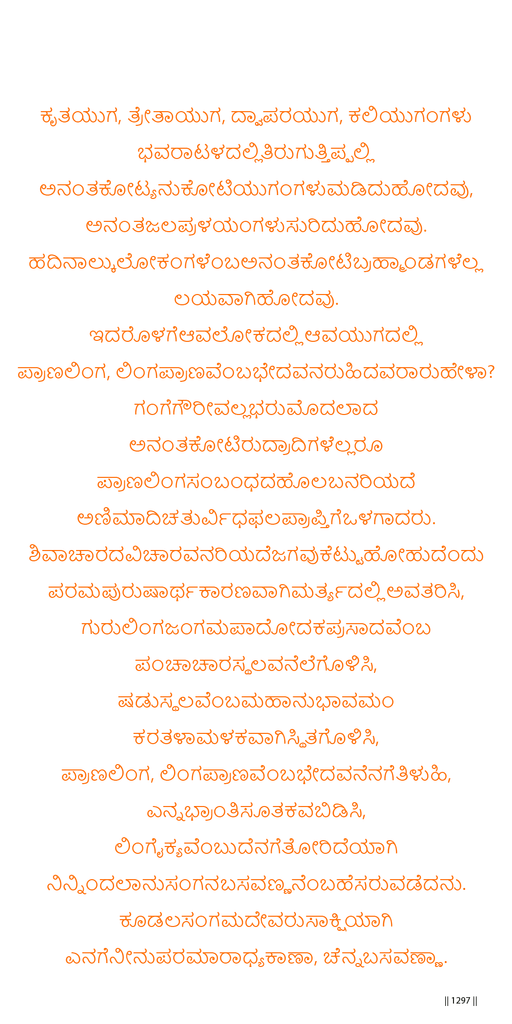
The four Yugas have revolved through the wheel of becoming; countless cycles, deluges, worlds, and universes have arisen and dissolved. Yet no one disclosed the distinction between Prana-Linga and Linga-Prana. Even the Lord of Ganga and Gauri and the countless Rudras did not know the true way of the Prana-Linga relation and remained occupied with limited attainments.
Seeing that the world would perish without understanding Shivachara, Chennabasavanna descended into the mortal world for the supreme purpose. He established Guru, Linga, Jangama, Padodaka, and Prasada; made the Anubhava of Shatsthala directly clear; revealed the distinction between Prana-Linga and Linga-Prana; removed Basavanna’s defilement of delusion; and showed him Linga-Aikya.
Through Chennabasavanna, Basavanna came to bear the name Sangana Basavanna. With Kudalasangama Deva as witness, he declares Chennabasavanna to be his supreme object of reverence.
Imagery & Symbolic Relevance
The four Yugas—Krita, Treta, Dvapara, and Kali—form the opening movement. They repeatedly turn within the wheel of becoming. The image shows immeasurable duration, but the passing of time does not by itself bring realization.
Countless Yugas have ended, and innumerable water-deluges have passed. Even vast cosmic destruction does not reveal the relation between life and Linga. What remains unknown cannot be made known merely through repeated creation and dissolution.
The fourteen worlds and countless universes are then said to have dissolved. Basavanna extends the question through the largest possible field: amid all these worlds and cycles, who revealed the distinction between Prana-Linga and Linga-Prana?
The rhetorical question prepares the contrast. Cosmic age, world, rank, and power have not disclosed this relation. The teaching requires a revealer.
The consort of Ganga and Gauri, together with countless Rudras, is then named. Despite their exalted standing, they did not know the holabu—the proper way, order, or living principle—of the Prana-Linga relation.
Because this relation remained unknown, they became involved in attainments beginning with aṇimā. The vachana does not deny such attainments, but it places them below the knowledge of Prana-Linga Sambandha. Extraordinary powers do not establish Linga-Aikya.
The world’s failure to understand Shivachara provides the reason for Chennabasavanna’s descent. He does not appear for personal greatness or sectarian establishment. He descends into the mortal world for Paramapurushartha, the supreme purpose, so that the living way of Shiva may not be lost.
He establishes Guru, Linga, Jangama, Padodaka, and Prasada as the fivefold sacred order named in the Kannada. Together, they establish the field in which Shivachara becomes lived relation.
Chennabasavanna then makes the great Anubhava called Shatsthala as clear as an āmalaka fruit held in the palm. The image of the fruit in the hand indicates direct and unmistakable clarity. Shatsthala is no longer a distant doctrine or verbal classification; its Anubhava becomes immediately evident.
He reveals the distinction between Prana-Linga and Linga-Prana. The two expressions indicate related but differently directed relations: Linga in relation to Prana, and Prana in relation to Linga. Chennabasavanna first makes this distinction known rather than prematurely treating the terms as interchangeable.
He then removes Basavanna’s bhrānti-sūtaka, the defilement produced by delusion. The obstacle is not merely lack of information. Delusion itself has polluted the understanding of the relation between life and Linga.
After revealing the distinction and removing delusion, Chennabasavanna shows Linga-Aikya. The order is important: relation is clarified, confusion is removed, and non-separation is directly shown.
Basavanna’s new name follows from this revelation. Through Chennabasavanna, he comes to bear the name Sangana Basavanna. The name is not claimed as self-given honour; it bears witness to what has been shown and established through the Guru-Sharana.
The closing statement preserves the roles clearly. Kudalasangama Deva is the witness. Chennabasavanna is the revealer whom Basavanna addresses as his Paramārādhya, the supreme one worthy of reverence.
Lingayoga
In Lingayoga, outward worship cannot replace understanding of the living relation between Prana and Linga. The seeker must know how Linga is related to life and how life is established in Linga.
Guru, Linga, Jangama, Padodaka, and Prasada must become a lived sacred order, while Shatsthala must become Anubhava rather than classification alone.
The realized Guru-Sharana reveals the distinction, removes delusion, and shows Aikya. Linga-Aikya is therefore not produced through personal reasoning or extraordinary attainment; it is directly disclosed and lived through grace-bearing revelation.
Editorial Commentary
The principal agent from the descent into the mortal world onward is Chennabasavanna. He:
descends for the supreme purpose;
establishes Guru, Linga, Jangama, Padodaka, and Prasada;
makes Shatsthala-Anubhava directly clear;
reveals Prana-Linga and Linga-Prana;
removes Basavanna’s delusion;
shows Linga-Aikya;
and becomes the one through whom Basavanna bears the name Sangana Basavanna.
The Kannada word bheda means distinction. It must not be erased at the beginning of the explanation. Chennabasavanna first reveals the distinction or precise relation between Prana-Linga and Linga-Prana; only then does he show Linga-Aikya.
The five named elements must remain as stated in the source: Guru, Linga, Jangama, Padodaka, and Prasada. They should not be replaced by a different conventional list.
The karatalāmalaka image means something as evident as an āmalaka fruit resting in one’s palm. It indicates direct clarity, not intellectual complexity.
Kudalasangama Deva is the Divine witness. Chennabasavanna is Basavanna’s Paramārādhya. Their roles must not be merged.
Related Vachana
Supporting Vachana
Sharana Sthala Vachana 1337 — Show Me the Difference Between Prana and Prana-Linga
In Sharana Vachana 1337, Basavanna confesses that he has not understood the intimate relation between Linga and Prana or between Prana and Linga. Because this living relation remained unknown, he fashioned a hollow form, worshipped outwardly, and allowed his days to pass without reaching the inner truth.
He therefore asks Chennabasavanna, within Kudalasangama Deva, to show the distinction between his Prana and the Prana-Linga. The truth must be shown; outer worship and conceptual understanding cannot disclose it by themselves.
This prepares Vachana 1154 directly. The Sharana vachana is the prayer for revelation; the Aikya vachana records its fulfilment. What Basavanna could not understand through outward worship is revealed by Chennabasavanna as the distinction between Prana-Linga and Linga-Prana. Delusion is removed, and the relation culminates in the direct showing of Linga-Aikya.
Advancing Vachana
Aikya Sthala Vachana 1344 — When Linga Is Anga and Anga Is Linga
Aikya Vachana 1344 declares that Linga is Anga and Anga is Linga; Linga is Prana and Prana is Linga. Nothing remains separately present to be demonstrated, and nothing remains absent to be sought. Uninterrupted Linga alone abides.
Vachana 1154 presents the revelatory movement: Chennabasavanna clarifies the Prana-Linga and Linga-Prana relation, removes delusion, and shows Linga-Aikya.
Vachana 1344 reveals the settled condition of that Aikya. The relation no longer requires explanation as two opposing positions. Anga, Prana, and Linga are known without separation, and the search for Linga as something absent comes to an end.
What is shown through Chennabasavanna in Vachana 1154 becomes uninterrupted Linga-presence in Vachana 1344.
