

Summary
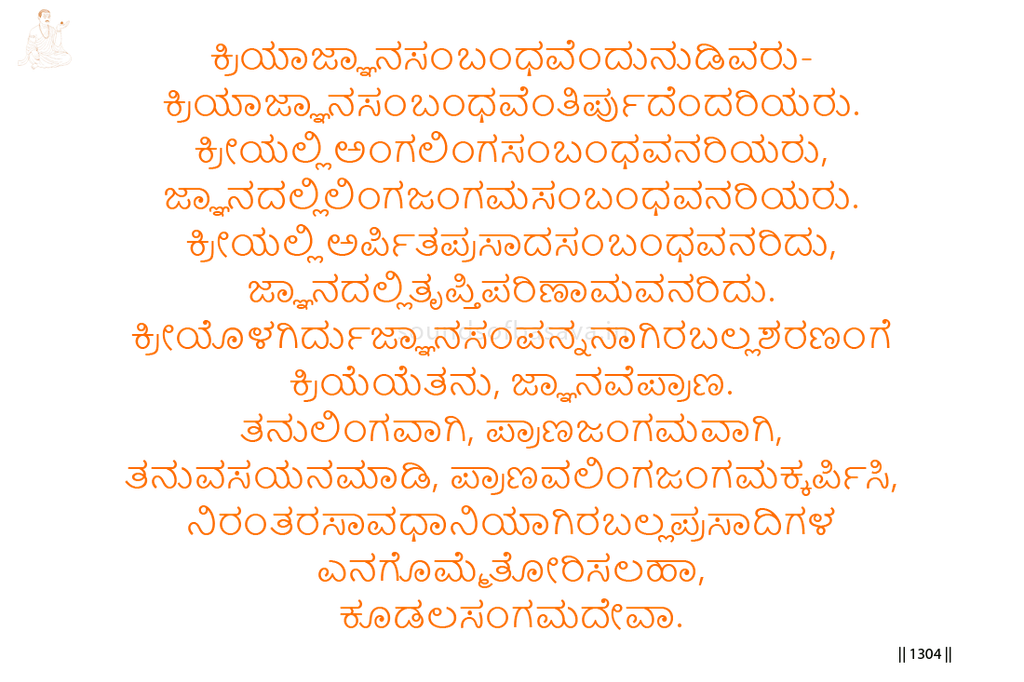
Many speak of the relationship between Kriya and Jnana without understanding what that relationship actually is.
In Kriya, the relationship between Anga and Linga is known. In Jnana, the relationship between Linga and Jangama is known. Kriya reveals the relation of Arpita and Prasada, while Jnana reveals satisfaction and ripened fulfilment.
For the Sharana who remains within Kriya while being fulfilled in Jnana, Kriya itself becomes the body and Jnana becomes the life-breath. The body becomes Linga, Prana becomes Jangama, the body is brought wholly into sacred service, and Prana is offered to Linga-Jangama.
Basavanna asks Kudalasangama Deva to show him such Prasadis—those who can remain continuously vigilant within this complete integration—and thereby protect and sustain him.
Imagery & Symbolic Relevance
The vachana begins by distinguishing speech from realization. People repeat the expression “Kriya-Jnana relationship,” yet Basavanna says that they do not know how that relationship truly exists.
Kriya is first defined through the relationship between Anga and Linga. Action is not independent bodily activity. It is the embodied relation in which the Anga acts before, through, and for Linga.
Jnana is defined through the relationship between Linga and Jangama. Jnana is therefore not mere intellectual knowledge. It recognizes the Linga as livingly present through Jangama.
The next pair clarifies the movement further. Within Kriya, one knows the relationship of Arpita and Prasada. Arpita is the act and condition of offering; Prasada is what is received through Divine acceptance. Kriya includes both surrender and sacred receiving.
Within Jnana, one knows trupti-parinama—satisfaction and ripened fulfilment. Jnana is not accumulation of concepts; it is the fulfilled condition in which the offered relation has matured.
The Sharana does not abandon Kriya after receiving Jnana. He remains within action while becoming endowed with knowledge. This prevents both mechanical action without understanding and knowledge that refuses embodiment.
“Kriya is the body; Jnana is the Prana” is the central declaration. The body gives Kriya its field of expression. Prana gives Jnana living continuity. Just as body and life-breath cannot function as complete life when divided, Kriya and Jnana cannot fulfil their purpose when separated.
The body then becomes Linga. This does not mean that the ordinary possessive body declares itself Divine. It means that the body no longer functions as an independent field of self-claim; its action has become wholly established in the Linga-relation.
Prana becomes Jangama. The living movement of awareness is no longer privately possessed. It becomes the living, moving sacred presence through which Linga is known and served.
The body is brought into complete sacred service, while Prana is offered to Linga-Jangama. Thus both embodied action and living awareness are surrendered.
The final quality is continuous vigilance. The Prasadi does not complete one act of offering and then become careless. The relation of Kriya, Jnana, Arpita, Prasada, Linga, and Jangama must remain continuously awake.
Lingayoga
In Lingayoga, action and knowledge cannot be maintained as separate paths.
Kriya without Jnana becomes outward performance. Jnana without Kriya remains without embodiment. The realized Sharana holds them together: action expresses knowledge, and knowledge gives life to action.
The Anga-Linga relationship must become visible through Kriya. The Linga-Jangama relationship must become known through Jnana. Arpita must mature as Prasada, and received Prasada must mature into satisfaction and fulfilment.
The practice-point is continuous vigilance. The body must remain aligned with Linga, Prana must remain offered to Linga-Jangama, and neither action nor awareness may return to personal ownership.
Editorial Commentary
In Lingayoga, action and knowledge cannot be maintained as separate paths.
Kriya without Jnana becomes outward performance. Jnana without Kriya remains without embodiment. The realized Sharana holds them together: action expresses knowledge, and knowledge gives life to action.
The Anga-Linga relationship must become visible through Kriya. The Linga-Jangama relationship must become known through Jnana. Arpita must mature as Prasada, and received Prasada must mature into satisfaction and fulfilment.
The practice-point is continuous vigilance. The body must remain aligned with Linga, Prana must remain offered to Linga-Jangama, and neither action nor awareness may return to personal ownership.
Related Vachana
Supporting Vachana
Sharana Sthala Vachana 1345 — The Vigilance of Linga-Arpita
Sharana Vachana 1345 defines Linga-Arpita as continuous vigilance. The one who has offered everything to Linga must remain watchful so that injustice does not enter and the six inner enemies do not touch the being. Through this vigilance, the body becomes Prasada-Kaya, the senses lose their binding authority, and Chennabasavanna is shown as the living example of ripened establishment in Kudalasangama Deva.
This prepares Vachana 1166 directly. Sharana Vachana 1345 establishes that offering must become vigilant embodiment and that the body itself must become Prasada.
Aikya Vachana 1166 gives the complete structure of that state: Kriya becomes the body, Jnana becomes Prana, the body becomes Linga, Prana becomes Jangama, and the Prasadi remains continuously vigilant.
Advancing Vachana
Aikya Sthala Vachana 1183 — Behold the One Ripened in the Dense Reality
Aikya Vachana 1183 asks the seeker to behold the fully ripened one who has established the Great Guru within, offered body, mind, and wealth to Guru, Linga, and Jangama, become established in Kaya-Prasada, and reached fullness in Shatsthala and Kudalasangama Deva. Chennabasavanna is presented as the embodied example of this complete establishment.
Vachana 1166 defines the integrated Prasadi: Kriya as body, Jnana as Prana, body as Linga, Prana as Jangama, complete offering, and uninterrupted vigilance.
Vachana 1183 carries that definition into visible fulfilment. The one whom Vachana 1166 asks Kudalasangama Deva to show is beheld in Vachana 1183 as the ripened Sharana established in Guru, Linga, Jangama, Kaya-Prasada, and Shatsthala.
The movement is from the structure of realized living to its embodied example in Chennabasavanna.
