

Summary
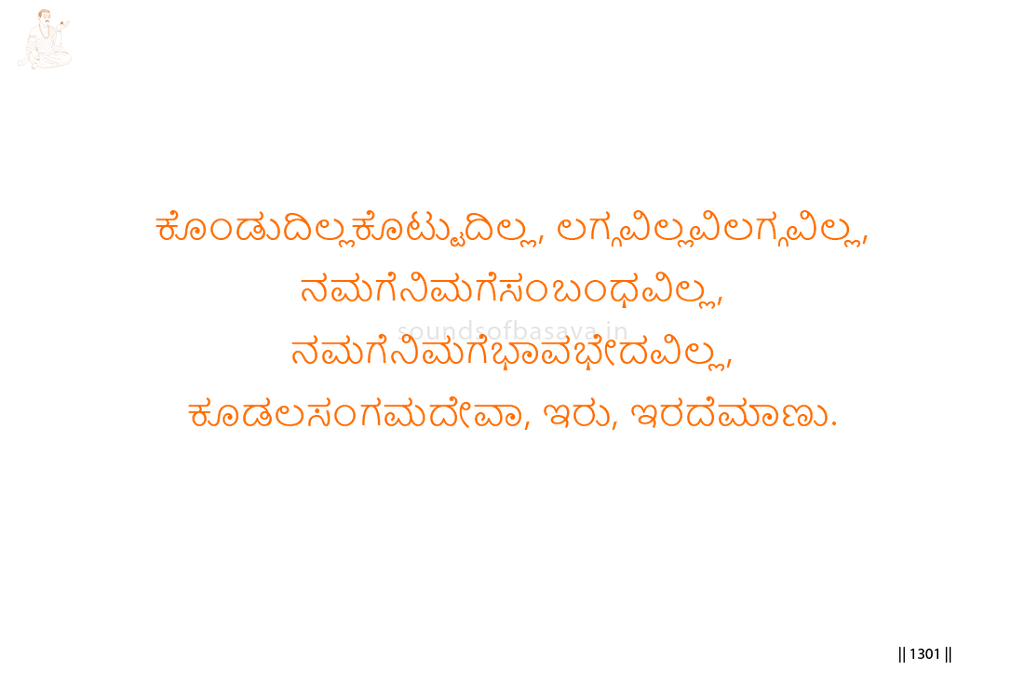
Basavanna declares that there has been neither taking nor giving, neither joining nor separation. Between himself and Kudalasangama Deva, no relationship remains that depends upon two separate participants, and no difference of bhava can be found.
The vachana does not describe the breaking of an existing bond. It speaks from Aikya, where the distinction required for giver and receiver, union and separation, or devotee and Lord no longer stands.
The closing words carry this non-difference beyond the contrast between presence and absence. Whether expressed as being or not-being, no second standpoint remains from which Kudalasangama Deva could be distinguished.
Imagery & Symbolic Relevance
The vachana contains no external narrative or natural image. Its movement is built through successive paired negations.
“Neither taking nor giving” removes transaction. Taking requires a receiver, and giving requires a giver. Basavanna does not deny that acts of giving occur in life; he denies that separate ownership can be established within them.
“Neither joining nor separation” removes another pair. Joining assumes two things that were previously apart, while separation assumes two things capable of being divided. Neither applies where difference has not been established.
The statement that there is no relationship between “us” and “You” is therefore not a declaration of estrangement. Ordinary relationship depends upon two identifiable parties standing in connection. At Aikya, that relational distance has disappeared.
The next line gives the decisive clarification: there is no bhava-bheda. No difference remains between Basavanna’s inward condition and Kudalasangama Deva. This prevents “no relationship” from being misunderstood as rejection, indifference, or absence of devotion.
The sequence is exact:
transaction disappears;
joining and separation disappear;
the relation between two disappears;
difference of bhava disappears.
The final expression addressed to Kudalasangama Deva carries the same movement into the language of being and non-being. Neither “You are” nor “You are not” can restore the division already dissolved. The Lord cannot be placed as an object on one side of such a distinction.
Lingayoga
In Lingayoga, worship, service, and Dasoha may continue, but the practitioner can no longer claim, “I gave,” “I received,” or “I established union.”
The relation between Anga and Linga is not abandoned. Rather, the distance through which Anga treats Linga as another is removed.
This vachana therefore marks action without transaction, devotion without separative relationship, and awareness without bhava-bheda. The seeker does not cease to act; the separate centre claiming the action ceases to govern it.
The practical discipline is to observe where spiritual life is still being measured through exchange: what was given, what was received, what union was gained, or what separation must be overcome. Such accounting cannot remain where Linga-Aikya is directly known.
Editorial Commentary
The absence of “relationship” must not be interpreted as alienation from Kudalasangama Deva. The following statement—“there is no difference of bhava”—shows that relationship disappears because non-difference has been realized, not because communion has been rejected.
The opening does not condemn giving, receiving, service, or Prasada. It removes their personal ownership. Giving may continue, but no independent giver or receiver can claim it.
The paired expressions concerning joining and separation must remain together. The vachana neither says that two have newly united nor that two remain inseparably bound. It removes the original assumption of two.
“No difference of bhava” must not be converted into an ordinary egoistic claim that the individual is God. The separate claimant who could make such an assertion is precisely what the vachana has dissolved.
The closing phrase should remain restrained. It does not require an expanded doctrine of existence and non-existence. Its force is that neither presence nor absence can recreate a distinction between Basavanna and Kudalasangama Deva.
Related Vachana
Supporting Vachana
Sharana Sthala Vachana 508 — Doer and Receiver Are You
Sharana Vachana 508 rejects personal merit after service to Kudalasangama Deva’s Bhaktas. Basavanna says that whatever has been accomplished has occurred through the grace of Sri Guru-Linga. The one who performs the act and the one who receives it are both Kudalasangama Deva. The deed remains, but the thought “I did it” is surrendered.
This prepares Vachana 1161 directly. In the Sharana vachana, action, doer, and receiver are still named, but personal ownership is removed by recognizing Kudalasangama Deva in both.
In Aikya Vachana 1161, the movement becomes still deeper. There is neither taking nor giving because no separate giver and receiver remain. What begins in Sharana as freedom from the claim of action reaches Aikya as the disappearance of relational difference itself.
Advancing Vachana
Aikya Sthala Vachana 1162 — The Giver and the Receiver Are Kudalasanga
Aikya Vachana 1162 declares that the giver is Kudalasanga, the receiver is Kudalasanga, and Kudalasangayya alone gives throughout the three worlds. It rejects the proud claim, “We are the ones who give.” Giving continues, but giver, receiver, and the power of giving are all recognized as Kudalasangama Deva’s own movement.
Vachana 1161 removes the distinctions underlying transaction: neither taking nor giving, neither joining nor separation, no separate relationship, and no difference of bhava.
Vachana 1162 gives the positive living expression of that realization. The disappearance of difference does not bring action to an end. Giving still occurs, but it is no longer assigned to an independent human giver or directed toward an independent receiver.
The progression is precise: Vachana 1161 dissolves the two; Vachana 1162 reveals Kudalasangama Deva as the one movement appearing as both giver and receiver.
