

Summary
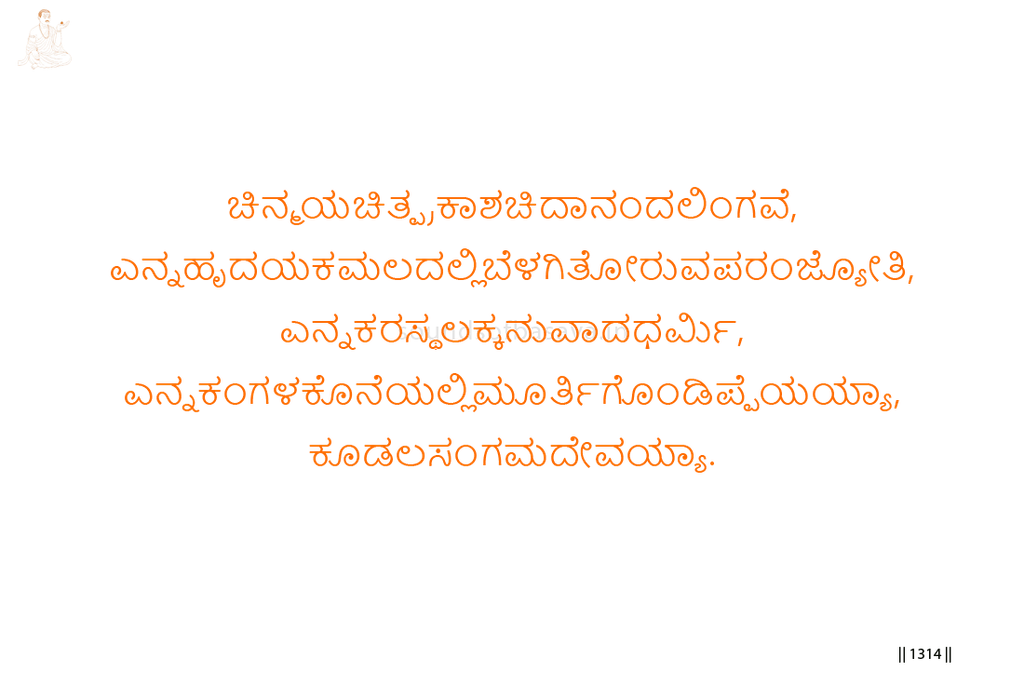
Basavanna addresses Kudalasangama Deva as the Linga who is Chinmaya, Chitprakasha, and Chidananda—formed of consciousness, radiant as awareness, and blissful in that consciousness.
The Lord shines as the Supreme Light within Basavanna’s heart-lotus, becomes the sacred reality appropriate to his Karasthala, and takes visible form at the very limit of his sight.
The same Kudalasangama Deva is thus known inwardly in the heart, directly in the Karasthala, and visibly within perception. These are not three separate revelations, but one Linga-presence becoming clear throughout Basavanna’s awareness.
Imagery & Symbolic Relevance
The opening gathers three descriptions into one address to Linga.
Chinmaya means formed of or filled with consciousness. Linga is not treated as an inert object standing outside awareness.
Chitprakasha indicates the radiance or illumination of consciousness. The Lord is not merely something illuminated and then seen; His presence is itself luminous.
Chidananda joins consciousness and bliss. Bliss here is not presented as a passing emotion added to awareness. It belongs to the revealed nature of the Linga.
The heart-lotus is the first field of manifestation. Kudalasangama Deva shines there as Paranjyoti, the Supreme Light. The image places illumination within the inward centre rather than at a distant external location.
The lotus need not be expanded into a detailed subtle-body system. Its exact function is to show the heart as the place where the Lord’s radiance becomes inwardly manifest.
The Karasthala gives the second field. The Lord becomes the sacred reality fitting Basavanna’s Karasthala—the Linga directly held and encountered in the hand.
This is important because inward illumination does not cancel Karasthala worship. The Supreme Light in the heart and the Linga of the Karasthala belong to one revelation.
The final line turns toward vision. Kudalasangama Deva takes form at the end or limit of Basavanna’s eyes. The Lord is no longer merely thought about, remembered, or inferred. He becomes directly present within seeing.
The movement is therefore complete:
Linga is named as consciousness, radiance, and bliss;
the same Linga shines within the heart;
the same sacred reality becomes present in the Karasthala;
the same Lord takes form within vision.
Inner awareness, embodied worship, and seeing are gathered without division.
Lingayoga
In Lingayoga, Karasthala worship must not remain disconnected from inward awareness.
The Linga held in the hand must become luminous within the heart, and inward luminosity must become living recognition rather than remain an abstract idea.
This vachana does not dismiss visible form in favour of formless consciousness. Kudalasangama Deva is known as consciousness and radiance, yet He also becomes the sacred presence of Karasthala and takes form within sight.
The practice-point is therefore integration: heart, hand, and eye must not point toward three different realities. The one Linga must become inwardly luminous, directly worshipped, and clearly seen.
Editorial Commentary
The opening descriptions—Chinmaya, Chitprakasha, and Chidananda—all qualify the Linga addressed by Basavanna. They should not be separated into three independent entities or stages.
Paranjyoti means the Supreme Light. The vachana identifies Kudalasangama Deva’s shining presence within the heart-lotus; it does not require a separate cosmological explanation of light.
The Karasthala phrase must retain its direct relation to Ishtalinga worship. The inward light does not replace the Linga in the hand.
The final statement says that Kudalasangama Deva has taken form at the end or limit of Basavanna’s eyes. It indicates direct visible presence within his field of seeing.
Kudalasangama Deva remains the single Lord addressed throughout. The vachana does not introduce Guru, Jangama, or another agent.
Related Vachana
Supporting Vachana
Sharana Sthala Vachana 209 — The Living Truth Beyond Scripture
Sharana Vachana 209 distinguishes sacred speech from realized truth. Veda, Shastra, and transmitted teaching may enter the ear, but words alone fade when they have not become lived realization. When Kudalasangama Deva’s Sharanas arrive, truth becomes visible in their presence and conduct rather than remaining dependent upon recitation or argument.
This prepares Vachana 1186 by moving from heard truth to inward seeing. In the Sharana vachana, sacred words must become embodied and visible through realized life.
In Aikya Vachana 1186, that movement reaches direct illumination. The Linga is no longer known merely through description: Kudalasangama Deva shines within the heart, becomes present in the Karasthala, and takes form within Basavanna’s sight.
What is first recognized as living truth beyond words in Sharana becomes self-luminous presence in Aikya.
Advancing Vachana
Aikya Sthala Vachana 1344 — When Linga Is Anga and Anga Is Linga
Aikya Vachana 1344 declares that Linga is Anga and Anga is Linga; Linga is Prana and Prana is Linga. Nothing remains separately present to be displayed, and nothing remains absent to be sought. Uninterrupted Linga alone abides.
Vachana 1186 reveals the same Linga throughout the heart, Karasthala, and field of vision. Although the fields are named distinctly, one Kudalasangama Deva shines through them all.
Vachana 1344 carries this recognition to complete non-separation. The Linga seen inwardly and outwardly is no longer held apart from Anga or Prana.
The progression is exact: Vachana 1186 gathers heart, hand, and sight into one luminous Linga-presence; Vachana 1344 reveals that no separate Anga or Prana remains outside that uninterrupted Linga.
