Poetic Rendering

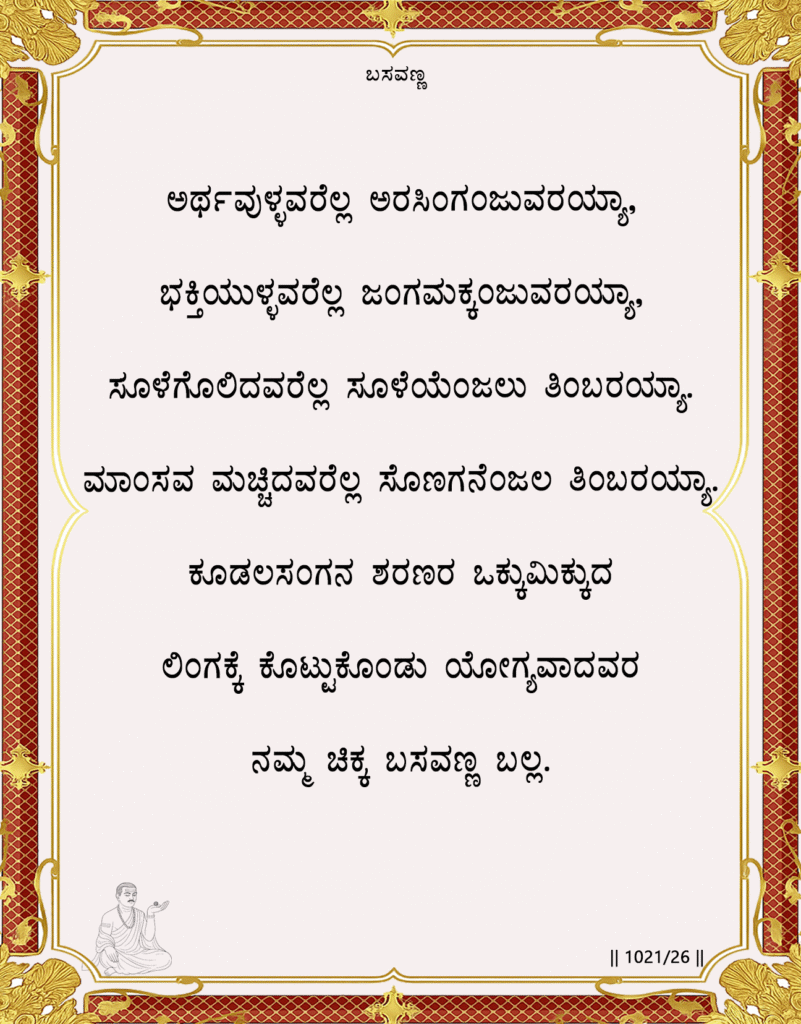
The wealthy gather around kings,
the devout gather around the jangama.
Those trapped in lust dine
at the courtesan’s table,
those steeped in meat gather with the monkeys.
But those who share with the sharanas of Koodalasangama,
giving to the Linga in unity,
are known only by Chikkabasavanna as worthy.
The poet observes that the wealthy gather around kings, the devout around the Jangama, the lustful around courtesans, and meat-eaters with butchers. But those who, in unity, make offerings to the Linga among the Sharanas of Kudalasangama are recognized by Chikkabasavanna as his true kin.
Spiritual Context
Core Spiritual Principle: An individual’s true nature and spiritual stature are revealed not by their claims, but by their spontaneous affinities and associations. We gravitate towards, and are defined by, the company that resonates with our inner state of consciousness.
Cosmic Reality Perspective: The Linga is the unifying center of all existence. Different groups form around different fragmented aspects of reality (wealth, power, sensory pleasure). The Sangha is the community that consciously organizes itself around this central, unifying principle, thus reflecting the cosmic order.
Historical Reality (Anubhava Mantapa context): This vachana serves as both a description and a criterion for membership in the Lingayat community. It clearly delineates the Sangha from other social groups (royal courts, sensual cliques) and establishes that the ultimate validation of a true Sharana comes from within the lineage of realized beings (like Chikkabasavanna), not from external social approval.
Interpretation
1. “The wealthy gather around kings…” : This describes the affinity of power. Those identified with wealth (Artha) are naturally drawn to the seat of temporal power (the king), as it reinforces and protects their identity.
2. “…the devout gather around the jangama.” : This describes the affinity of devotion. Those whose primary drive is spiritual surrender (Bhakti) are drawn to the living embodiment of the Divine (the Jangama).
3. “Those trapped in lust… those steeped in meat…” : This describes the affinities of primal desire (Kama). Lust draws one to objects of gratification, while a crude, unrefined state of being (“steeped in meat”) aligns with a base, instinctual community (“monkeys”).
4. “But those who share with the sharanas… giving to the Linga in unity…” : This defines the highest affinity. It is not just gathering, but sharing (Dasoha). It is not just devotion, but devotion enacted in unity (Aikya) with a community. The offering is made to the Linga , making the entire act God-centered.
5. “…are known only by Chikkabasavanna as worthy.” : This is the ultimate authentication. Chikkabasavanna, as a foundational figure and realized saint, represents the discerning eye of spiritual wisdom. He can recognize the subtle quality of consciousness in those who participate in this unified offering. Their worth is spiritual, not social. Practical Implications: A seeker must consciously audit their associations. The people you spend time with are a mirror of your inner state. To progress spiritually, one must actively seek the company (Satsangha) of those who are engaged in selfless sharing and God-consciousness, as this environment will naturally elevate one’s own consciousness.
The Cosmic Reality
Anga (Human Dimension): The individual soul, whose inclinations and choices determine its spiritual associations and, consequently, its evolution.
Linga (Divine Principle): Kudalasangama Deva as the ultimate focal point and recipient of the unified offering. The Linga is what transforms a mere social group into a sacred community.
Jangama (Dynamic Interaction): The Jangama is the active, living Sangha engaged in Dasoha. It is the dynamic field where individual Angas, through the act of shared offering, unite around the Linga and are transformed into a collective body with a higher, discernible spiritual identity.
Shata Sthala
Primary Sthala: Sharana. This vachana describes the lived reality of the Sharana, whose primary identity and social world is the Sangha engaged in sacred sharing.
Supporting Sthala: Aikya. The act of “giving to the Linga in unity” is a direct expression of the Aikya stage, where the boundaries between individual devotees dissolve in the collective act of worship and service.
Practical Integration
Arivu (Awareness): Cultivate awareness of your own affinities. Notice who you are naturally drawn to and what that reveals about your own inner state. Use this awareness to consciously choose elevating company.
Achara (Personal Discipline): Make it a discipline to prioritize time with your spiritual community. Actively participate in collective prayers, service, and meals (Dasoha), recognizing these as acts that define your spiritual identity.
Kayaka (Sacred Action): Let your professional and social circles be influenced by your spiritual values. Seek out collaborators and friends who support your growth and with whom you can engage in meaningful, truthful exchange.
Dasoha (Communal Offering): Understand that every act of sharing within the Sangha is not just charity but a sacred ritual that forges the “body of the Sharanas.” Your participation is what builds and sustains this field of unified consciousness.
Modern Application
We often curate our social lives based on professional networking, shared hobbies, or algorithmic suggestions on social media, without considering the consciousness-based impact of these associations. We can find ourselves in communities that reinforce materialism, cynicism, or superficiality, which slowly shapes our own values and identity.
This vachana liberates by giving us a powerful tool for self-directed evolution. It tells us that if we want to change who we are, we must change our community. By consciously joining a “Sangha” a group dedicated to conscious living, service, and spiritual growth we immerse ourselves in an energy field that actively pulls us toward our highest potential. Our tribe defines our vibe.
Essence
Tell me the company you keep,
And I’ll tell you the secrets deep.
But those who share in God’s own name,
Are known by saints, and bear that flame.
Metaphysically, this vachana describes the law of spiritual resonance (Sparsha). Every individual has a specific vibrational frequency based on their Samskaras (mental impressions). This frequency automatically attracts them to a corresponding social field. The Sangha is a collective with a Sattvic frequency, polarized around the Linga. To be recognized by a realized being like Chikkabasavanna means that an individual’s vibrational signature has harmonized with the pure frequency of the Sangha, making them a coherent part of that spiritual organism. This is a measurable shift in consciousness, perceptible only to those who themselves operate at that refined level of perception.
You are the average of the five people you spend the most time with. Choose your tribe wisely, for it will dictate the trajectory of your life. The most valuable community you can belong to is not the richest or most powerful, but the one that challenges you to grow, supports you in service, and reminds you of your highest purpose. True belonging is found in a shared commitment to a transcendent ideal.

Views: 7