

Summary
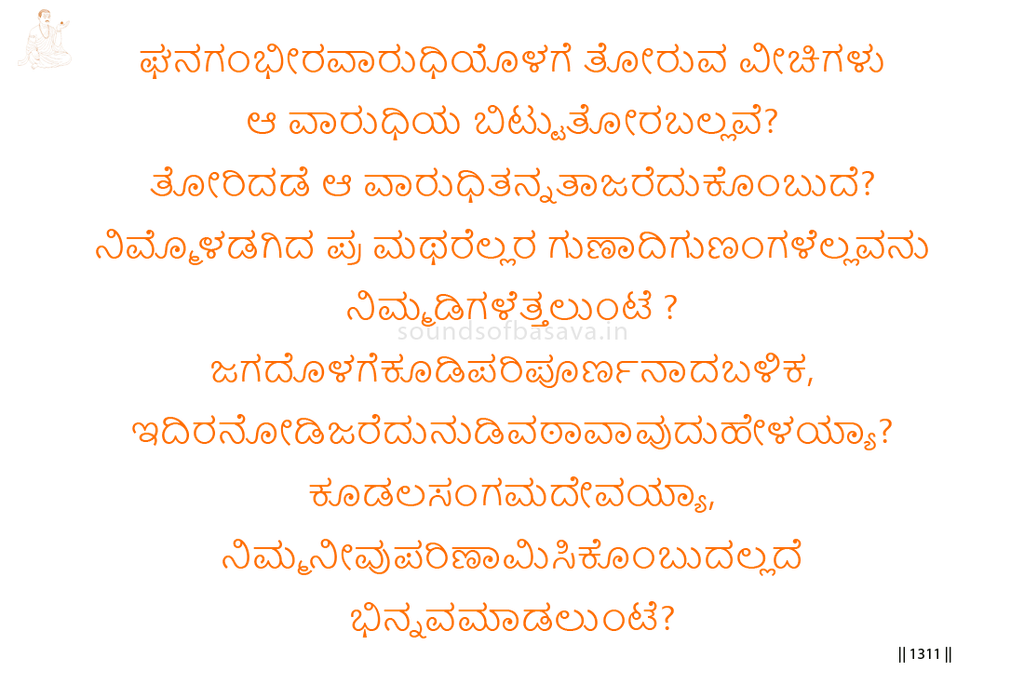
The waves appearing within the deep and majestic ocean cannot appear apart from that ocean. Their arising neither divides the ocean nor diminishes its fullness.
In the same way, the Pramathas and their manifold qualities abide within Kudalasangama Deva. Their virtues, actions, realization, and fulfilment cannot be extracted and established as independently theirs.
Once one has entered the world and become complete within the Lord, no separate standpoint remains from which one may face Him as another and speak. What appears as the fulfilment of the Pramathas is Kudalasangama Deva fulfilling Himself through them; difference cannot be established.
Imagery & Symbolic Relevance
The deep and majestic ocean is the governing image. Its depth cannot be measured by looking only at the movement upon its surface.
The waves are clearly visible. They rise, move, and possess distinguishable forms, yet they have no substance or place apart from the ocean.
Basavanna’s question does not deny the appearance of waves. The waves truly appear, but their appearance does not create an independent existence outside the ocean.
Their arising also does not diminish the ocean. The ocean does not lose part of itself by appearing as waves. Movement occurs within its own fullness.
The image is then applied to the Pramathas abiding within Kudalasangama Deva. They may be recognized through diverse qualities, forms of conduct, acts of service, compassion, steadfastness, knowledge, and Anubhava.
These qualities are visible like waves, but they do not stand outside their Divine ground. They cannot be separated from Kudalasangama Deva and assigned to an autonomous individual.
The reference to the Pramathas “contained within You” is essential. They do not first exist independently and later enter the Lord. Their life and qualities arise and remain within Him.
Basavanna then asks whether all their qualities can be separately lifted out and placed before the Lord’s feet. The implied answer is no. Even the act of praising a realized quality must not detach it from its source.
The next movement concerns becoming complete within the world. Realization does not require departure from the living world. The Pramatha moves among beings and acts within the world, yet becomes paripūrṇa—complete—without establishing an independent identity.
Once this fullness is known, no place remains from which one can stand opposite Kudalasangama Deva. The observer cannot maintain the distance required to judge, define, or speak of Him as an external object.
The conclusion gathers the whole image. The Pramathas’ fulfilment is Kudalasangama Deva’s own pariṇāma—His ripening or manifestation through those who abide within Him.
The wave is not another substance produced beside the ocean. In the same way, the fulfilled Sharana is not a second reality standing beside Kudalasangama Deva.
Lingayoga
In Lingayoga, qualities arising through practice must not become personal possessions.
Devotion, awareness, compassion, service, knowledge, and realized conduct may become visible in the practitioner, but they must remain known as movements within Linga rather than achievements belonging to an independent Anga.
The practitioner need not suppress qualities or deny embodied action. The wave is allowed to rise and move. What must disappear is the claim that it possesses a source, substance, and fulfilment apart from the ocean.
This recognition also removes spiritual comparison. One cannot isolate the quality of a Pramatha, praise the individual as its independent producer, and forget Kudalasangama Deva in whom that quality arises.
The practical movement is to act fully while surrendering ownership of both action and virtue.
Editorial Commentary
The ocean–wave image must preserve both appearance and non-separation. The vachana does not say that waves are unreal or that visible distinctions never arise. It states that they cannot arise or remain apart from the ocean.
The ocean is not reduced by its waves. Divine fullness is therefore not divided, diminished, or exhausted by appearing through countless Pramathas and their qualities.
The Pramathas must not be treated as passive or indistinguishable persons. Their qualities and conduct remain visible, but these do not establish separate spiritual ownership.
Paripūrṇa means complete or full. Pariṇāma indicates ripening, fulfilment, or consummation. The conclusion presents the Pramathas’ fulfilment as Kudalasangama Deva’s own fulfilment becoming manifest through them.
The final question is stronger than ordinary union. It does not describe two independently completed beings coming together. It denies that difference can finally be established between Kudalasangama Deva and the fulfilment appearing within His Pramathas.
Related Vachana
Supporting Vachana
Sharana Sthala Vachana 1181 — The True Servant of Kudalasangama Deva
Sharana Vachana 1181 tests sacred identity through living qualities. True aim is proved through unwavering direction, courage through endurance, freedom from poverty through inner sufficiency, and servanthood through humility and devotion at the Guru’s feet.
The name “servant of Kudalasangama Deva” is therefore not established by speech or self-description. It becomes true only when its defining qualities are lived.
This prepares Vachana 1182 directly. In the Sharana vachana, the servant is recognized through steadfastness, courage, sufficiency, compassion, and Guru-pāda-bhakti.
Aikya Vachana 1182 reveals the source of those qualities. They do not belong independently to the servant; they arise like waves within the ocean of Kudalasangama Deva.
What is tested as authentic Sharana-quality in Vachana 1181 is known in Vachana 1182 as the Lord’s own fulfilment appearing through the Pramatha.
Advancing Vachana
Aikya Sthala Vachana 1344 — When Linga Is Anga and Anga Is Linga
Aikya Vachana 1344 declares that Linga is Anga and Anga is Linga; Linga is Prana and Prana is Linga. Nothing remains separately present to be displayed, and nothing remains absent to be sought. Uninterrupted Linga alone abides.
Vachana 1182 uses the ocean and wave to reveal that the Pramathas and their qualities possess no separate ground outside Kudalasangama Deva. Their fulfilment is His own pariṇāma.
Vachana 1344 carries that recognition into explicit Lingayoga identity. The relation is no longer expressed through ocean and wave or Lord and Pramatha. Anga is known as Linga, and Prana as Linga.
The progression is exact: Vachana 1182 removes independent existence from the visible qualities of the Pramathas; Vachana 1344 reveals uninterrupted Linga in which Anga and Prana can no longer be held as separate fields.
